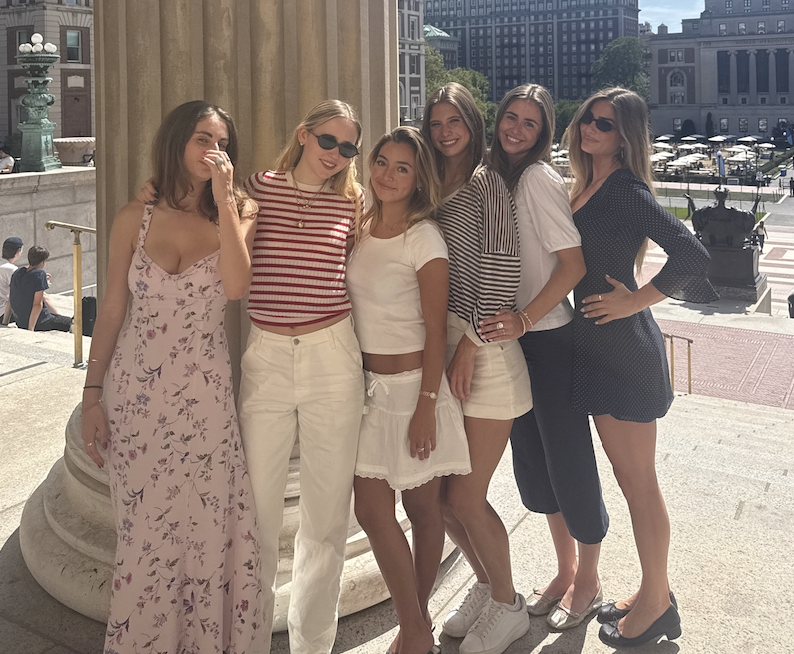
What The Girls Are Wearing On Campus This Fall
Well, well, well. Did you miss me? Because I certainly missed you.
After a euro summer that involved more aperol than applied math, I am back on this side of the Atlantic surviving syllabus week, and fully briefed on what the girls are wearing to class. With the lawns buzzing and the library steps as a runway, there is so much to discuss.
Here are the 10 things I am into this week that’ll get you fall-on-campus ready.
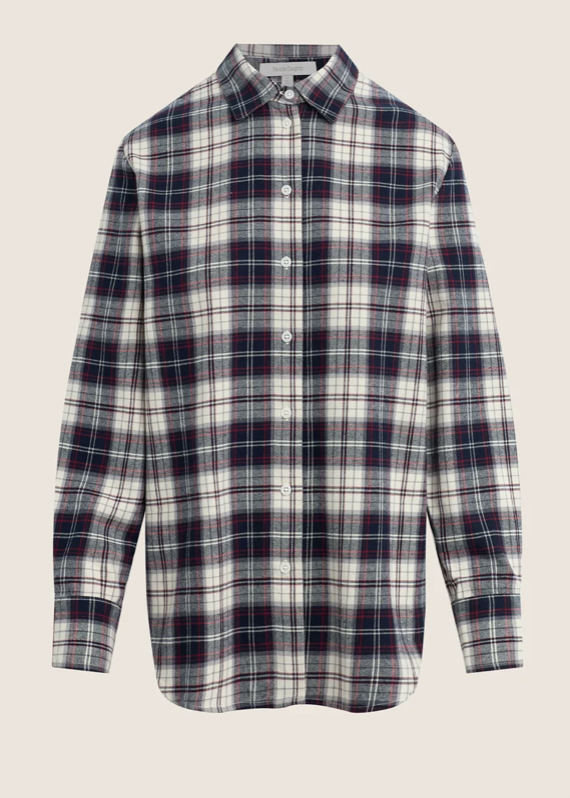
So cool with white tank or wrapped around your waist. The relaxed hem gives it a "stollen” button up look - iykyk.
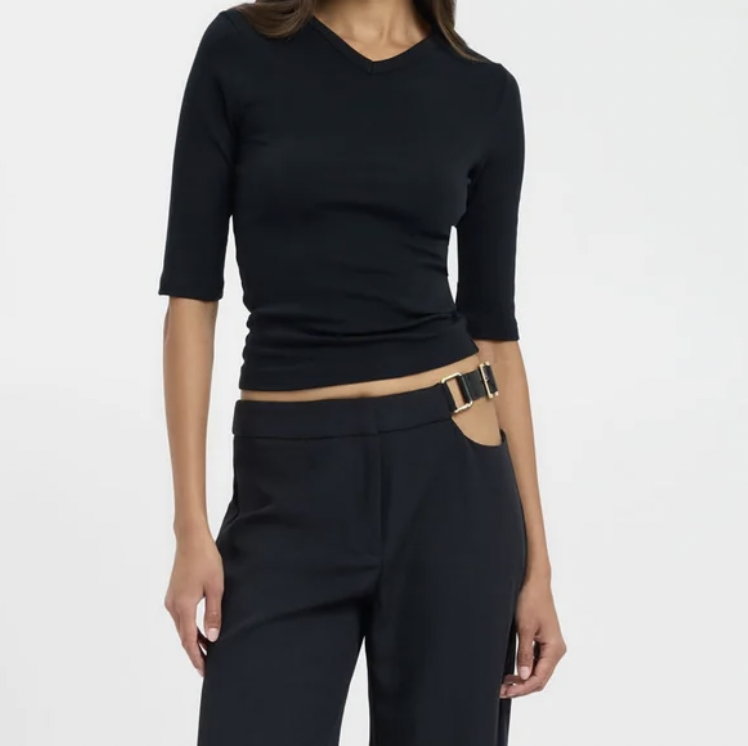
Fitted, v-necked, three-quarter sleeves. I wear mine at least 3x/week.
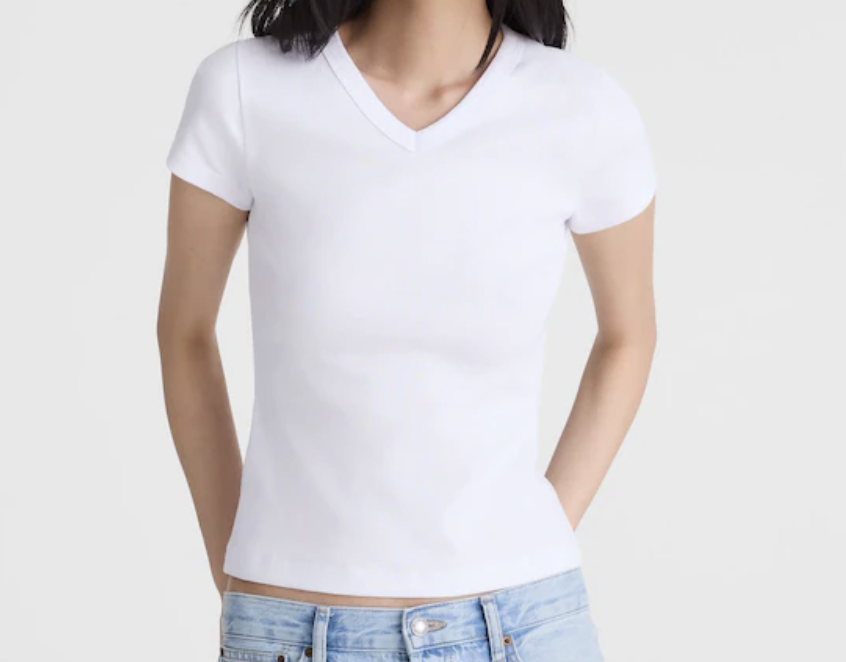
I changed my mind. This is the perfect white tee.
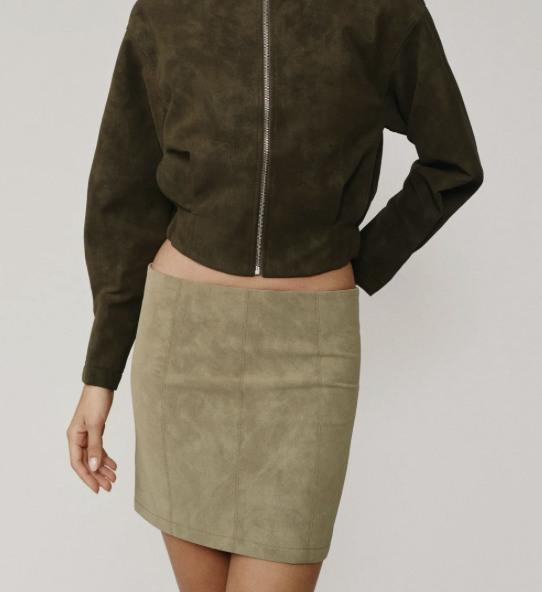
I wear mine with knee-high boots.
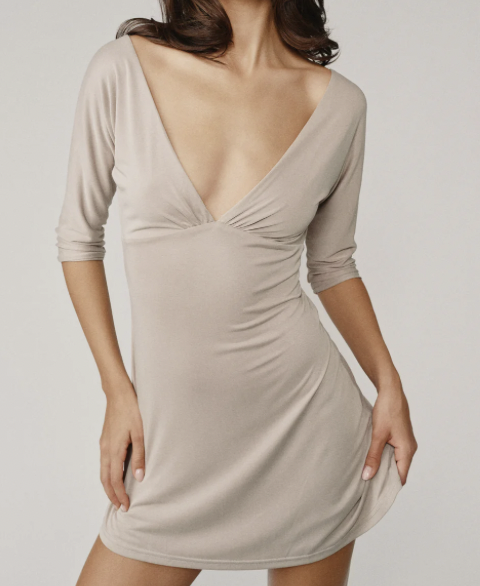
So feminine and easy for the heat.
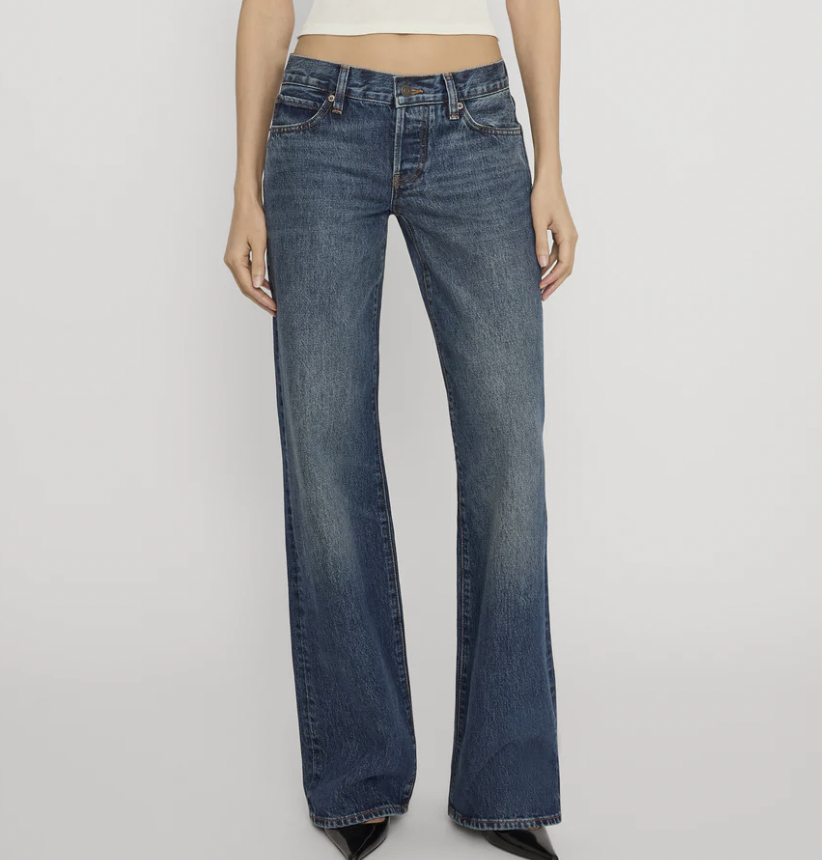
The Amelia Gray collab jean is just that good.
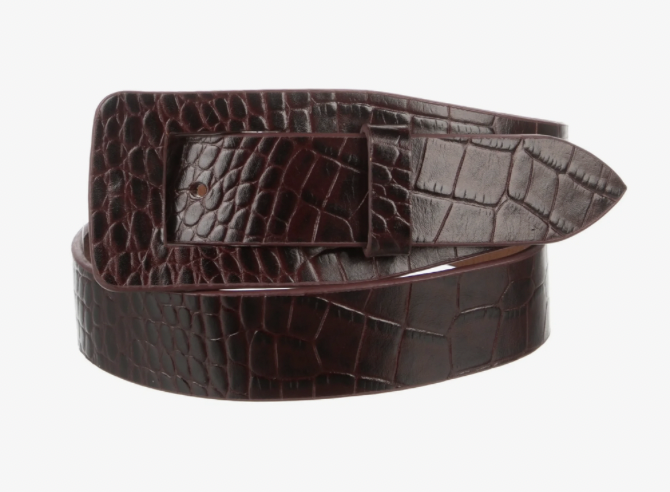
RUN to The RealReal!
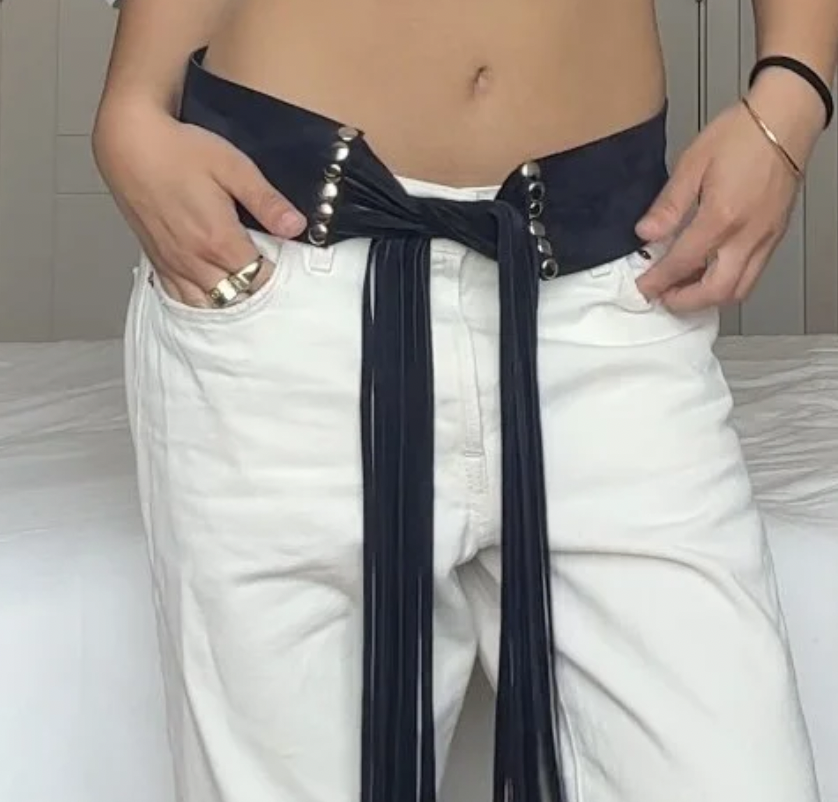
Woman-owned brand that I am obsessed with. I picked mine up in gunpowder grey from the Grand Bazaar and wear it with everything.
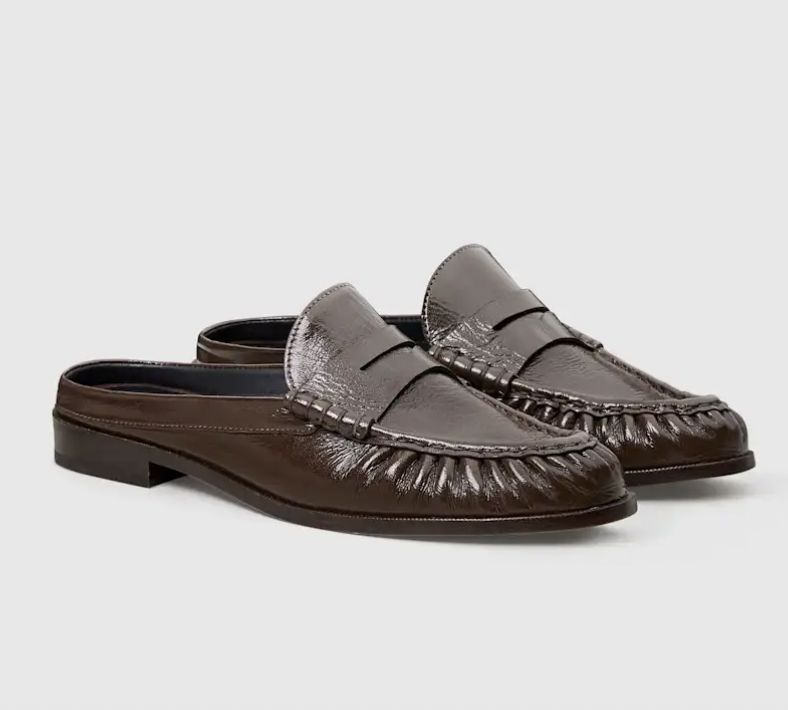
I love a mule for low effort days.
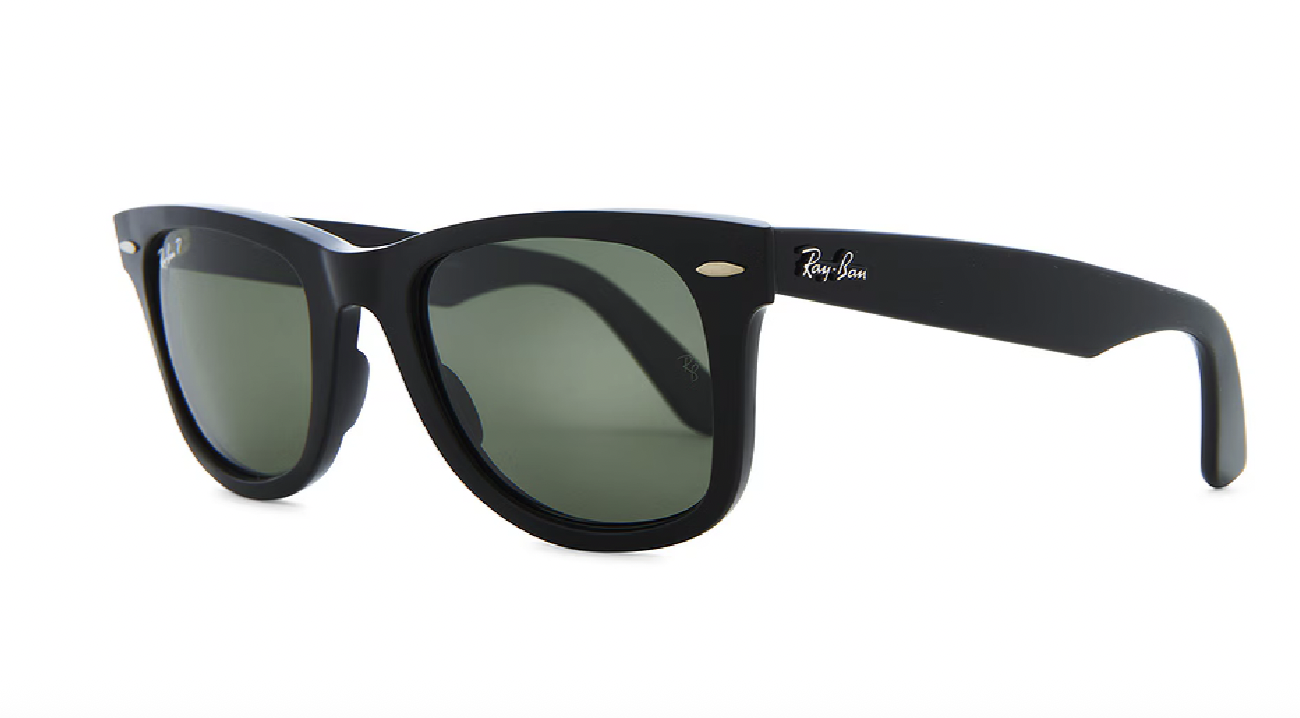
Timeless and untouchable.
I also have been discussing these findings with my perfect, cool, amazing roommate, Chloé, who mentioned the increased use of resources like The RealReal and Nuovo Paris to source their looks this fall. She spilled the secret that Nuovo is taking over our campus and for good reason. So many unique pieces in all price points and sourced by fashion experts in Paris. Stay tuned for an upcoming post on our favorite finds from them.
See you next week!
Xoxo,
Annie
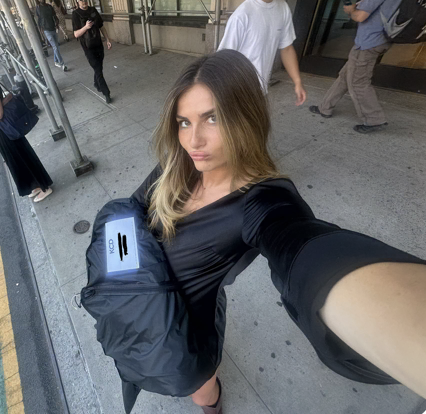
So you want to work in fashion?
If there's one question that lands in my inbox more than any other, it's this: "How do I actually get into fashion?" Honestly, it's one of those industries that feels both totally glamorous and completely impossible to crack from the outside. However, as I wrap up my first big fashion internship, I thought it would be the perfect time to really dissect the ins and outs of getting involved in this industry. I also decided to go straight to the source, by asking my fellow fashion interns to share their honest advice. I am so tired of recycled LinkedIn platitudes, and would have loved real anecdotes and lessons when I was on the prowl.
Whether you're hoping to land your dream internship in styling, PR, beauty, or somewhere in between, consider this your big sister advice column from the people who are living it right now. Let's get into it.
A little background on where I am first:
This summer I was a PR intern at KCD Worldwide in New York City. I genuinely am so grateful for this opportunity, and had the most amazing experience with the team. I'll spare you the polished LinkedIn version of events, but between managing the accounts of my dream clients, tracking coverage, chasing down media, and pulling off events, I learned more about this industry than I even expected.
But the rumors are true. It turns out there is not one smooth path to entering the industry – which, if you ask me, is actually very comforting.
Anise Kruse, a student at the University of Michigan and Beauty Intern at KCD, got her start as a makeup artist before falling head over heels for beauty. She's now pursuing a degree in Business Administration with a minor in UX and Art/Design, and found her sweet spot exactly where marketing and PR intersect.
Sofia Sharam, a full semester PR Intern at KCD and student at Northeastern, admits she dealt with a serious case of impostor syndrome — until she landed a role in PR/sourcing for her school's fashion magazine. That's where it clicked, and she fell in love with the behind-the-scenes chaos of editorial, and the feeling of watching her own contributions bring a publication to life. From there, she went all in with months of applications, networking, and cover letter drafts, and she arrived at KCD. Now she is sourcing her own vintage designer curation for a shop she hopes to open one day, and taking construction and design classes just to understand every layer of the process.
Lou Giretti’s first internship was as a stylist assistant during the Cannes Film Festival, which she now participates in every year. From there, she knew she wanted PR — so she sent one email to her dream fashion PR agency and that was it. Her eye for beauty and talent under pressure really came across in her application and interview process.
Sophie Kern was an intern at both Novella Paghera and Mirror Palais while earning her degrees from the University of Miami and Parsons School of Design. After taking sewing classes starting at just 12 years old, she knew that this is exactly what she wanted to do. Sophie and I even spent a summer at fashion school in London together!
Mylene Lee, my fellow Columbia University Fashion Society bestie, is finishing her first year as an intern at Louis Vuitton. After moving to Manhattan, she really focused on putting herself on the radar of the industry’s biggest names. Mylene is both extremely hardworking and has an intense intellectual curiosity for all things fashion. She really has learned the business from every angle, and is now working her way up.
Moral of the story? There's no single "right" way in. From a beauty artist and magazine intern to a Cannes stylist and fashion school student everyone's door looked different.
I also asked them for the best piece of advice they'd ever received. If I had to condense every answer into one line, it's this: results speak louder than requests. This industry runs on tight turnarounds and constant pressure, so being "a learner," as Anise put it, is really the baseline. "Closed mouths don't get fed," says Sofia. She only figured out what she actually wanted after she asked for more responsibility — and then delivered on it once she had it. Worst case, someone tells you no, but at least you tried. As Lou put it, the first move is just having "the courage to give it a try and send those emails." If this is what you are good at and genuinely want to pursue, “follow your gut.”
For Mylene, it all comes down to passion. She points out that working in fashion “covers a huge range of jobs that all look completely different day to day,” whether that's styling, merchandising, PR, buying, or wholesale, and figuring out how they differ takes real curiosity. Her go-to method has been simply talking to people about what they do and how they got there, because, as she put it, "people can tell when you're genuinely interested and when you truly want to learn." That curiosity, she says, "goes a long way" in an industry so built on relationships.
I'll be the first to admit: I sent out probably fifty (that's right, FIVE ZERO) applications that went nowhere before I got a single "yes." The fashion industry truly rewards people who show up and put themselves out there over people who are waiting to be discovered. I am blown away by the level of talent in my office every day. All of these girls built their stories and experiences by putting themselves in the rooms where they were not necessarily invited into yet, and them proceeding to make them impossible to overlook. Yes our talent got us noticed, but our persistence got us hired.
If I was considering applying for a job in the fashion industry for the first time, there are so many pieces of advice I wish I would have known prior.
What has personally helped me most is doing extensive research and always keeping up with fashion news sources. I have notifications on and genuinely enjoy reading sources like @stylenotcom, Dylan Kelly, Liana Satenstein, WWD, BOF, The Cereal Aisle, Robb Report, and so many more (I can do a whole post on my favorite fashion news sources…lmk)! I was extremely up to date on my fashion news and I cared enough to have commentary on it.
NOW PAY ATTENTION!!! An even more super secret insider tip is to get your LVMH certification and be familiar with both Excel and Launchmetrics. These three skills were what really got me integrated. Not only did I have my own narrative of this blog and my previous roles, but I had the skill set that they did not necessarily need to teach me on the clock.
Mylene wishes she'd understood earlier just how much tailoring your resume to the specific role matters, since even within fashion, positions can call for entirely different skill sets — what lands you a communications job won't necessarily work for merchandising or buying. After talking with HR and picking up more experience in the field, she came to realize the application process is really about fit. A rejection, she says, "doesn't mean you weren't good enough.” It may just mean the resume failed to show why your background made you right for that particular role, and learning to highlight the most relevant parts of your experience can change everything.
Similarly, Sophie has built significant experience in curating a “strong digital portfolio” and, crucially, tailoring it slightly for each application to align with the brand’s aesthetic.
Additionally, it is timeless advice, but you need to build those contacts. Anise didn't sugarcoat it: “fashion and beauty run on nepotism, and a lot of the entry-level jobs don't pay.” It's not the version of the industry you see on Instagram, but it's the one you should walk in expecting. Sofia says that connections aren't just nice-to-have, but the whole game. It's” incredibly hard to hear back from a job when nobody on the inside can vouch for you.” So the real work is building genuine relationships with people, not only to land the job, but to have someone to call when you need advice in an industry that is constantly evolving. While you’re reading your fashion news articles, research the editors and reach out to have a chat! They likely will be very happy to talk about their work and you will be inspired.
So there you have the real, unglamorous, occasionally rejection-filled truth about how we all actually got into the BEST industry ever. If you take one thing from Anise, Sofia, Lou, Sophie, Mylene and me, let it be that, contrary to popular belief, nobody is coming to hand you a seat at the fashion show. I am so grateful I got to spend this summer figuring that out alongside people this talented.
If you have any other questions, I am always happy to chat!
Xoxo,
Annie
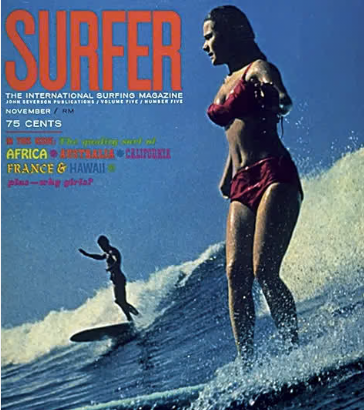
Surfer Girl Summer?
I was born to live in the city. I surprisingly love the stimulation and truly am heartbroken when I have to leave — although I yearn for a break at least once a week (trust me, it makes sense). However, I was born and raised in the water, idolizing the Roxy girls wearing board shorts and minuscule bikinis, with bleach blonde hair and a permanent tan. I want to reincarnate as Alana Blanchard or Coco Ho, and spend my life back home, in Hawaii, Australia, etc. I used to have Blue Crush on repeat and magazine pages of surf magazines from Banzai Bowls taped up on my wall, listening to my Jamz playlist full of Iration and Tribal Seeds. That endless-summer aesthetic has always sold itself because it is effortless. This summer it's back, and it's everywhere, from California to the south of France.
Here are five things I'm into this week that'll get you that endless-summer feeling.
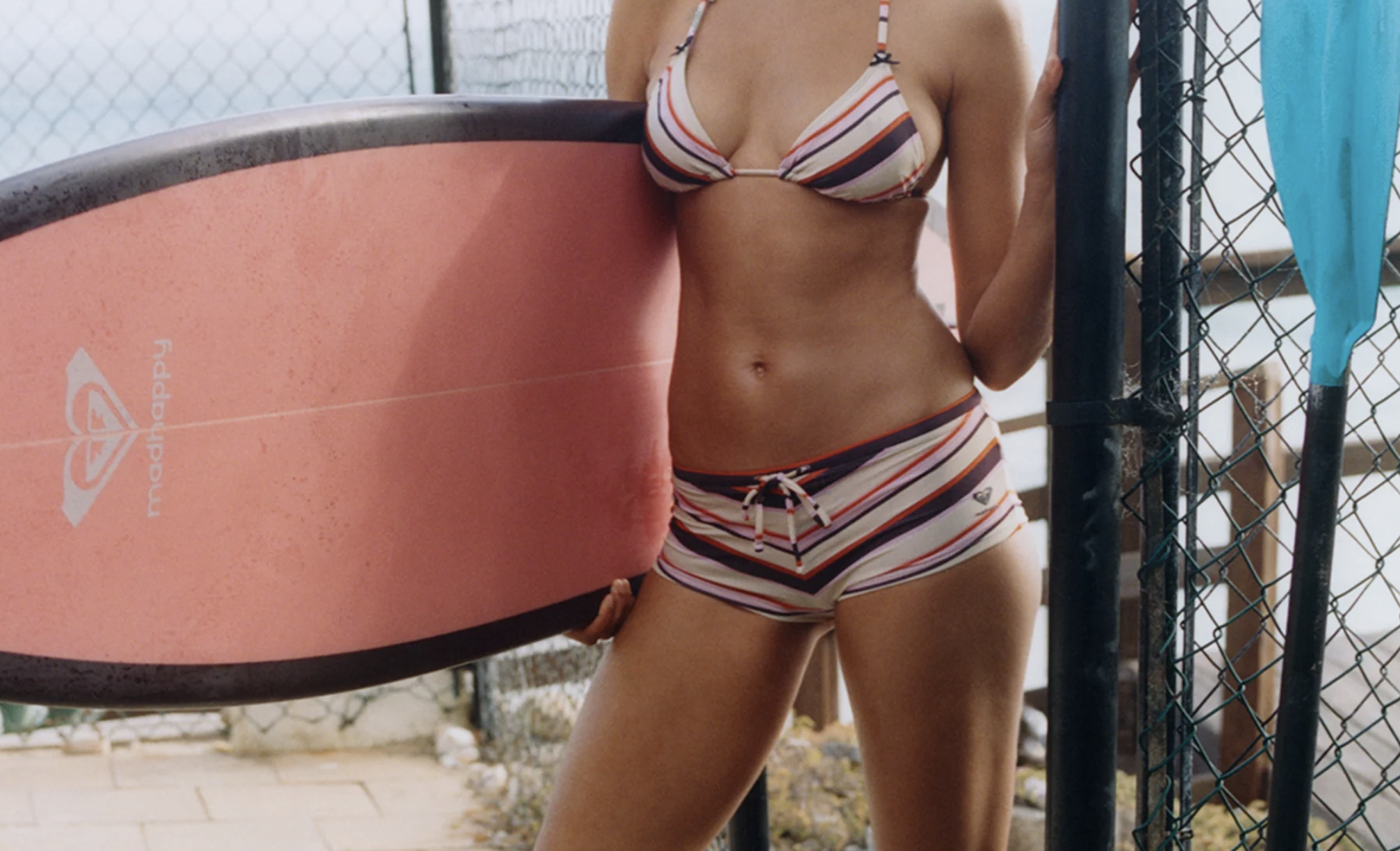
The Roxy x Madhappy collab is so nostalgic
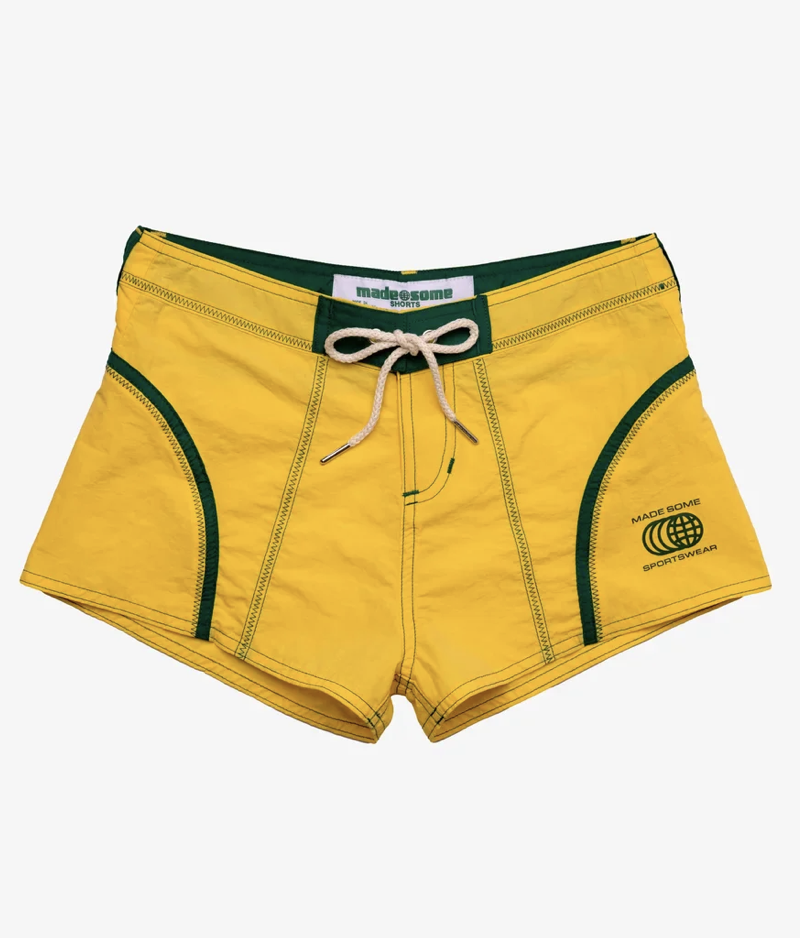
These paired with cool sunnies and a raffia tote balances sporty and feminine so well.
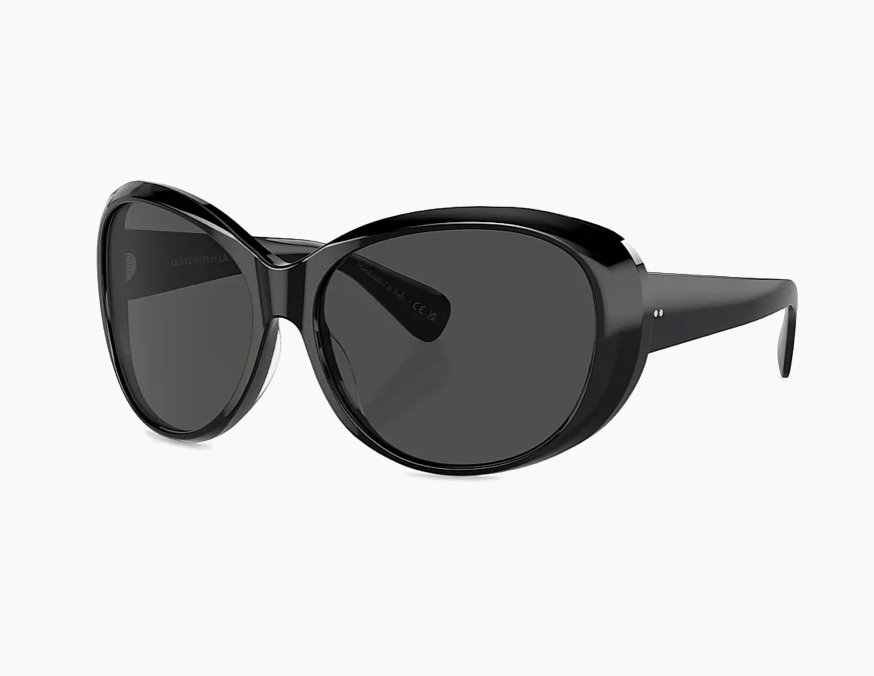
These are like if vintage Maui Jim and Celine had a baby. Great for the coast and the city.
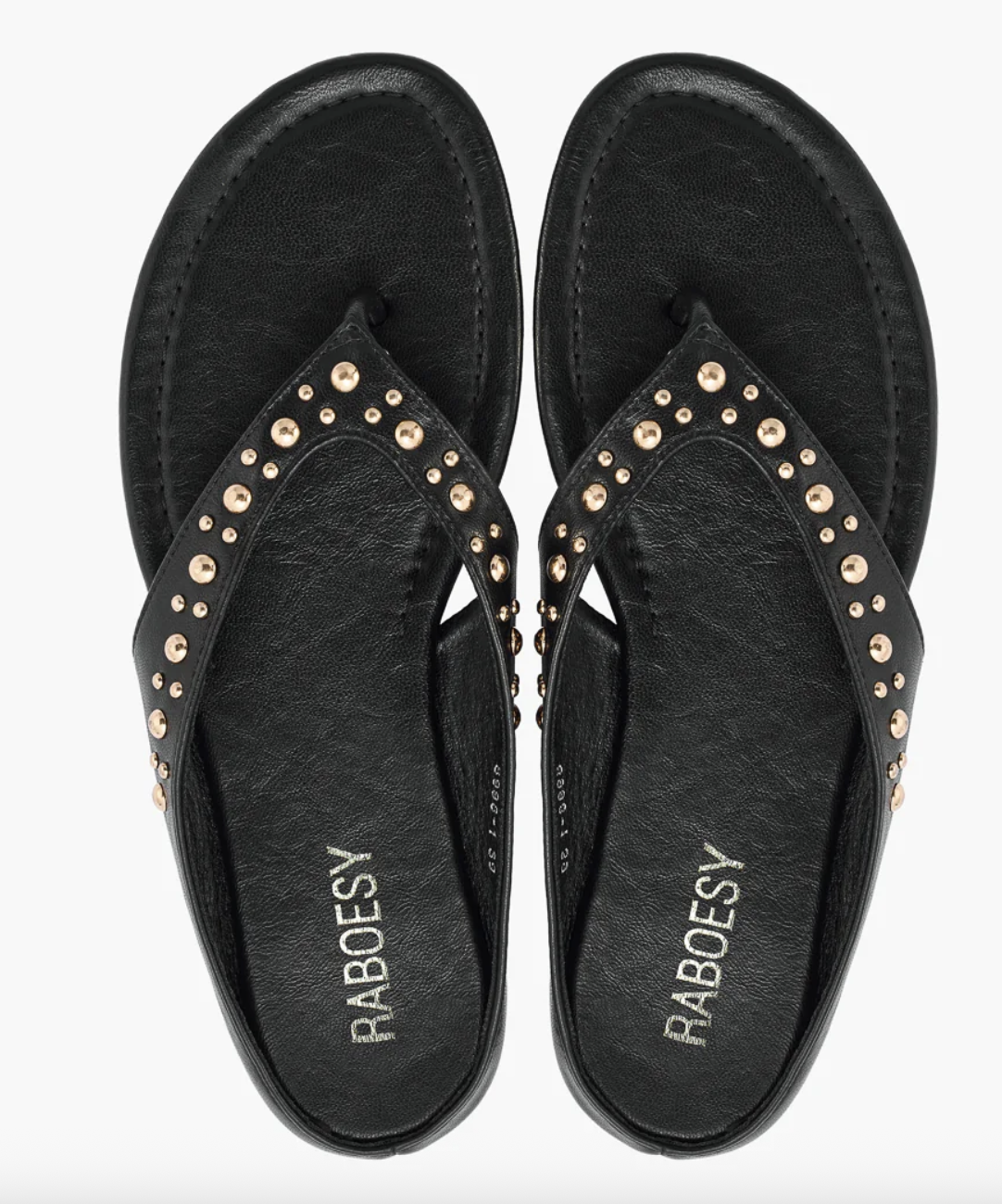
These will resist summer conditions and add some edge to your look.
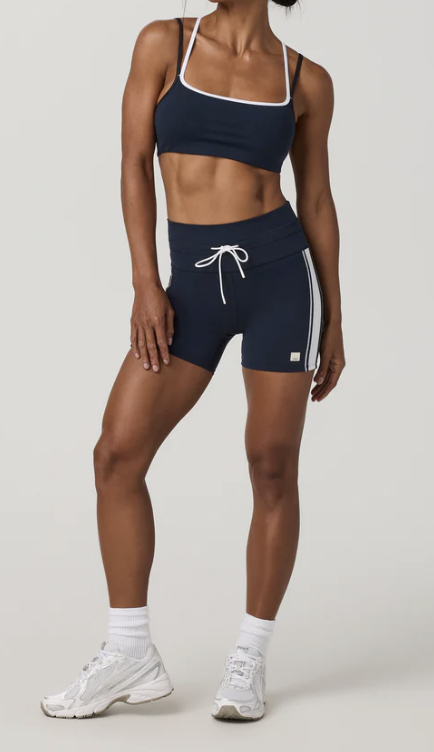
Perfect for pre or post beach walk.
Xoxo,
Annie
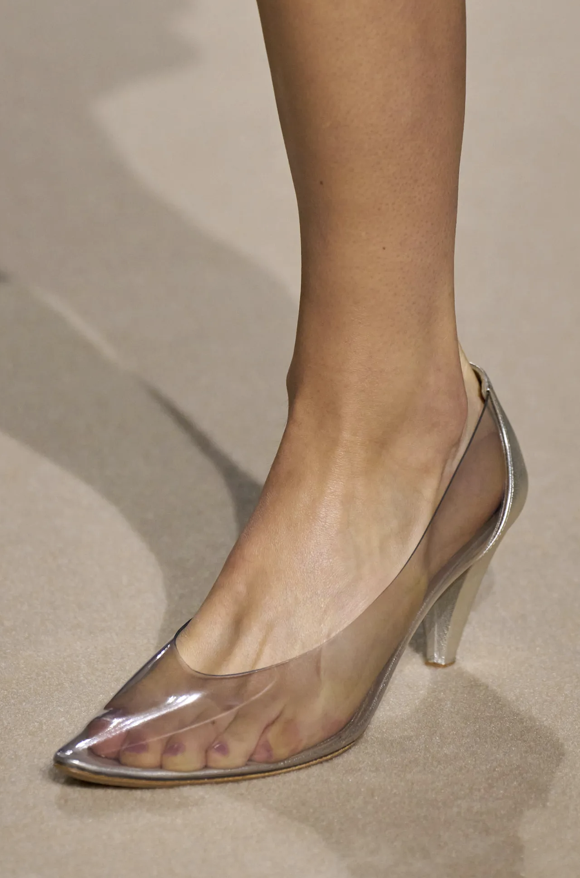
Once Upon a Jelly Flat
For quite some time now, the shoe game has been dominated by a supreme leader: the jelly flat. This shoe has been everywhere, squeaking, sweating, and imprinting a waffle-like tattoo deep into your skin. It was the shoe of boardwalks and swim decks, of Upper East Side chic moms, eclectic, Anthropology-loving substack writers, on every Vogue headline, but also sold in bins for the price of a lemonade.
And for a very distinct period, that was fine because the jelly flat didn't need to be desired. Rather, by focusing on being functional and accessible, it became a cult favorite. In my opinion, it was the plastic wine glass of footwear: it did the job, and the job was beneath it. But somewhere between one summer and the next, the jelly staged a coup against its own reputation.
Then the same slick, translucent, candy-shell material to a design that has spent seventy plus years perfecting French insouciance was given to new hands. The flat was lifted into a roughly two inch heel, creating what many are coining the ‘Cinderella Shoe.’
This, among a rising number of other models, is the Chloé jelly mule — spearmint green, fully waterproof, glazed like a hard candy, and it is a jelly flat’s evolution into the glass slipper.
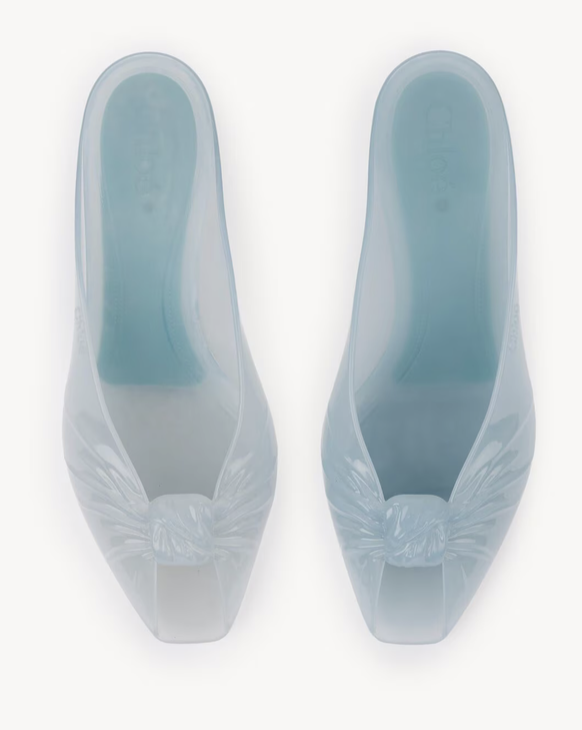
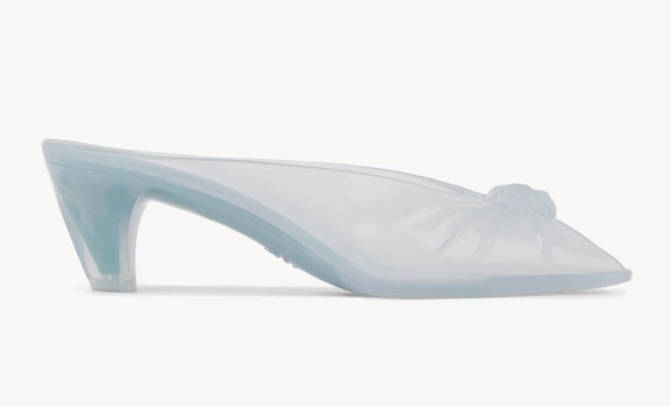
Credit: Chloé
As a kid, I fell in love with Cinderella's glass slipper both because it was a symbol of true love, and because it was magical. It was a shoe made of glass, of all things, worn to a ball, surviving a run down a marble staircase at midnight without so much as a scuff. Chloé's mule is still, materially, jelly. Still rubber. Still the same democratic goo that filled beach bins for a decade. So why is it so enticing?
Editors at Who What Wear put a number on this trend and called it "Cinderella toe summer" — a July 2026 roundup naming the Chloé jelly mule alongside a very specific lineup: a $560 pair of Ida Immendorff "Princess Clogs," $380 Aeyde mesh Mary Janes, $500 Tory Burch clear pumps, $710 Gucci rubber fisherman sandals, $1,495 Christian Louboutin PVC slingbacks, and, at the far end, $1,800 Loewe x Paula's Ibiza mules. The same list also includes a $90 J.Crew jelly sandal and a $138 Schutz pair — so the material spans the entire price ladder, eight dollars to eighteen hundred, sitting side by side in one trend report.
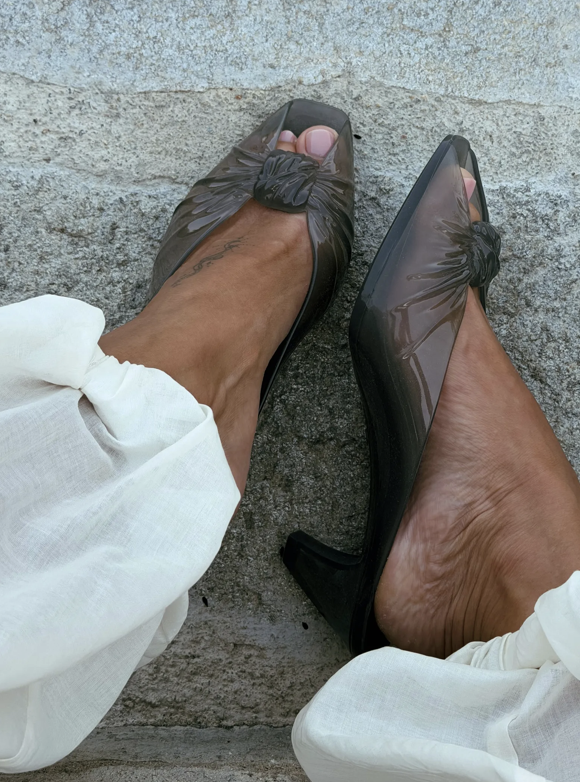
Credit: @imdominikapolak
But underneath the trend reports and price tags, the pull is a lot more personal. Most of the women buying into this grew up with a specific image lodged somewhere in the back of their memory of a cartoon girl in a blue gown running down a grand staircase only to lose the shoe that brings her prince charming home.
A two-inch jelly heel in spearmint green is a strange, small thing to do that recalling, but it works. You don't need to know the material is TPU or that it costs $600 more than the flat version to feel the tug. This shoe is glossy, precious-looking, and catches light the way glass does in the movie. Nobody at Chloé needed to write "feel like a princess" on the box because the reference is already loaded in most customers' heads from age six onward. These brands have mastered the jelly material by figuring out how to charge for a memory and a vision instead of a shoe.
My prediction is that this summer will conclude with a mass rise of the jelly mule and with pedicures on full display. This shoe can be worn with a slip skirt or mini dress, mimicking the youthful whimsy of the iconic glass slipper, now remodeled by the fairy godmothers of fashion.
Xoxo,
Annie
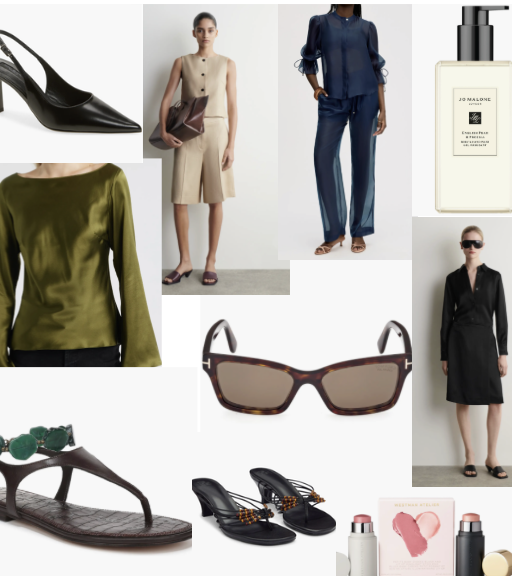
What to Buy from the Nordstrom Anniversary Sale
I have a love-hate relationship with the Nordstrom Anniversary Sale. The sale marks the beginning of the end of my favorite season. But leave it to Nordstrom to cure that grief by dangling knee-high boots and chunky sweaters in front of me while it's 90 degrees.
This year is extra special, as for their 125th Anniversary, Nordstrom is discounting both new and old items. Somewhere in that glorious mess are genuine hidden gems. I did the sorting so you don't have to lose an afternoon or your sanity. Below are 10 must-haves and standout pieces from fan-favorite brands like COS, Reformation, and Sam Edelman — no digging required.
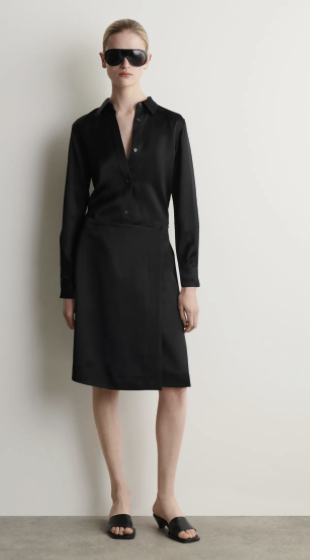
This is such a staple for me. So effortless and easy to style.
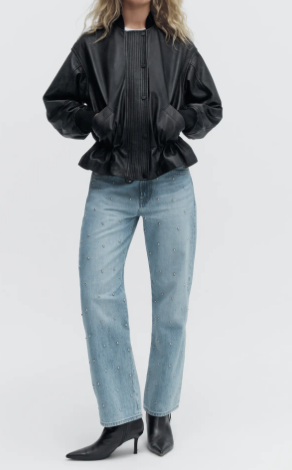
The structure and texture of this jacket is so sick. Plus it’s discounted from $649 to $399.
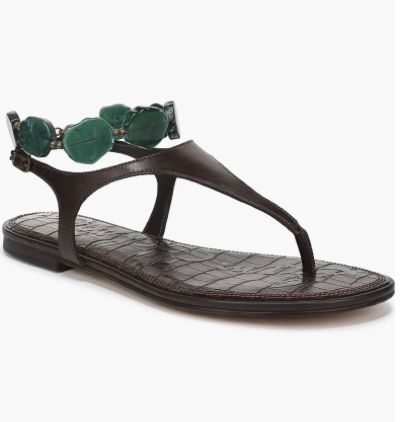
Extra accessories included!
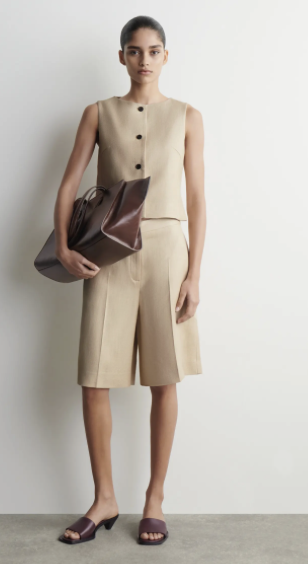
I've been seeing every French fashion editor wearing this exact pair.
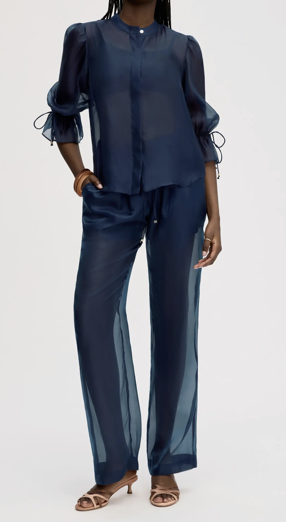
Throwing these over a bikini immediately.
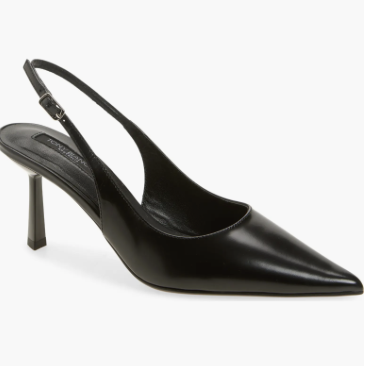
You already know I love TB, but these are confirmed the best universal black heel.
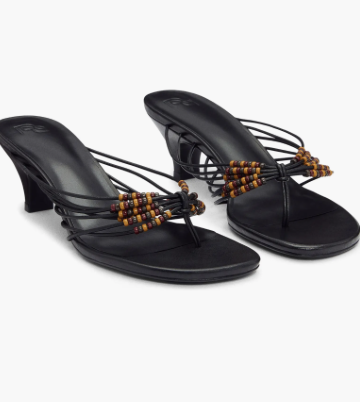
Khaite dupe.
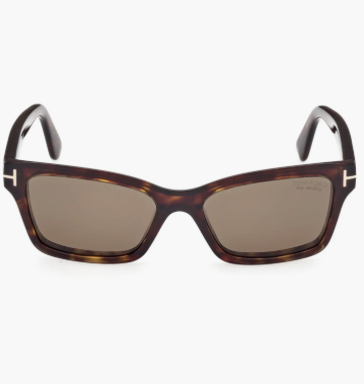
Timeless and dying for these in green.
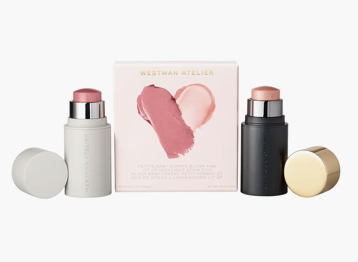
Forever grateful to my DG girls for putting me on to Westman Atelier products. These are incredible.
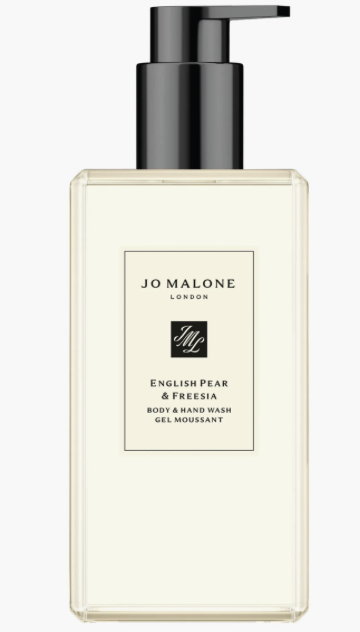
Had to include one of my all time favorite scents. This is such a great gift and literally 50% off.
Happy shopping!
Xoxo,
Annie
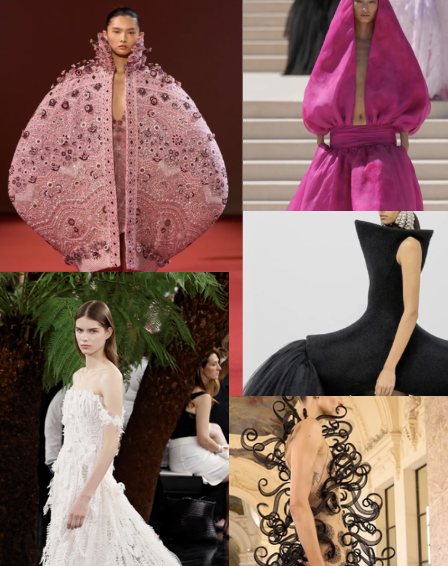
Masters of Haute Couture
Wow! What an incredible PFW we just experienced! I have spent the past week waiting for any and all coverage of Couture week, and I am here to give you an in-depth rundown.
If I can describe this week in one word it would be triumphant. There are roughly four categories of risk that the designers were very conscious of: skepticism, embarrassment, redundancy, and collapse. Let’s go house by house.
Pierpaolo Piccioli was at the highest risk of skepticism, as he arrived at Balenciaga with a genuinely tricky inheritance. Denma left Balenciaga's fanbase behind in shock and with a lot of hoodies, tip-toeing between streetwear hangover and couture aspiration. But now, Balenciaga is back. Piccioli has literally breathed life back into Cristóbal Balenciaga's history, using almost all silk gazar, classic silhouettes, color, craftsmanship, and strategic cycling of elements. The palette oscillates between electric, Valentino-esq, brights into stretches of pure black to reset the audience's eyes mid-show. Some of my favorite looks framed the models with halo-like necklines and gravity-defying volume. He even reworked the classic City Bag into a new glittery must-have that EVERYONE is obsessing over. The cherry on top was that God himself approved of the designs, sending the most glorious light over 10 Avenue George V’s gardens.
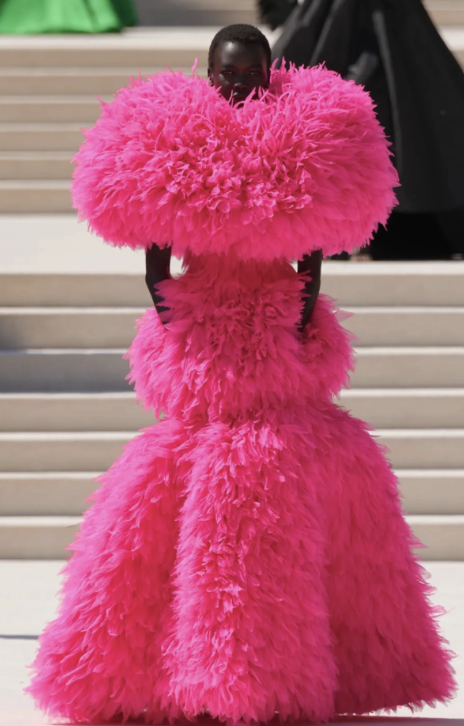
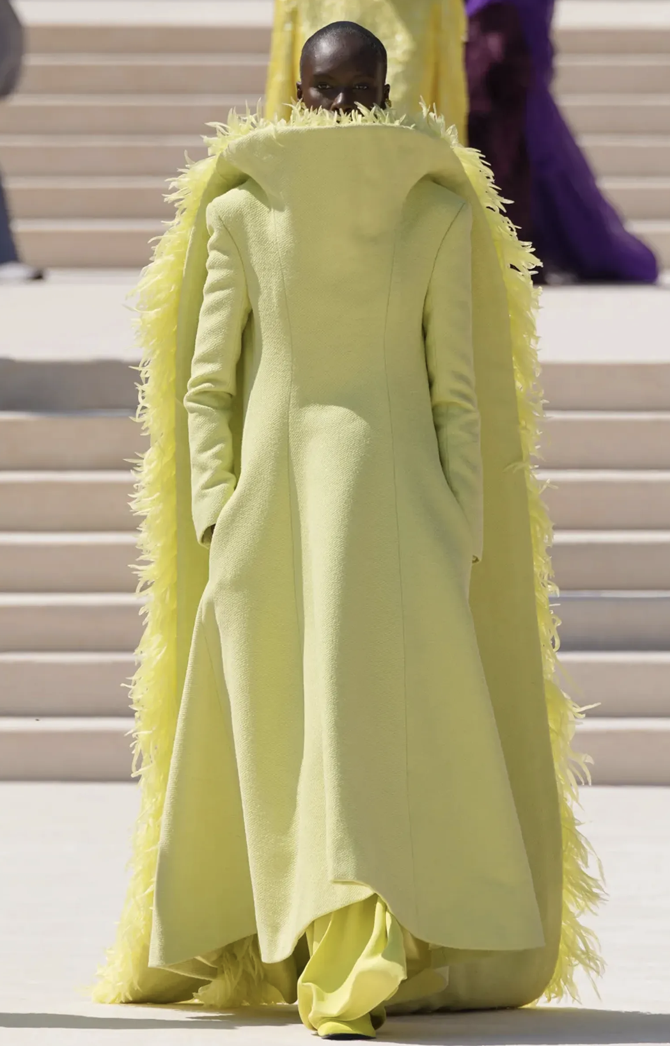
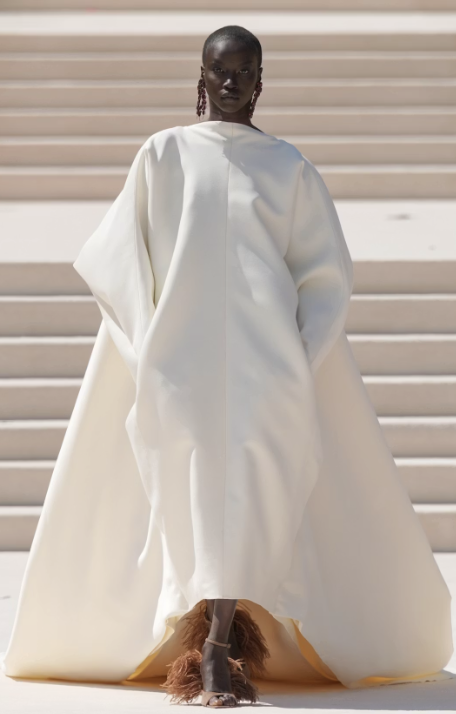
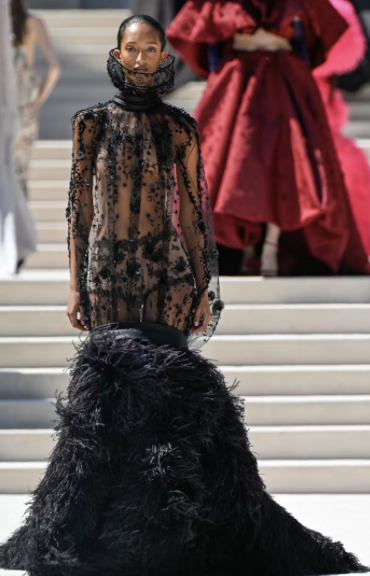
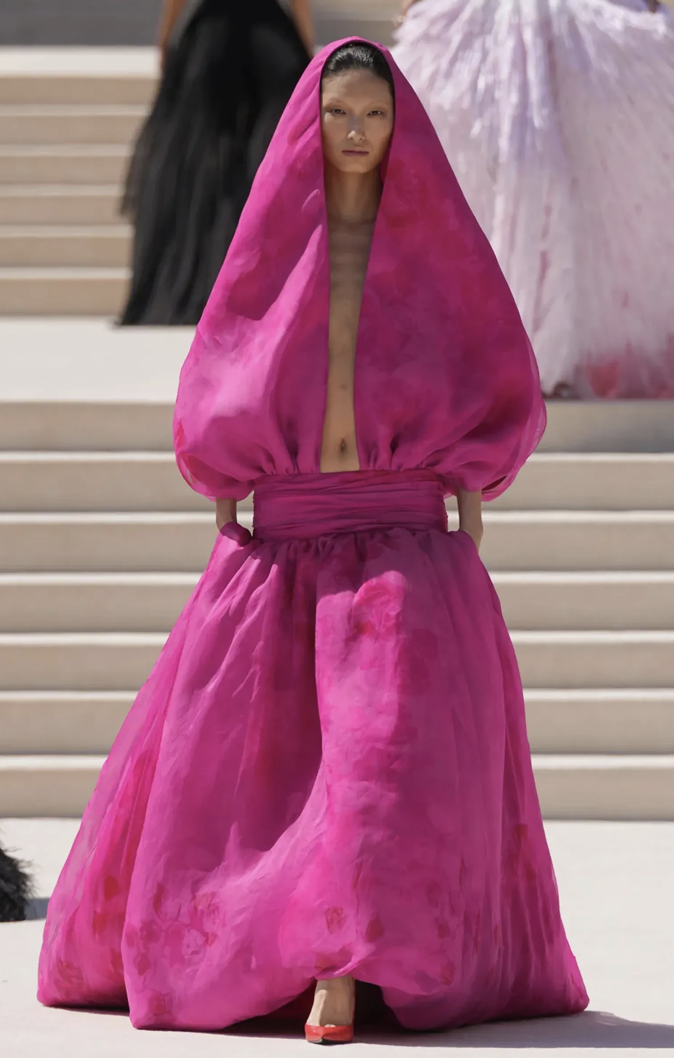
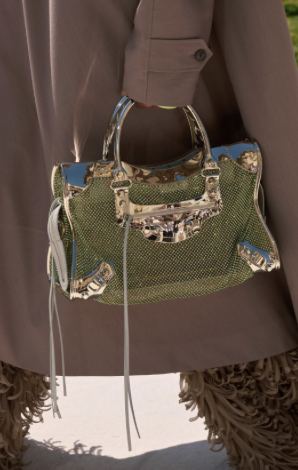
Courtesy of Vogue
Duran Lantink for Jean Paul Gaultier has mastered the tromp l’oeil. Although he prides himself in provocation, without technique this risk resorting to a stunt of embarrassment that fashion critics are reluctant to excuse. Lantink centered his collection around the idea of a body engineered to dominate a room using elements such as 3D scanning and industrial flocking, layered over old school cut-and-sow. He titled the collection “Tech Couture,” converting his marinière stripe and cone bra-filled atelier into a laboratory of technique driven by body builder corsets, upcycling, and an androgynous body. From waisted trucker jackets out of recycled 1997 denim to dresses spiked with cones from Gautier’s 2008 “Cages” collection, it was abundantly clear that Lentink did his homework on the archives. The fusion of old couture techniques like corsets and boned panniers, with materials like 3D prints and industrial form created something that felt unmistakably JPG yet completely innovative. Zero room for embarrassment.
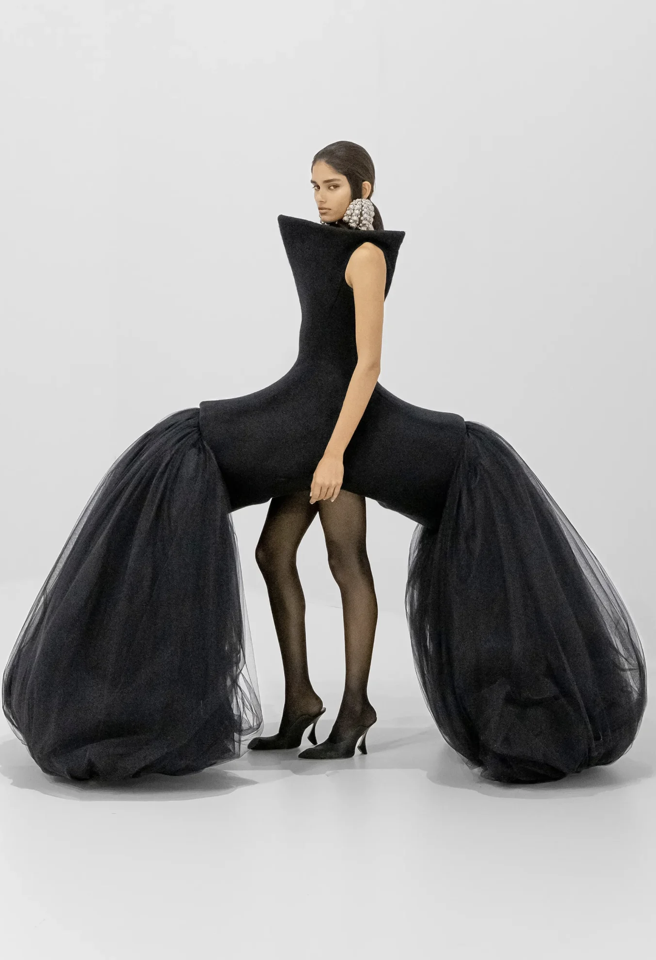
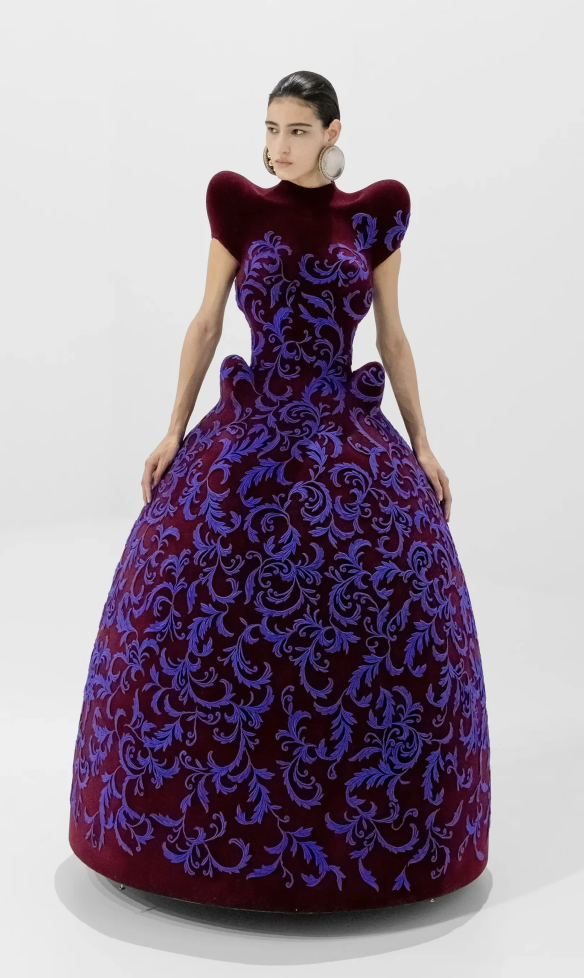
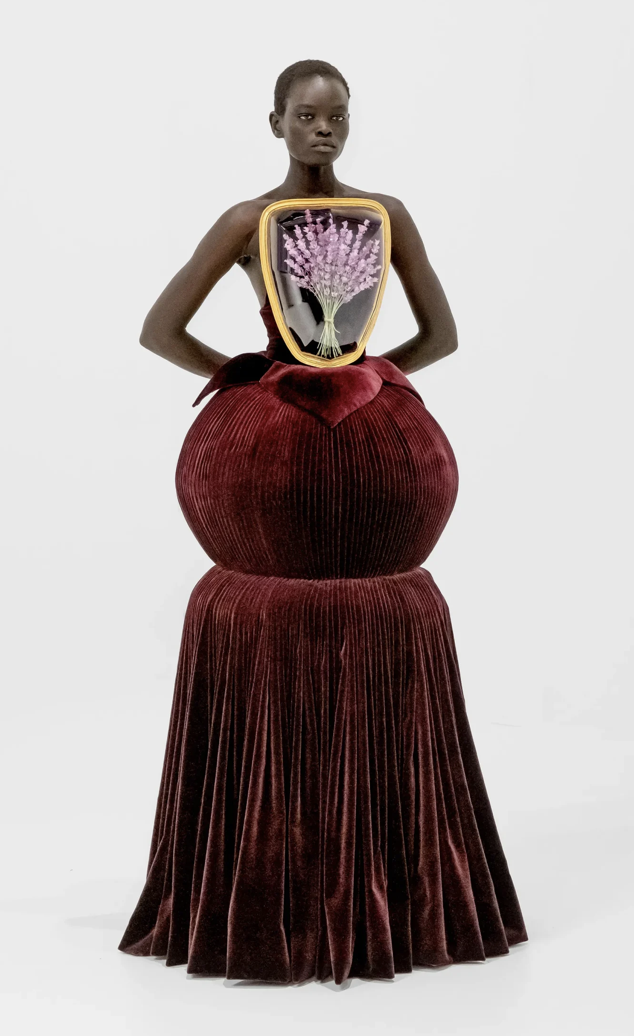
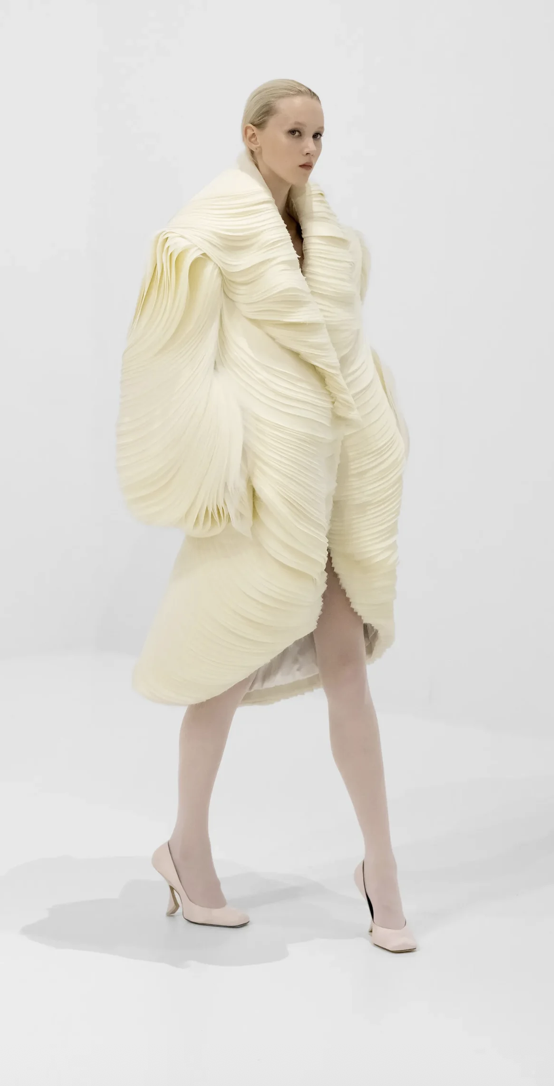
Courtesy of Vogue Adria
Jonathan Anderson for Dior faced a major risk of redundancy. His first couture collection back in January was an incredibly hard act to follow. And this season he had the extra complication of designing Taylor Swift’s actual wedding dress, no one else on the calendar was dealing with.
Yet Anderson has simply become better and better every time. This collection was complex yet got to the heart of simply well-done couture. Debuted in the Rodin Museum gardens and inspired partially by the sculptures of Lynda Benglis, his work took on the form of molten-metal forms. The fabric was twisted, pleated, and moulded until it stopped looking like fabric entirely. He closed, as tradition demands, with a feathered, pearl-toned column wedding dress. If I had watched Schiaparelli first, would I have viewed this collection the same? Considering the blinders that Roseberry puts on me as my go-to palette cleanser, definitely not. However, I loved every new and spectacular minute.
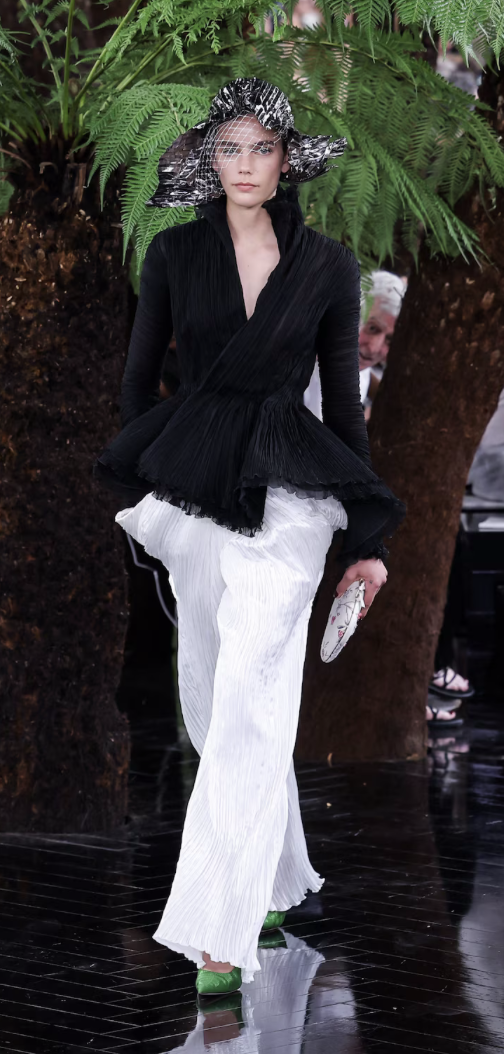
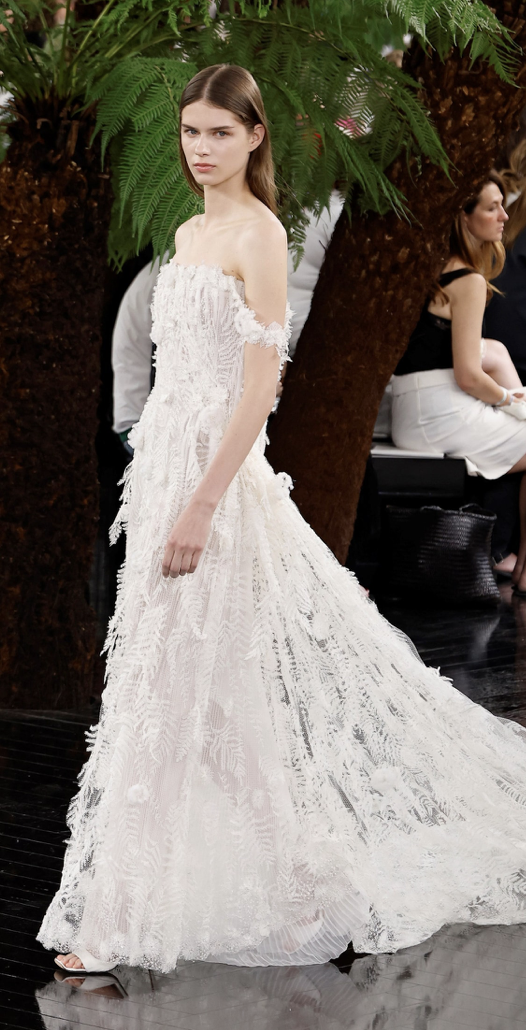
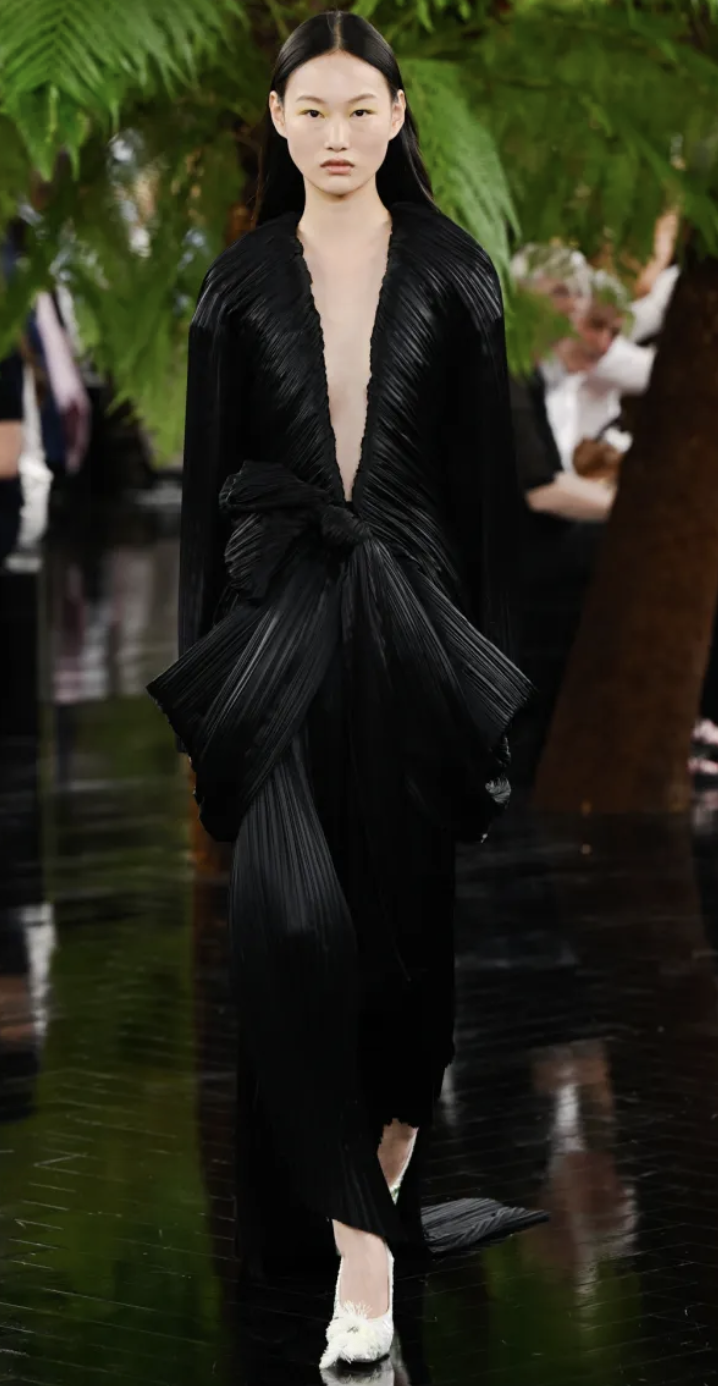
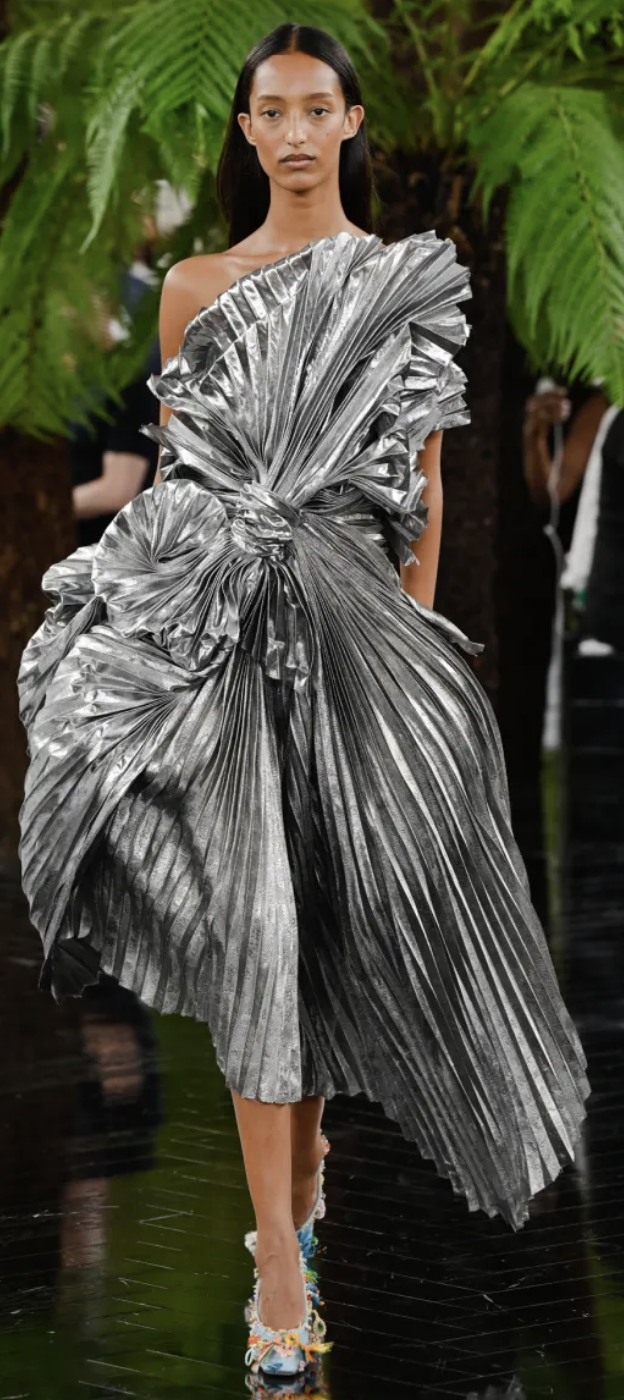
Courtesy of Dazed and WWD
Regarding the risk of collapse, I wanted to defend Armani Privé after the house’s recovery after the death of Giorgio, but I was just so underwhelmed. So instead, I will highlight the resurgence of Malhotra. He had earned his spot on the official PFW calendar and lost his mother soon after, which could have easily derailed the collection. Critics were worried about the oversentimentality of the pieces or the risk of leaving it too raw to be a collection at all. Titled “Maa,” he turned the bond of a mother and her children into formal structure, from Cocoon to Abundance. We saw balloon pieces that represented early life and extremely broad-shouldered gowns that held the weight of a mother’s responsibilities. His Indian-inspired rose and blush color palette completed the feeling of closeness and warmth.
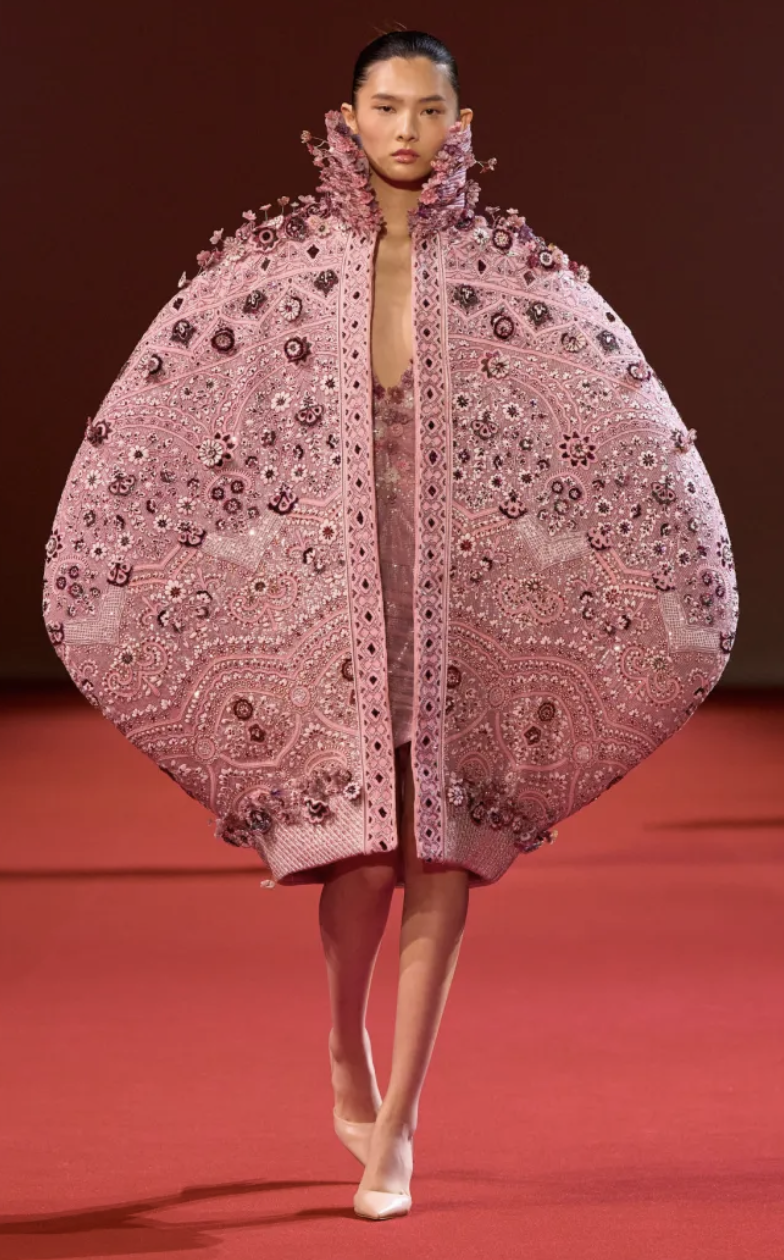
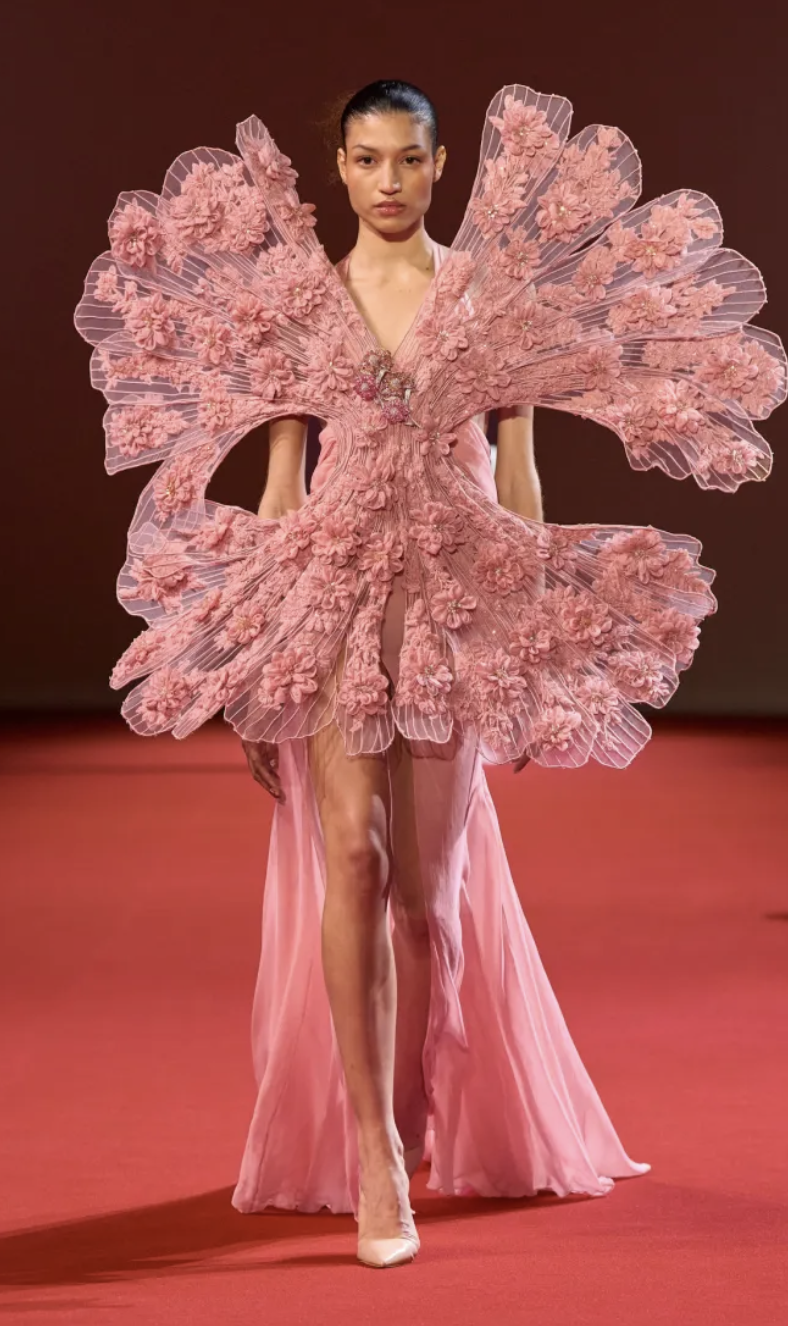
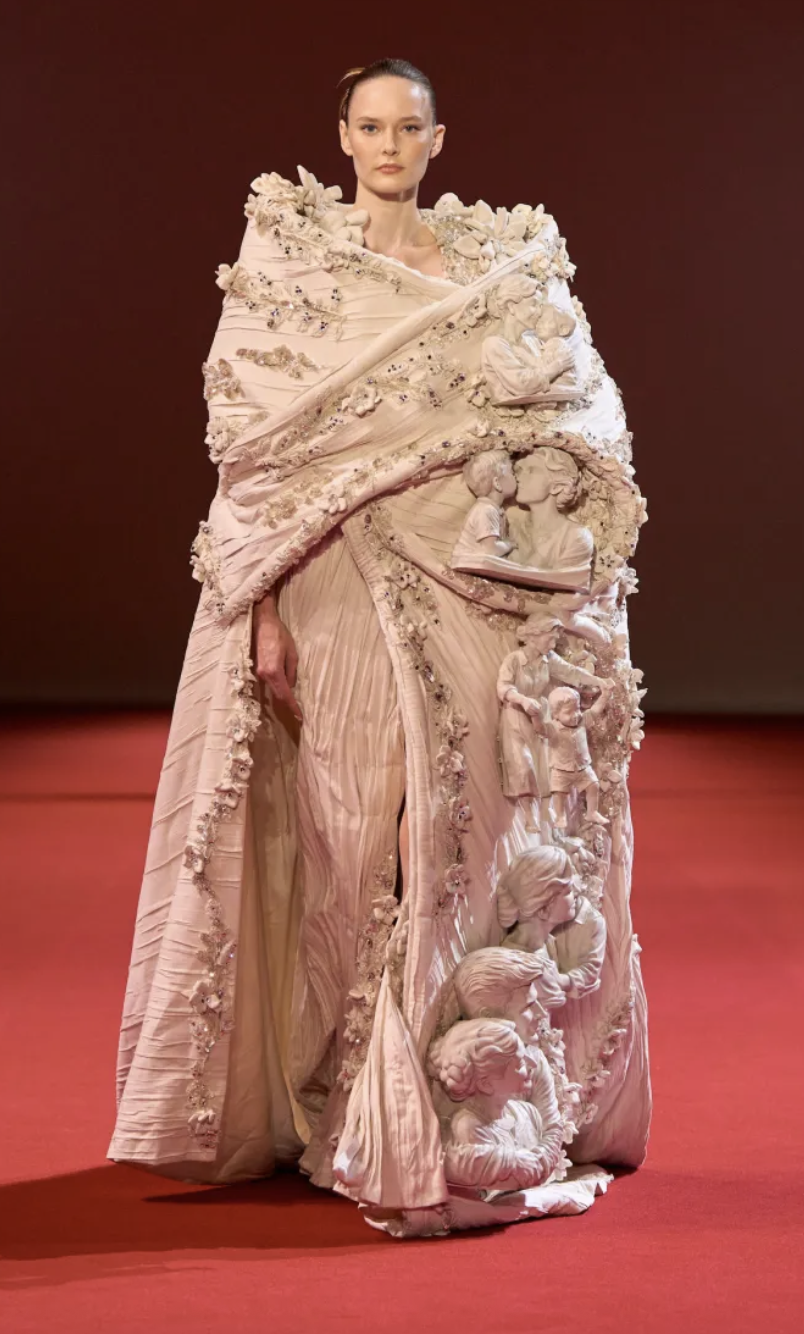
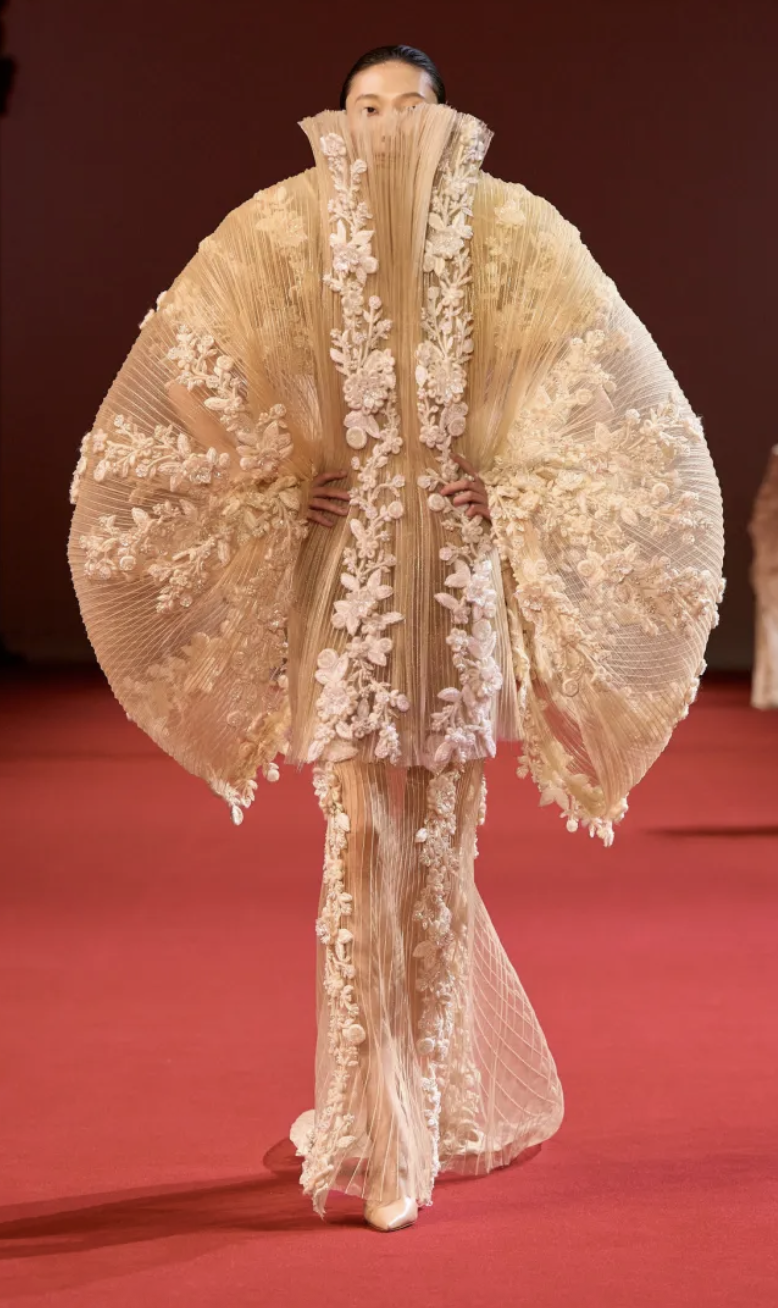
Courtesy of WWD
My favorite collection was hands-down Schiaparelli. I am just going to leave these photos here as evidence of proper couture.
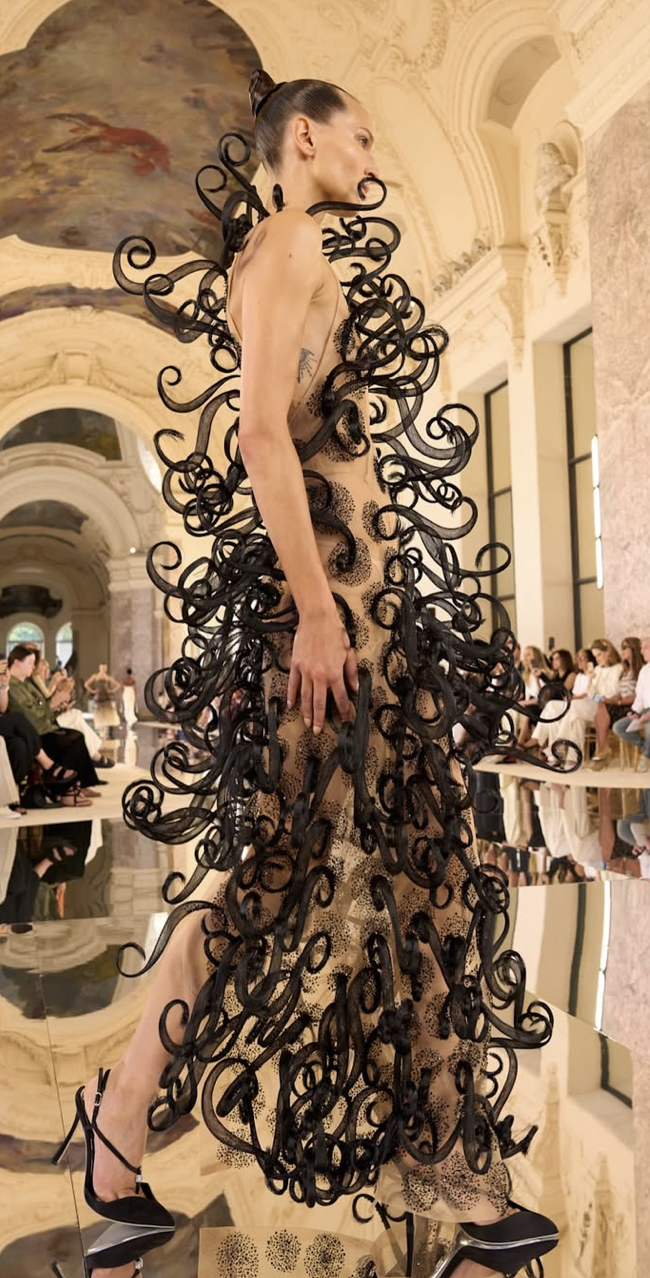
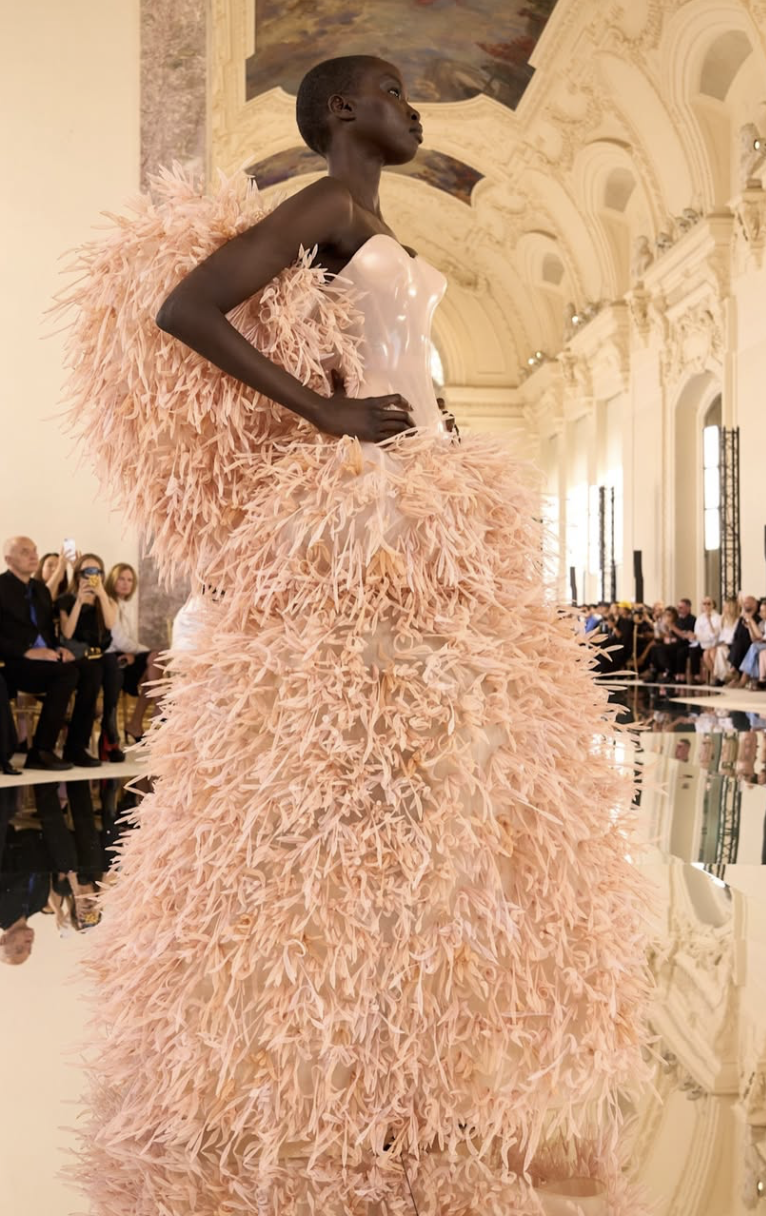
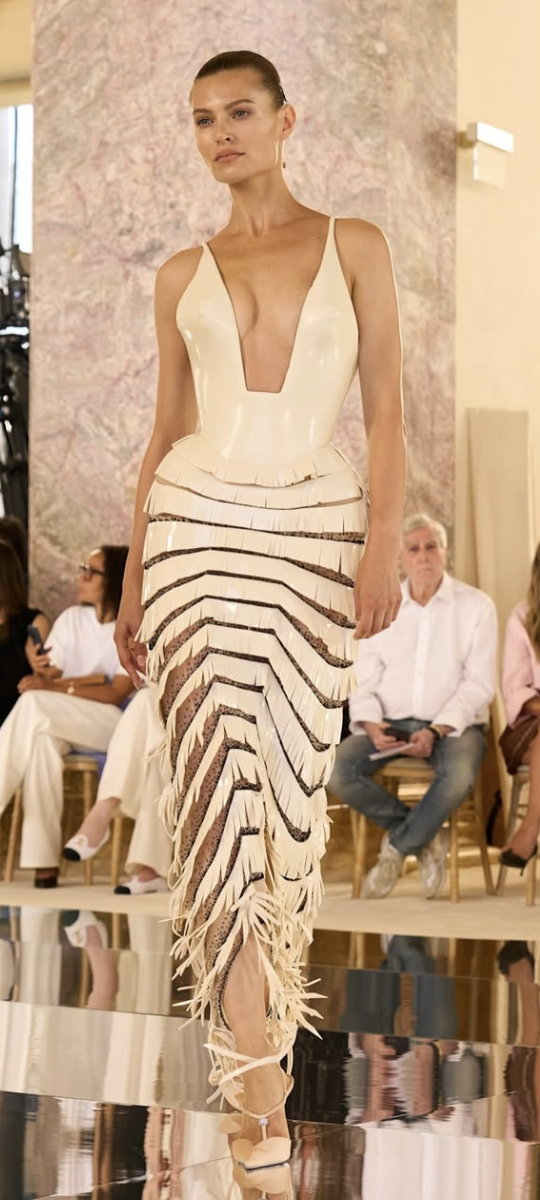
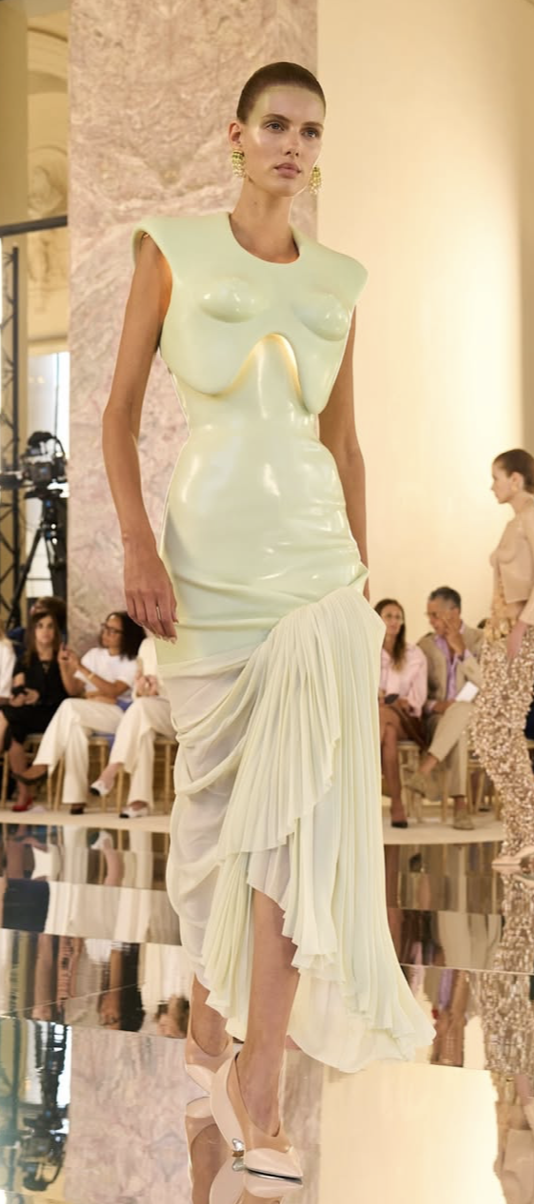
Courtesy of @HauteCoutureWeek
Four risk factors were on the table this week and all were conquered triumphantly by showstopping couture. What I enjoyed most was the depth of storytelling this week, as every collection felt especially emotional. This is the magic of couture that made me fall in love as a little girl, and has inspired me ever since. Back for more next week!
Xoxo,
Annie
What Should You Expect at Paris Haute Couture Week FW 26-27?
Couture is risky. When it comes to couture, there's a clause built into the format that ready-to-wear doesn't necessarily have. There are real clients, real fittings, real money, and a federation that can strip the word "couture" off a house's name if the craft isn't actually there.
To even call a collection "haute couture," a house has to maintain specific guidelines such as keeping an atelier in Paris, hand-making every garment to a client's measurements, and answering to a federation that can revoke the label. Some may even argue that couture gets judged on whether the hand behind it actually knows the rules well enough to bend them. To me, it is a fairytale. Let me tell you why.
Paris Haute Couture Week for Fall/Winter 2026-2027 opened yesterday, and on paper it looks like four days, huge house names, and a crazy heatwave over the city that is still going rather strong. But it is worth beginning our discussion with three designers to keep an eye on.
Matthieu Blazy is showing his second couture collection for Chanel. In his case, the follow-up matters more than the debut, because we're arguably past the honeymoon stage now. Typically, a first outing can run on good will, while a second show has to have a cohesive and captivating point of view. His first couture collection was built on reduction, working directly on the body with no sketches at all. The real test now is whether he can prove range without abandoning his philosophy of intimacy that he just spent a season establishing.
I woke up on this lovely Tuesday morning to @stylenotcom’s live updates about the show, and WOW. The response Blazy has given us is "Gaby and the Beanstalk.” Blazy found a copy of a book of fairy tales in Gabrielle Chanel's own library and cast her as the heroine of an imagined fable, opening the show with a deconstructed tweed suit rendered in sheer mousseline, with a model carrying Chanel's actual book in one hand. Poisonous camellia flowers appeared tangled up with thorny vines throughout reflect Blazy’s concept of the fairy tale as something that is unsettling rather than comforting. So instead of introducing a new structural pole to prove range, he went deeper into the same fairytale-intimacy thread from January. The looks were classically Chanel, from ample tweed to floral appliqués, but given life by Blazy’s new fairytale.
Haute Couture in itself is a fairytale. These incredibly precise and expensive pieces come together with the bibbidi-bobbidi-boo of magical hands, and possess the power to enchant the beholder. So by transporting viewers to the mystical land of Chanel, where Gabrielle herself is the heroine amongst walking scarecrows and organically placed beanstalks, Blazy is continuing her legacy and relying on our ability to believe that impossible labor can look effortless. A dress that took three hundred hours to hand-finish has to walk out looking like it grew that way, the same way fairy tales play tricks on children. Even the fact that the bride moved out of the finale, because it was never going to be Chanel's fairy tale, resists Gabrielle from being handed a fictional narrative. Instead, he closed with the classic little black dress as perfect revenge.
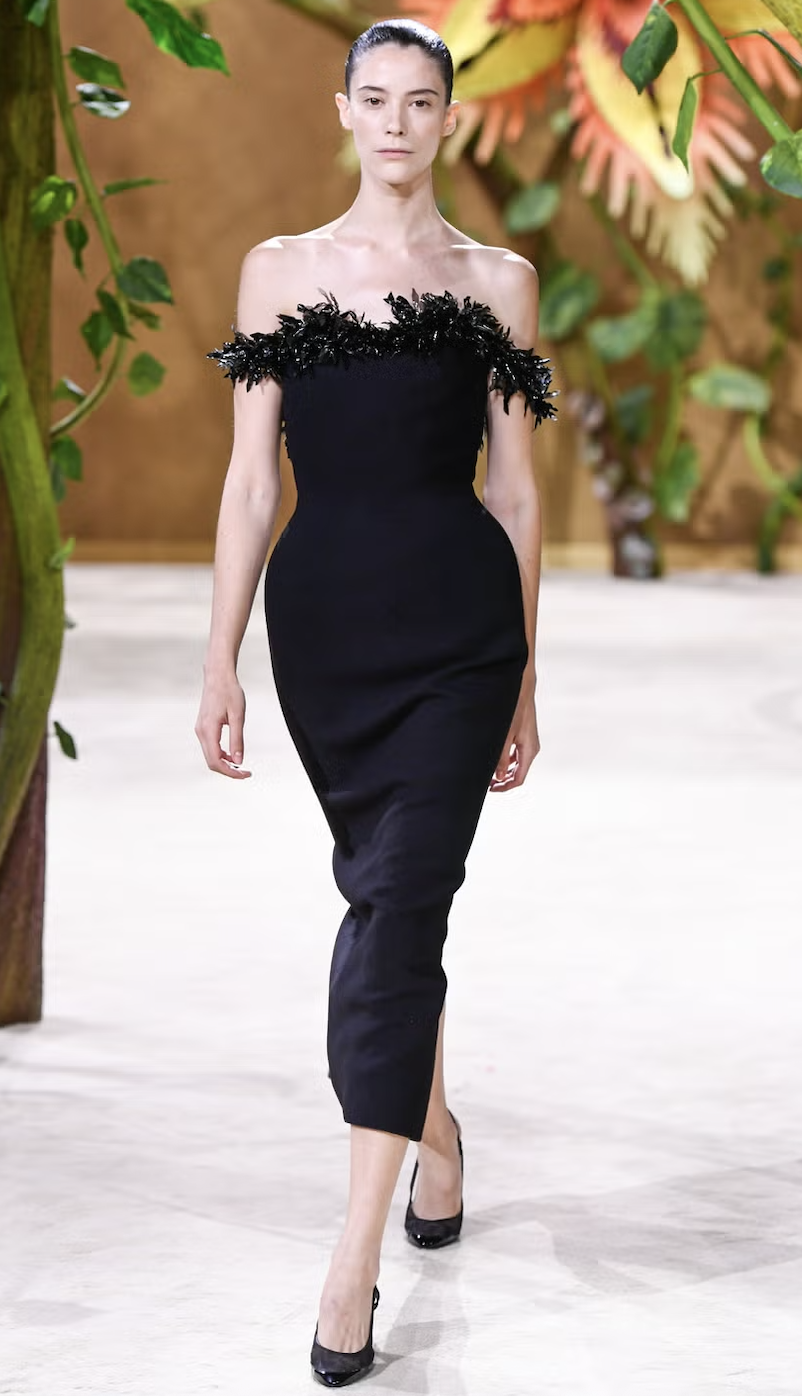
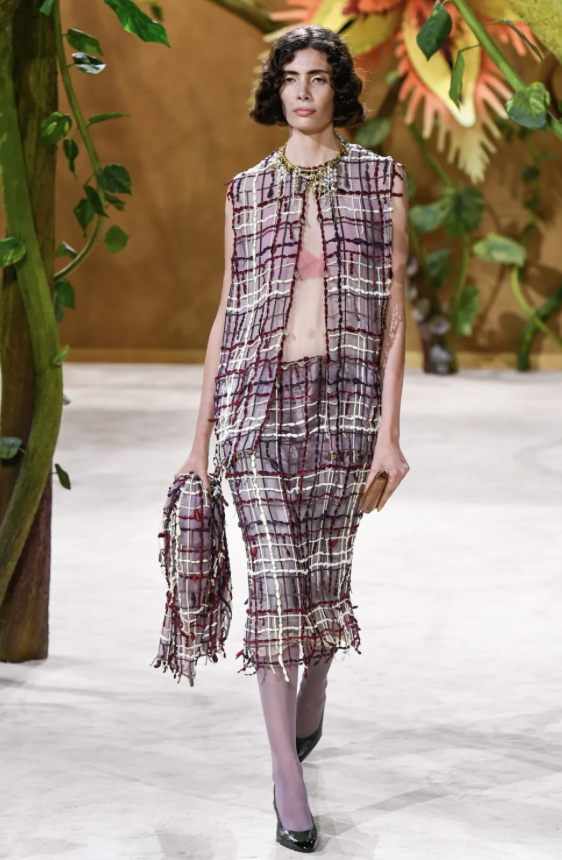
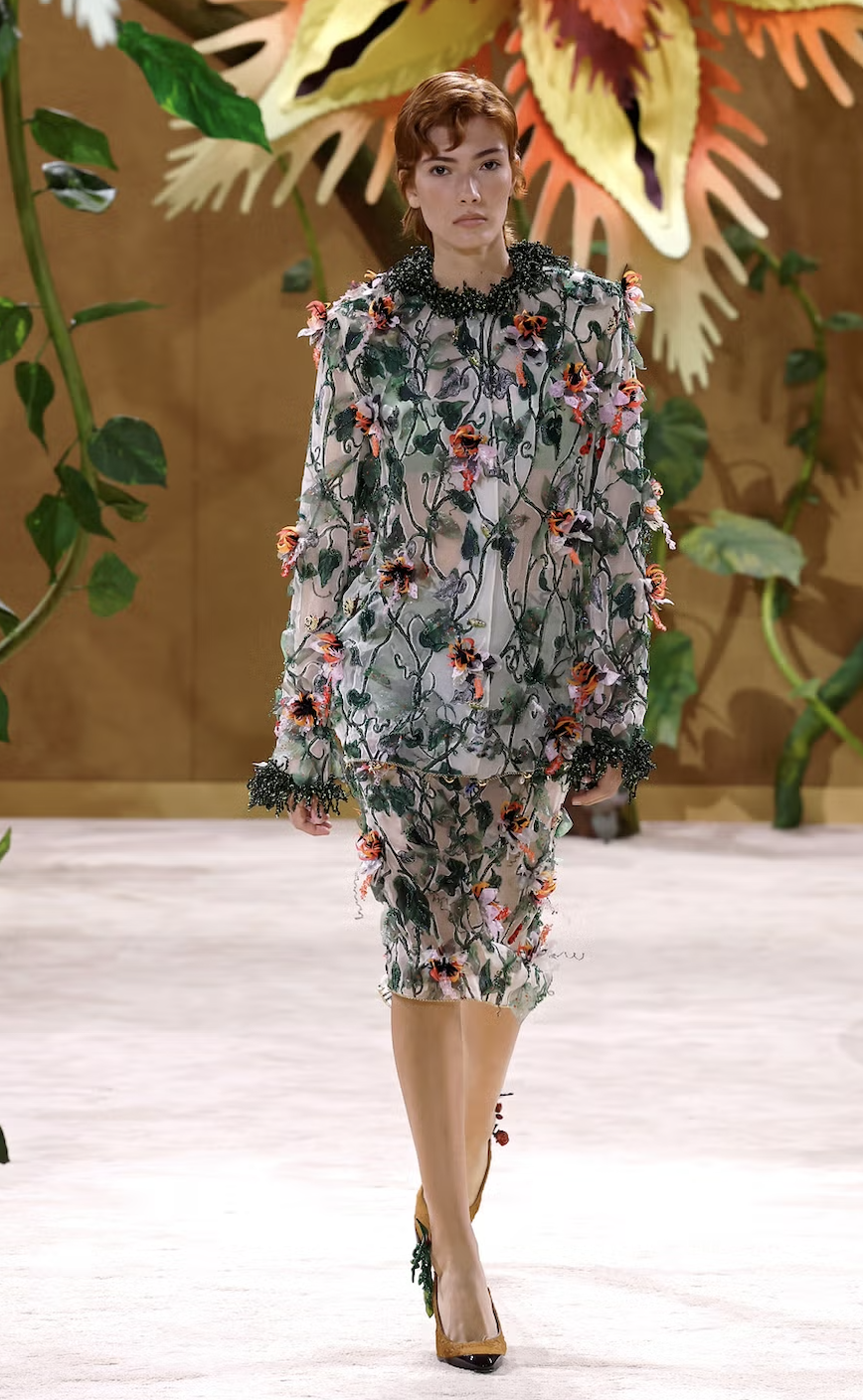
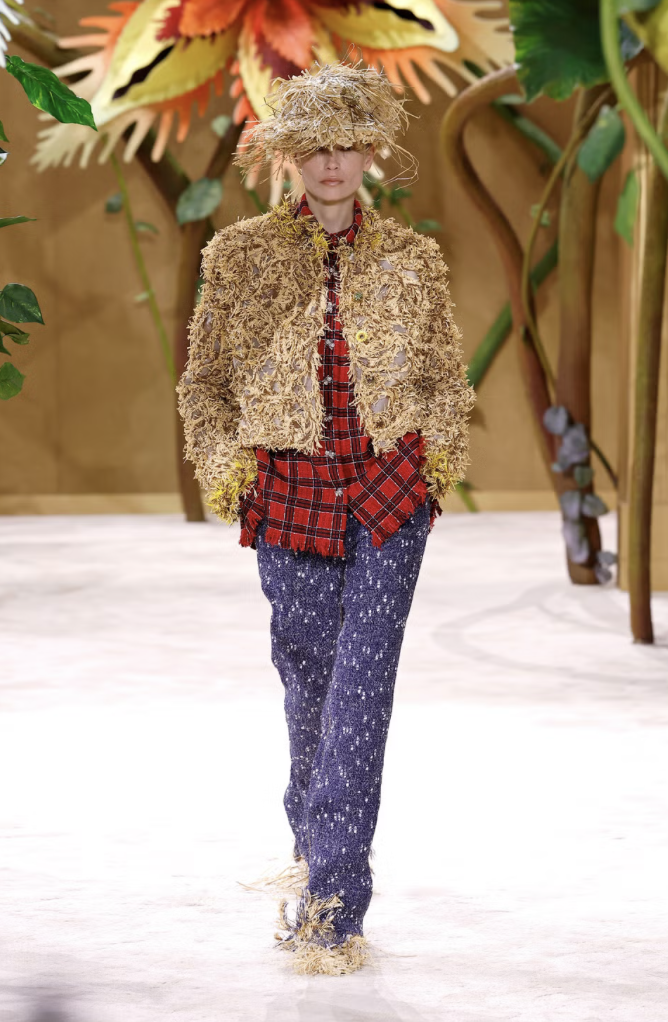
Courtesy of Chanel
Pierpaolo Piccioli is also showing his first couture collection for Balenciaga, stepping into a house whose recent identity was built almost entirely on shock timing and spectacle staging, and doing it in the one format that has no room for a viral moment to cover for a weak silhouette. Every collection he's shown since taking over has leaned on the natural elements and Cristóbal's own archival gazar fabric as construction, so I am leaning towards another reverent collection. Duran Lantink debuts his first couture for Jean Paul Gaultier, and I'm expecting something technically flawless. Gaultier loves provocation. His ready-to-wear debut split the room between those who called him the true heir to Gaultier's spirit and those who called it shock value without the construction to back it up, so couture will be a very interesting way to test him out.
Giorgio Armani Privé also returns to the calendar for the first time since Armani's death last September, which makes it the week's one collection being judged less on ambition and more on whether the house can hold its own hand steady without him. Can the people already there keep the line exactly where he left it? Using the precedent of someone like Elsa Schiaparelli and Daniel Roseberry, I want to see a successful blending of past and future rather than a new anatomical take on something that was already revolutionary once.
I attended Paris Haute Couture Week in 2018, and my favorite part of the week was, without a doubt, the fittings of designers like Adeline André. Watching art come together in real time, on a real body, hours before anyone outside the room sees it, is a privilege most of the industry never gets. It's also the part that is rarely photographed, although it is proof of whether a house can still do the thing it's named after. That's what I'll be watching most attentively for this week.
With thirty houses showing over the next three days there will be much to discuss.
Au revoir for now
Xoxo,
Annie
4th of July Edit
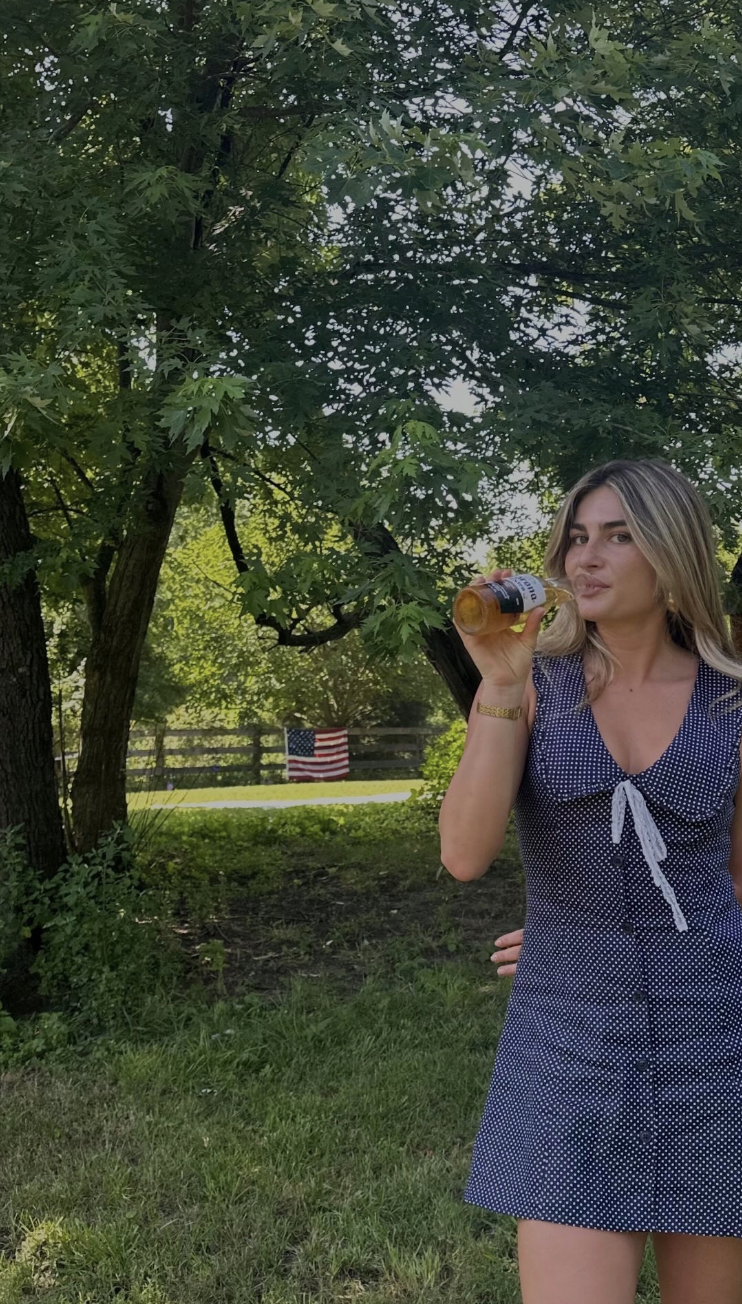
If there's one thing I know very well, it's how to do the 4th of July. Growing up in Newport, it was the holiday. Some of my most vivid memories live on that beach, from watching fireworks over the ocean, to teaching Elle how to launch her own, and eating an unreasonable number of hot dogs. This year, I won't be home, but I'm bringing the spirit with me. This will be an East Coast year full of funky prints and a healthy dose of festive chaos. From a long boat day to the Hamptons at its most gloriously over-the-top, I've been obsessing over pieces that feel celebratory and chic. Here is a pull of amazing pieces as shopping edit and styling inspo for doing the 4th the right way.
Dissh - Annabel White V-Neck Top and Shorts
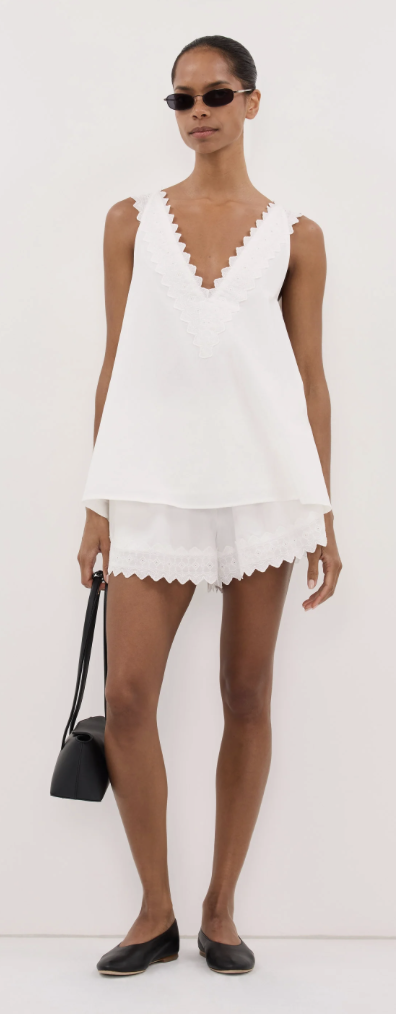
So perfect for a picnic or walking around town. Would style with the Ballerette flats and a silk scarf.
Seven Wonders — Arlette Strapless Top and Palazzo Pant
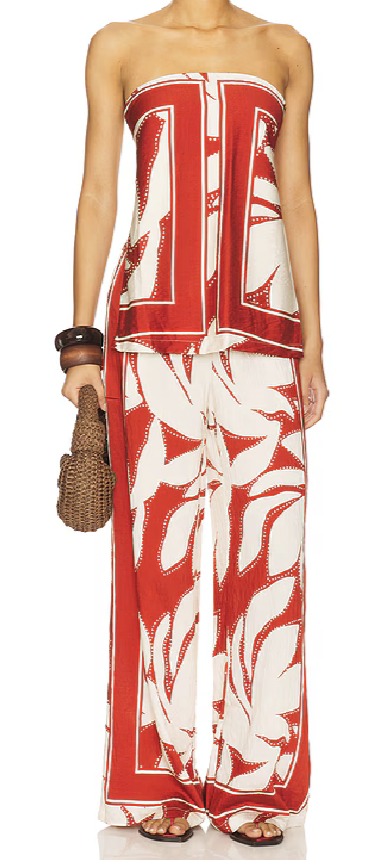
Easy and chic.
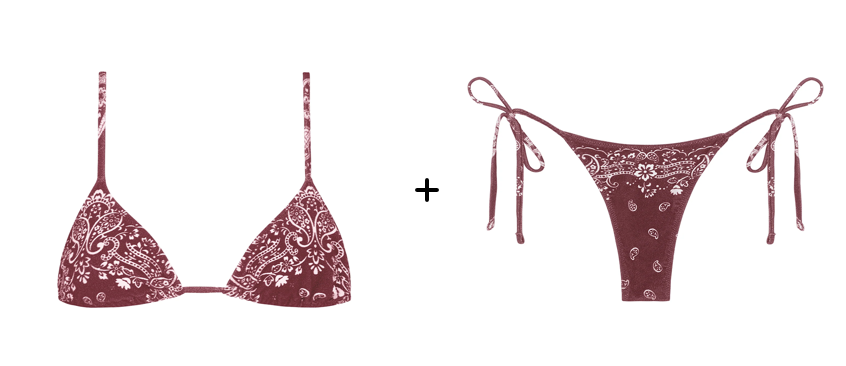
Obsessed with bandana print. Need.
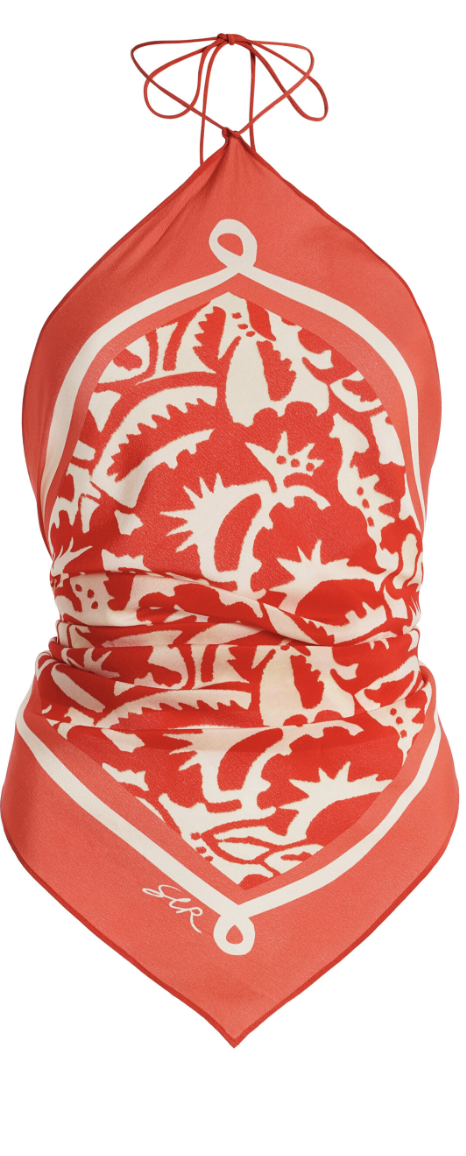
Effortlessly cool.
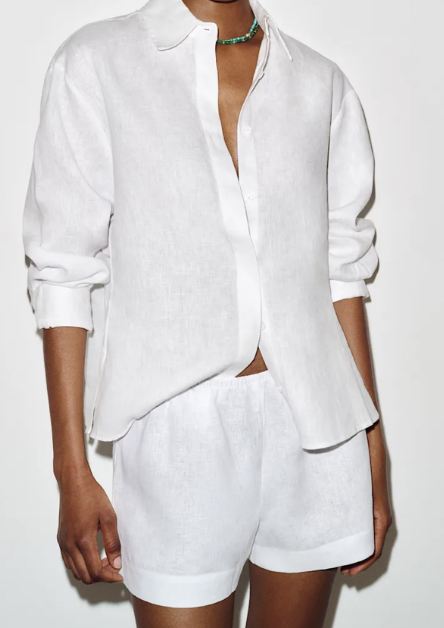
This with a sheer skirt and chunky beads = perfect.
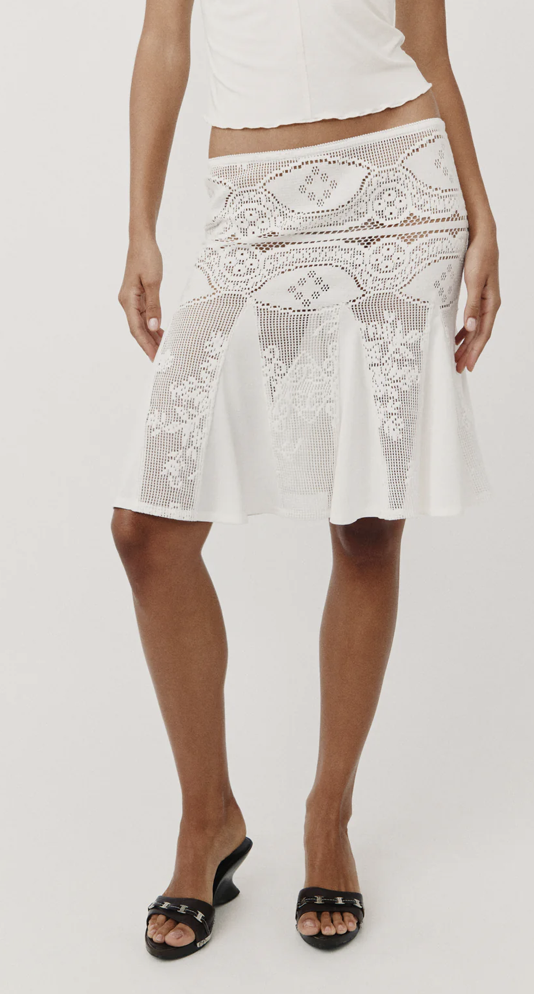
This is my perfect piece of clothing.
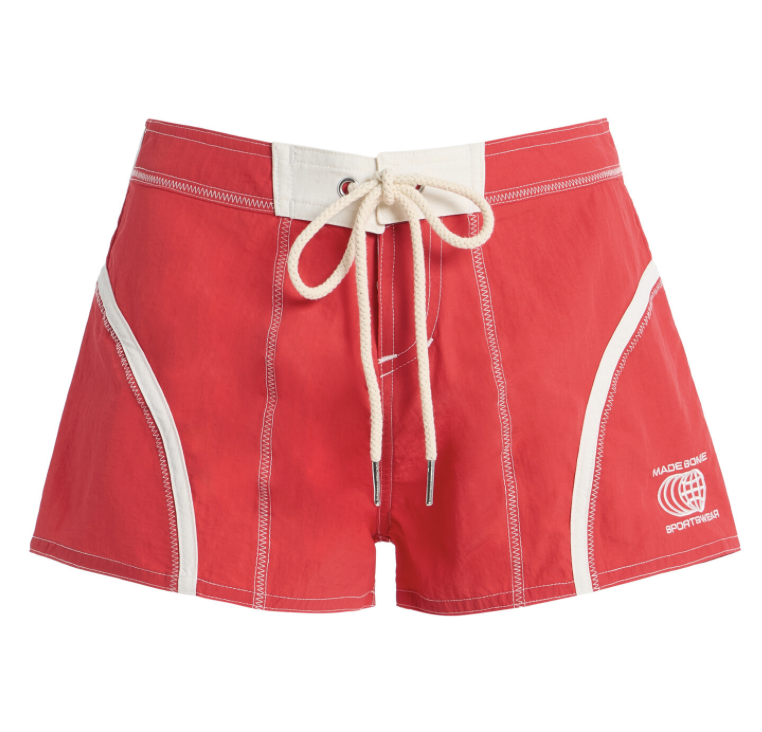
Cool version of my old junior lifeguard shorts.
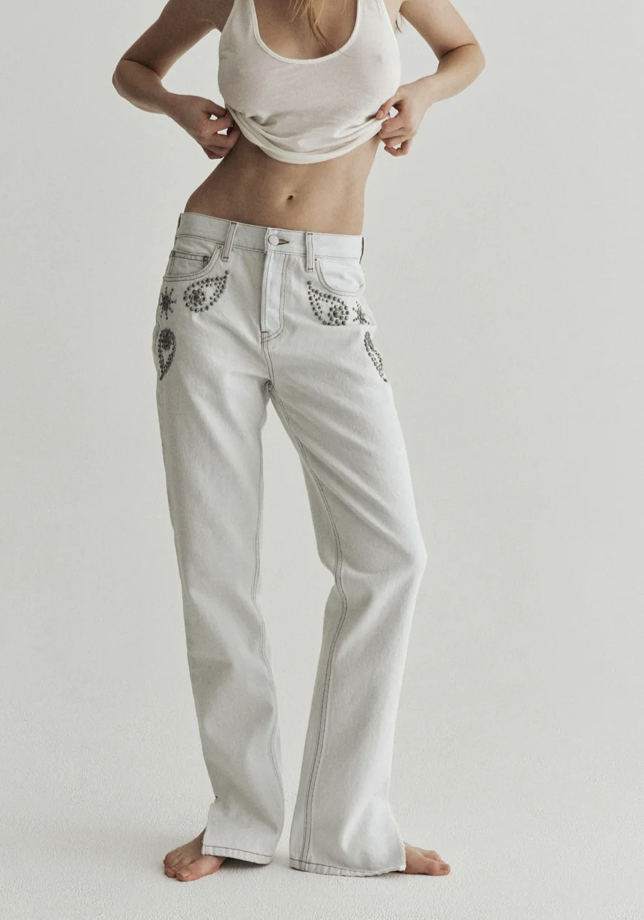
Such fun beading.
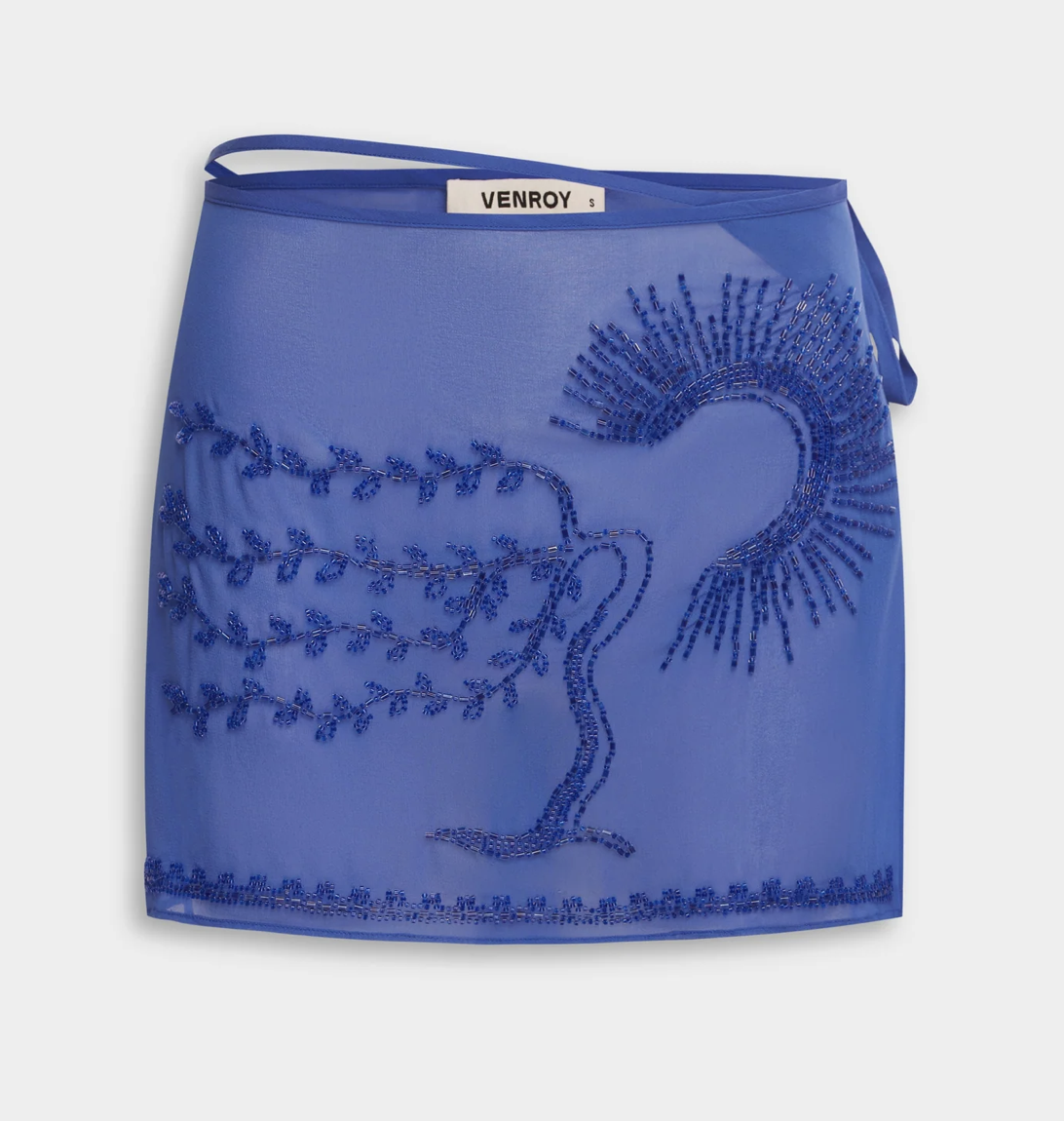
Need to wear this with a whit button down and ballet flats or little bikini.
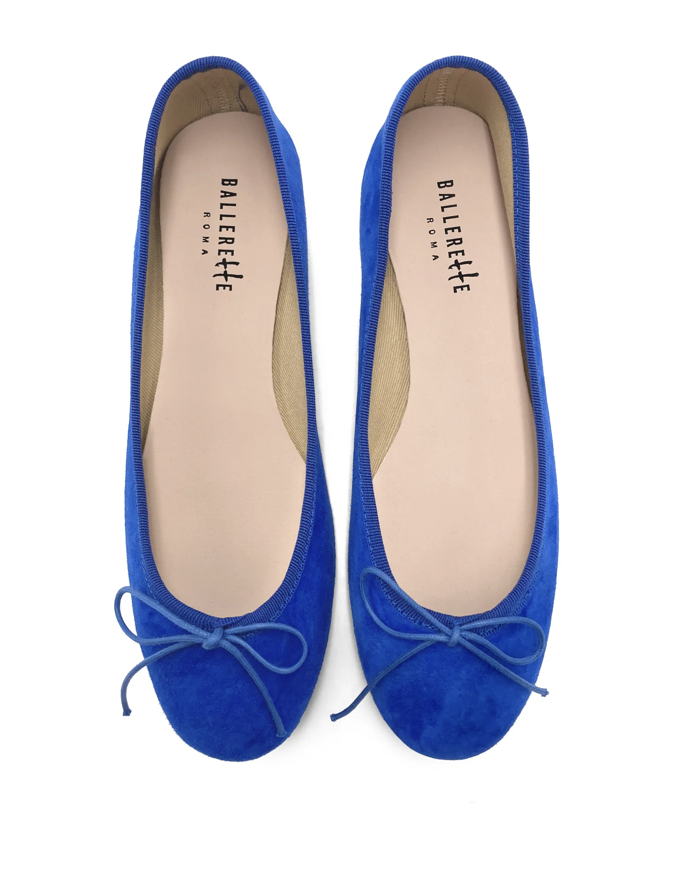
This color is insane.
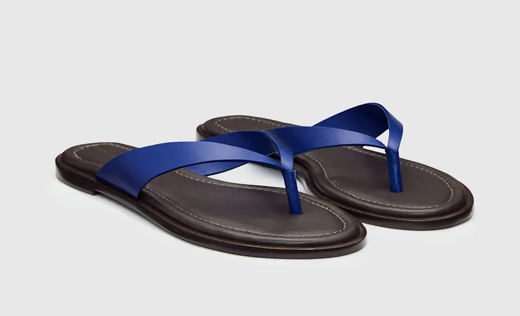
These are so comfortable and cool.
Xoxo,
Annie
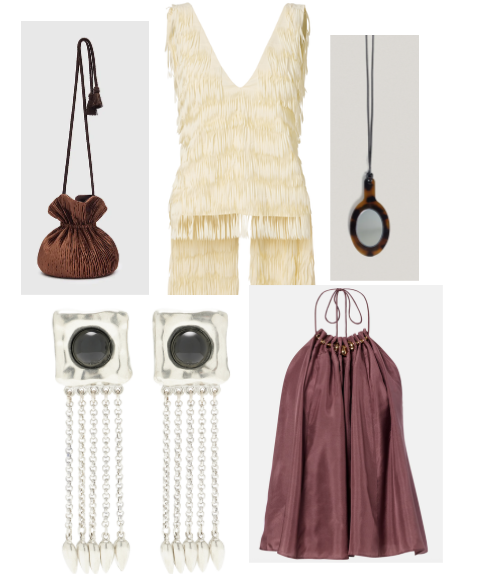
5 Things I Want This Week
I love to dress from the outside in, adding in as many unique accessories as acceptable to a relatively simple outfit. I enjoy the stability and timelessness of a quality base, and often splurge on pieces that enhance my personal style. Especially now that the city is a sauna, I want to wear as little as possible, while looking as cool as possible. This week’s wishlist includes picks with minimum fabric and maximum accessorization potential. Enjoy!
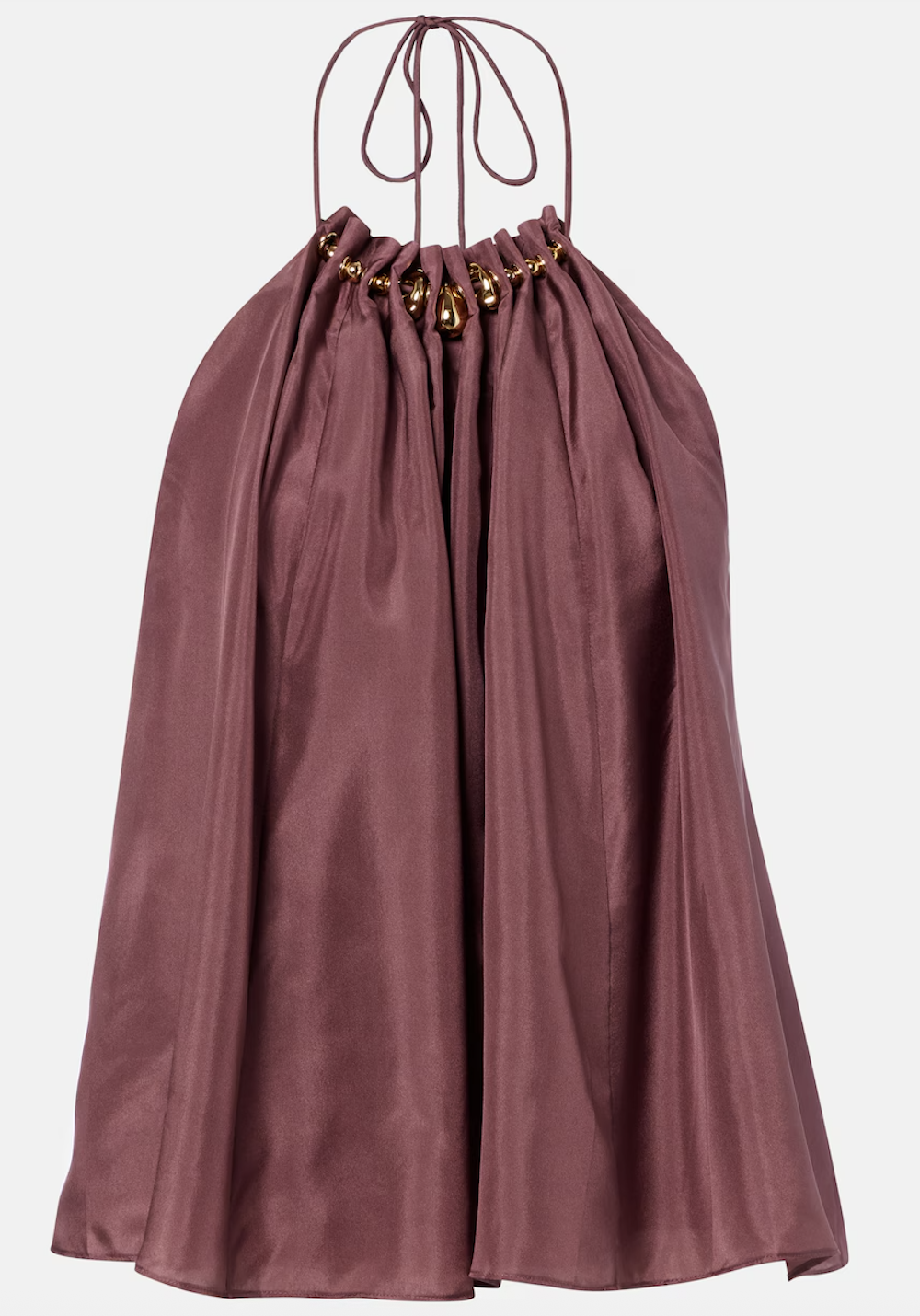
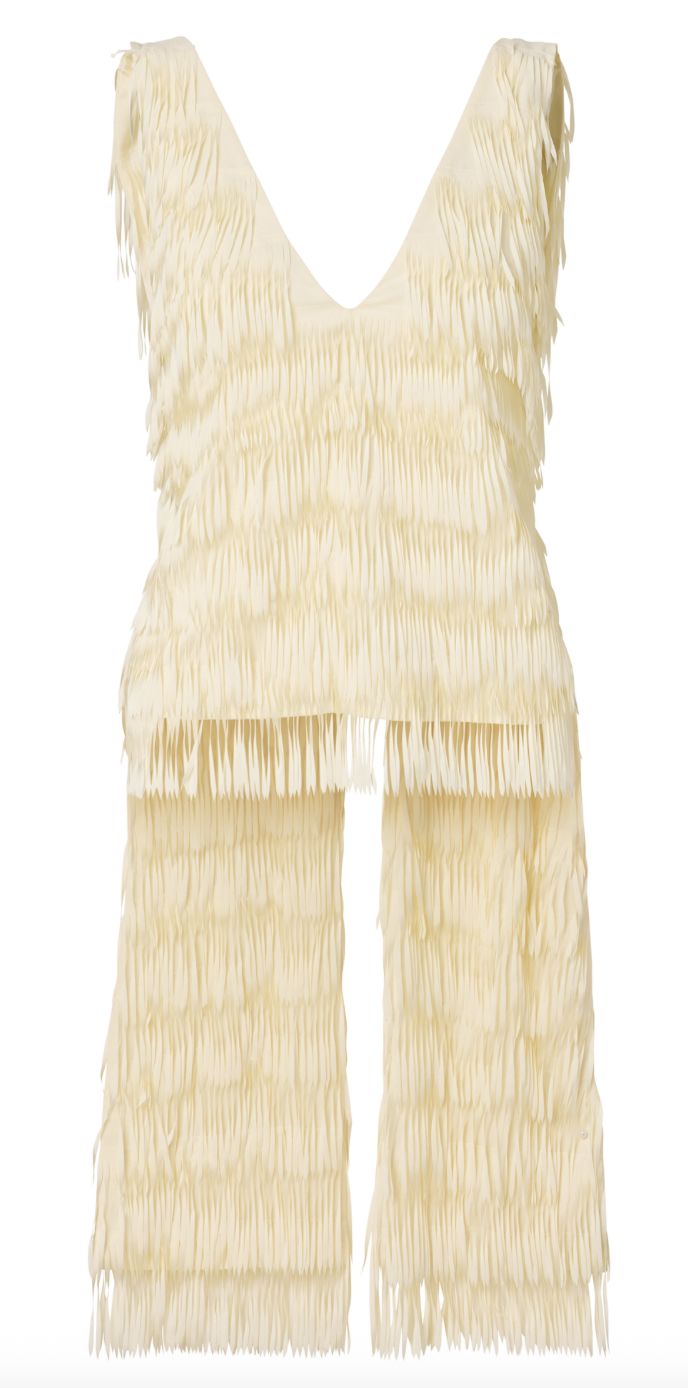
Zimmermann doing what Zimmermann does best. Get the matching pants to complete the coolest look.
An angelic take on this summer trend.
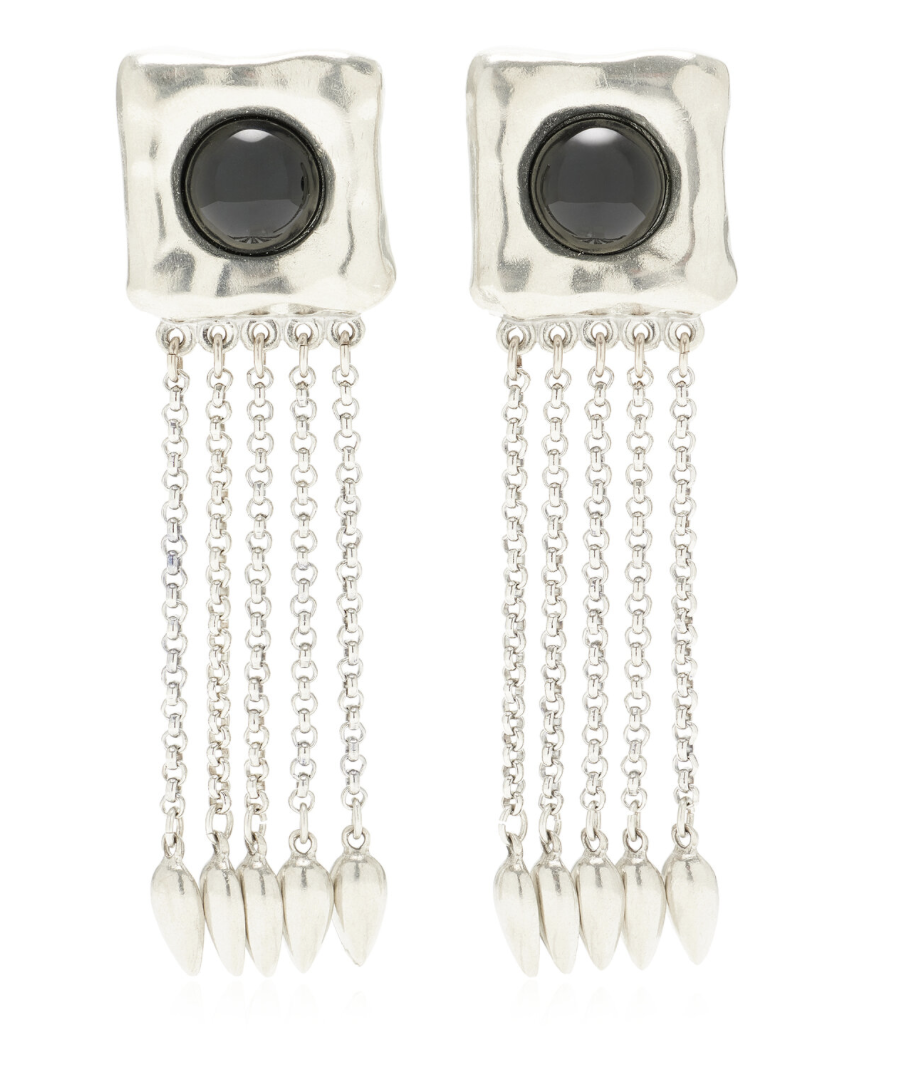
Obsessed with the length and movement.
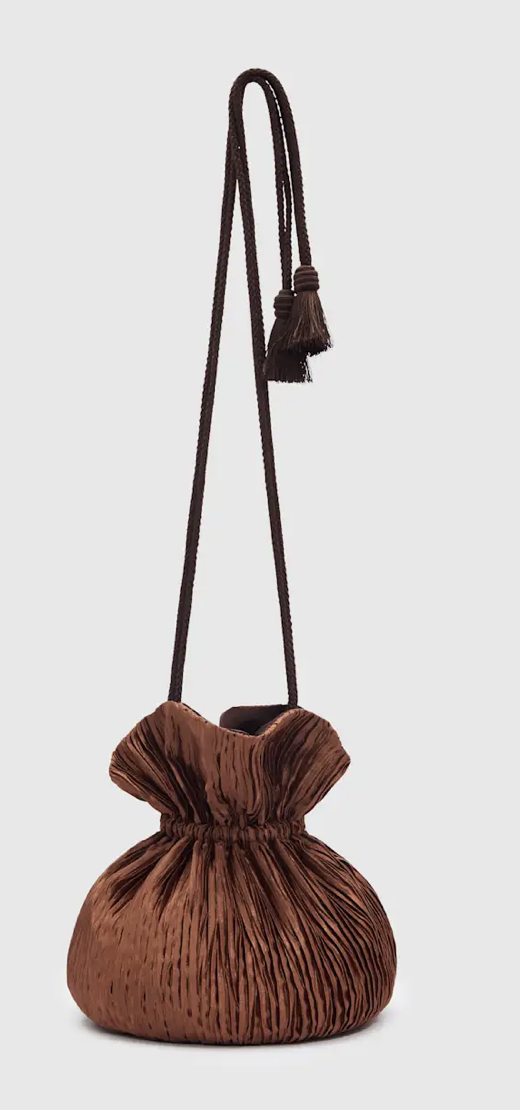
Darling “silly little pouch” with deadstock plissé satin and a drawstring handle. Need.
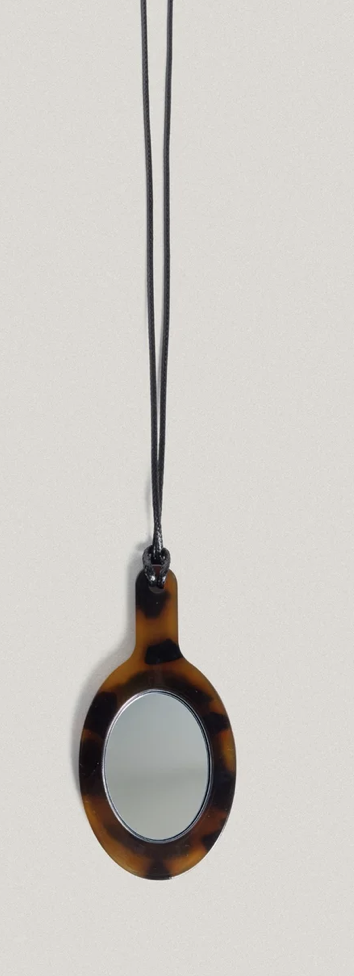
Such a great convo starter.
Back for more soon!
Xoxo,
Annie

5 Things I Want This Week
Recently, I have been reflecting on the thought of my younger self. She would be so excited to know that she is still playing dress-up. During a classic post-week stress debrief with my roommate, she reminded me of how therapeutic playing around with different pieces and having a fashion show can really be for the creative mind. The next day, my other roommate and I went shopping at French Sole in the Upper East Side. There, we found ourselves transported back in time to backyard tea parties and absurdly poofy Easter dresses. She bought these insane leopard ballet flats that I would have DIED over as a little girl – and am still dying over now. So this week’s post is dedicated to my younger self and all of her wildest dreams coming true working my first fashion job. Enjoy a collection of beaded minis, silk dresses, girly ruffles, and funky accessories.
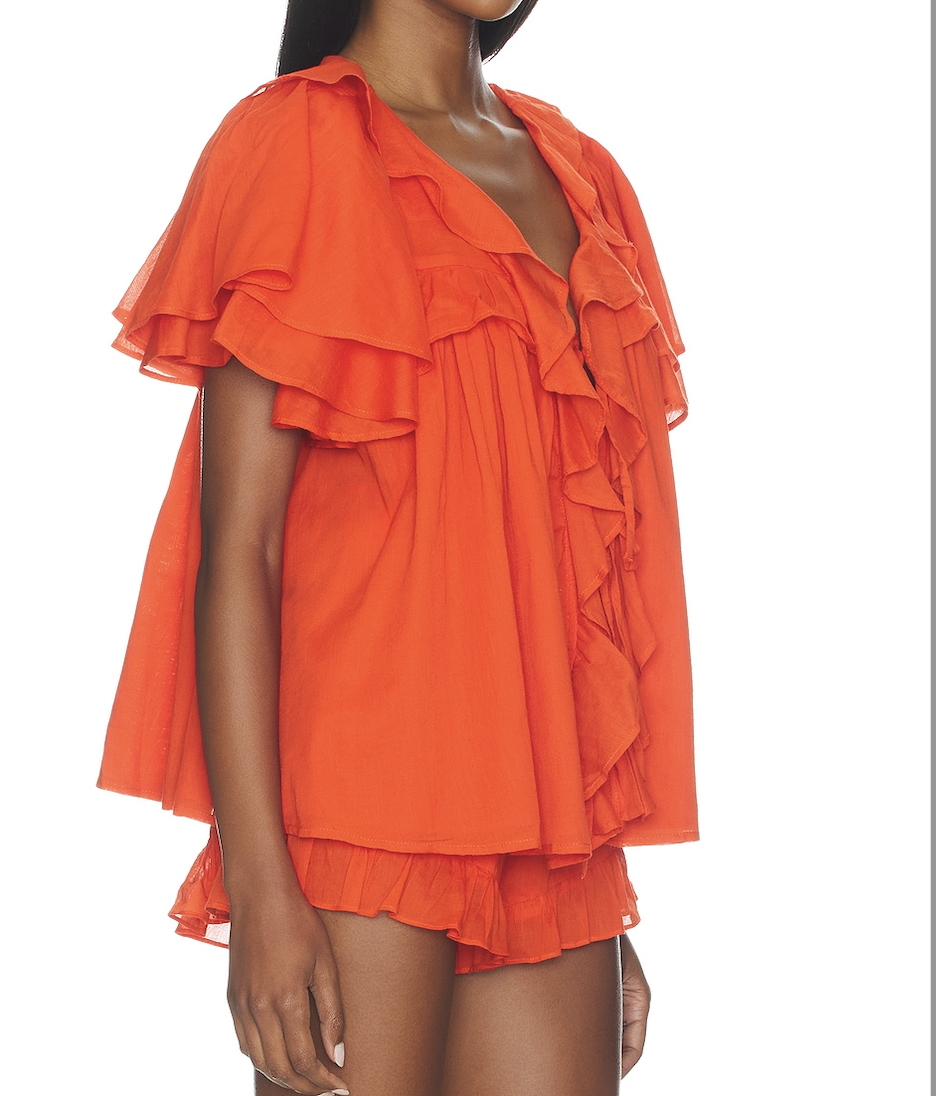
I see myself eating breakfast on a terrace in Italy.
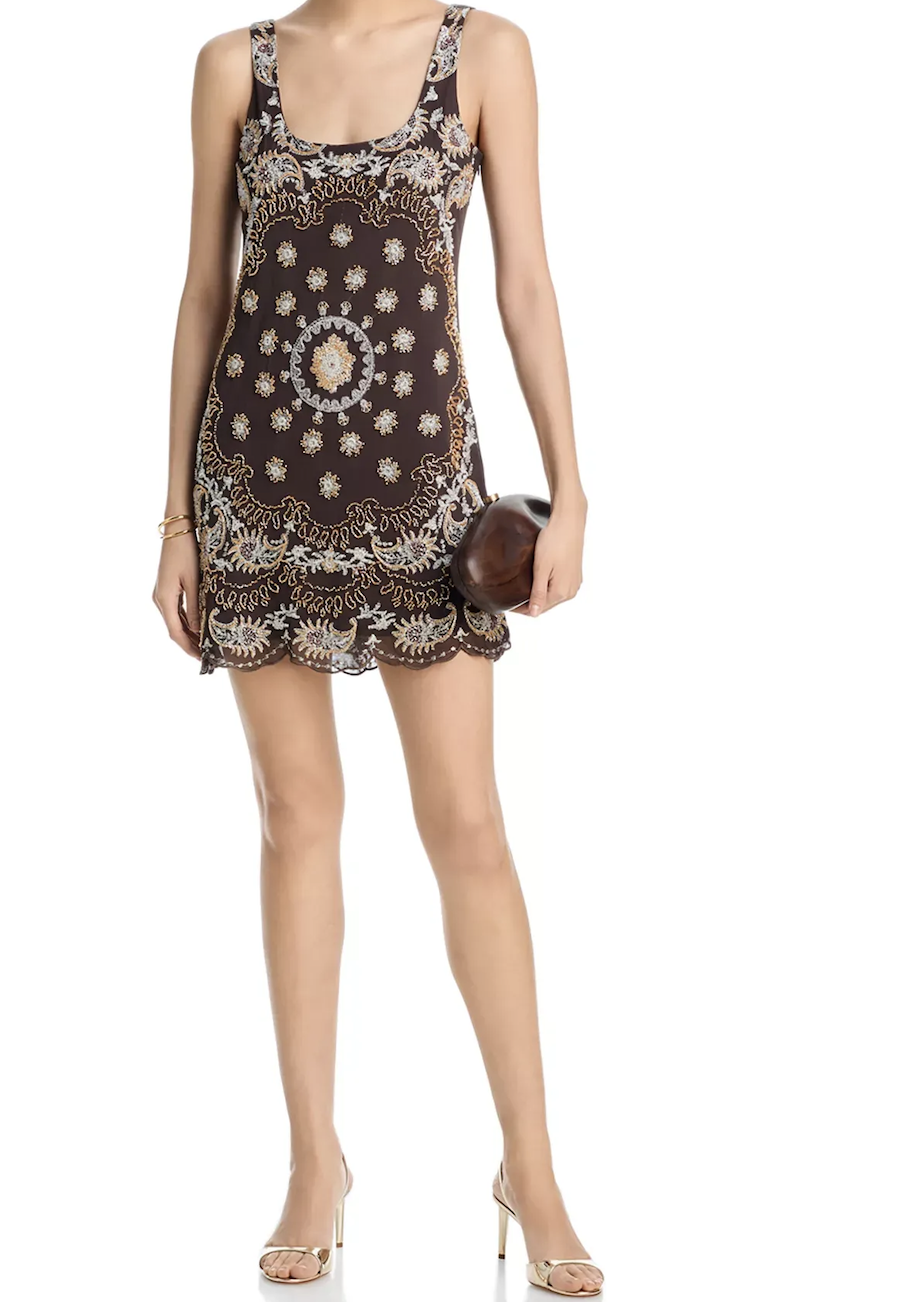
My American Girl Dolls would have definitely LOVED the beading on this dress
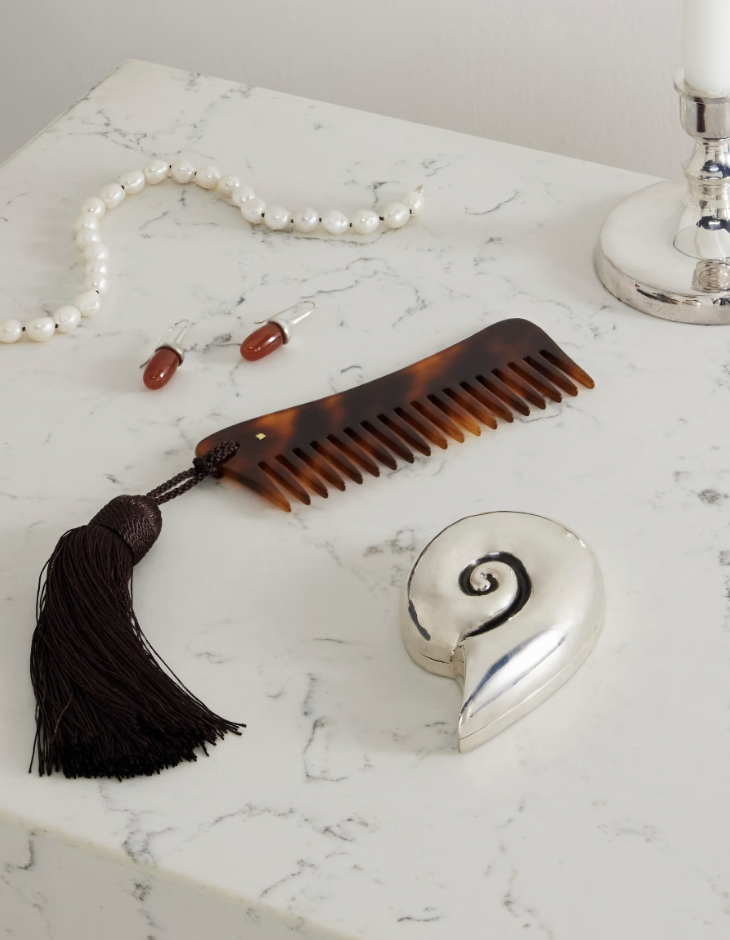
Little me always had a hair brush in her bag. This tasseled comb is the sophisticated version.
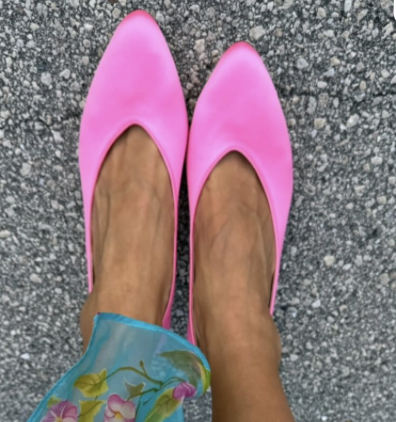
I saw these on Hannah Lovey and fell in love with the Polly Pocket color and shape.
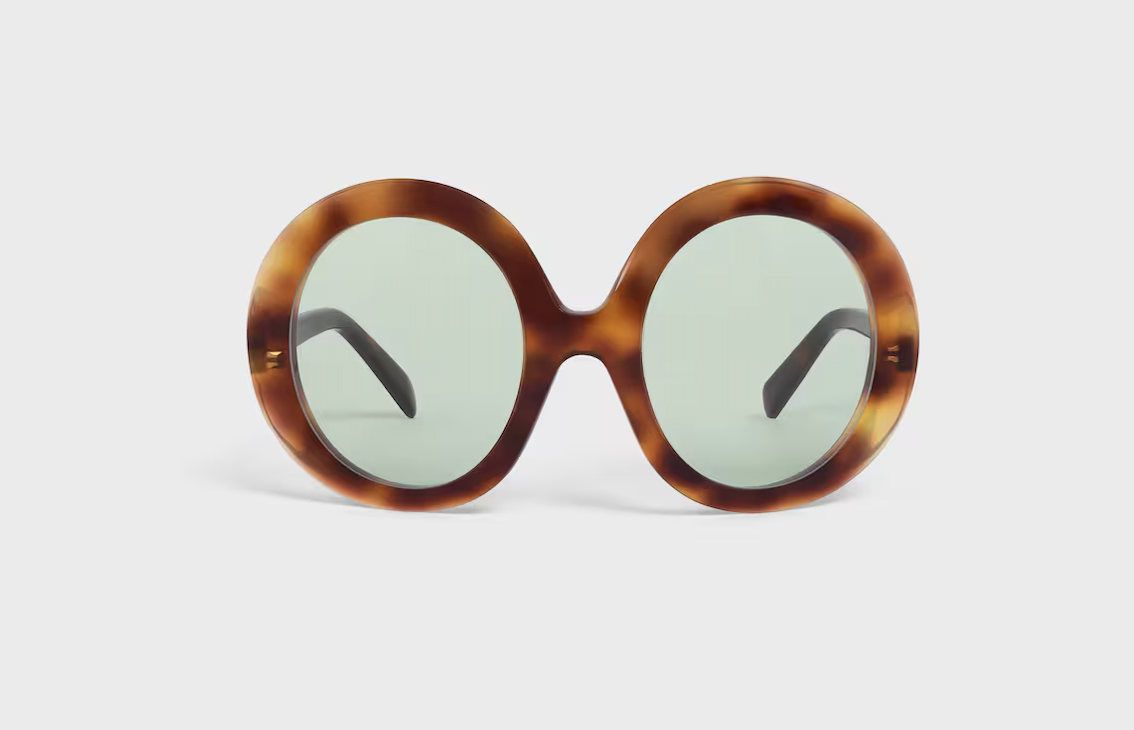
Big glasses are in and these are so funky and fun.
The fashion shows and tea parties only got cooler.
Xoxo,
Annie
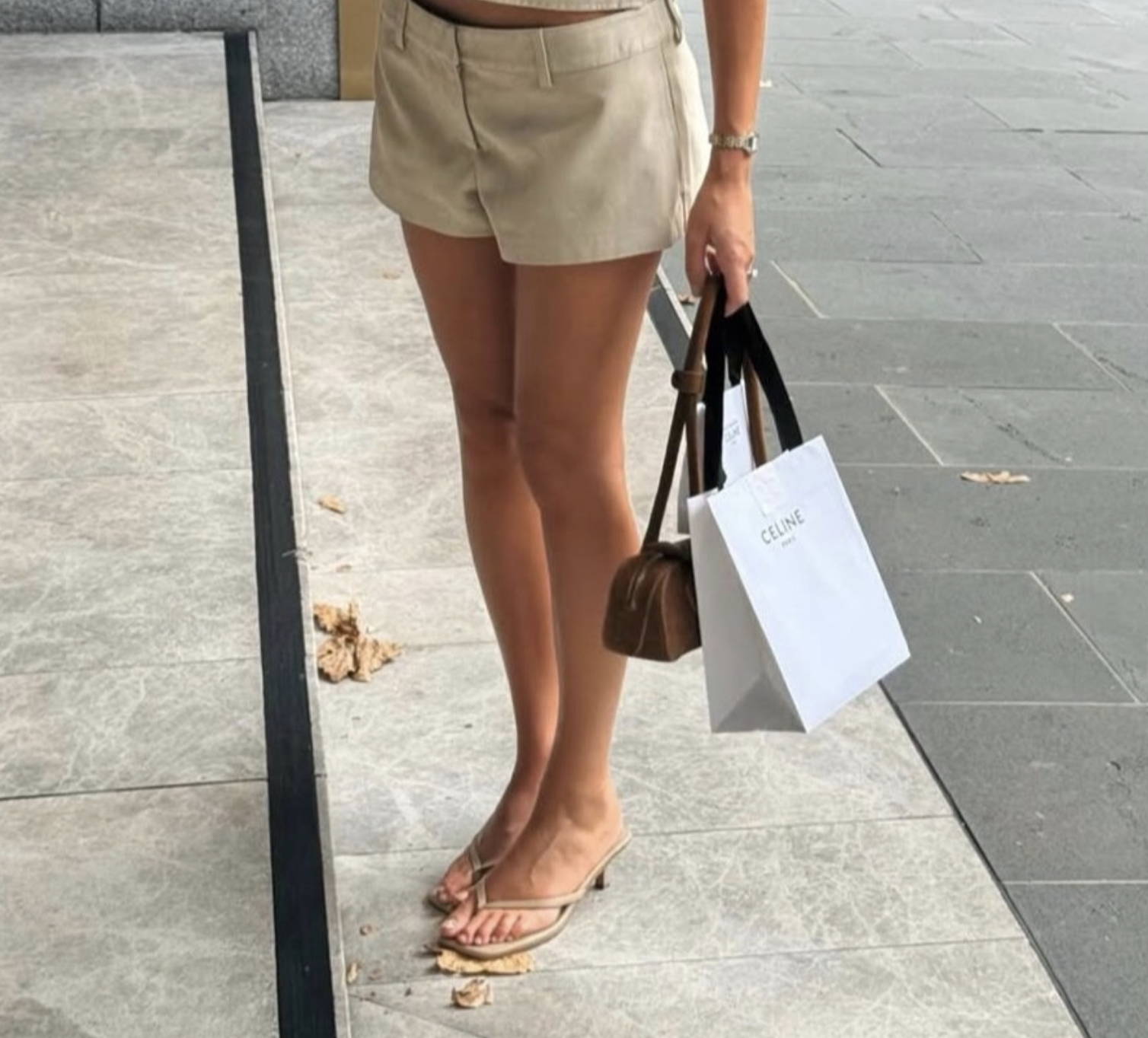
What I Am Wearing This June
It's June 2nd and I can already predict what the girls will be wearing for the rest of the month. New York City is absolutely buzzing with funky necklaces, satin pants, and boatneck tanks. Left and right I see strappy sandals, toe-cleavage ballet flats, and open-toe heels paired with capris and adidas zip ups. A new strain of the typical European resortwear style is making its way to the city and infecting the streets. I really do enjoy the hints of St. Tropez I am seeing at Bar Valentina and the new Le Dive location.
Below is a quick list of your June must-haves.
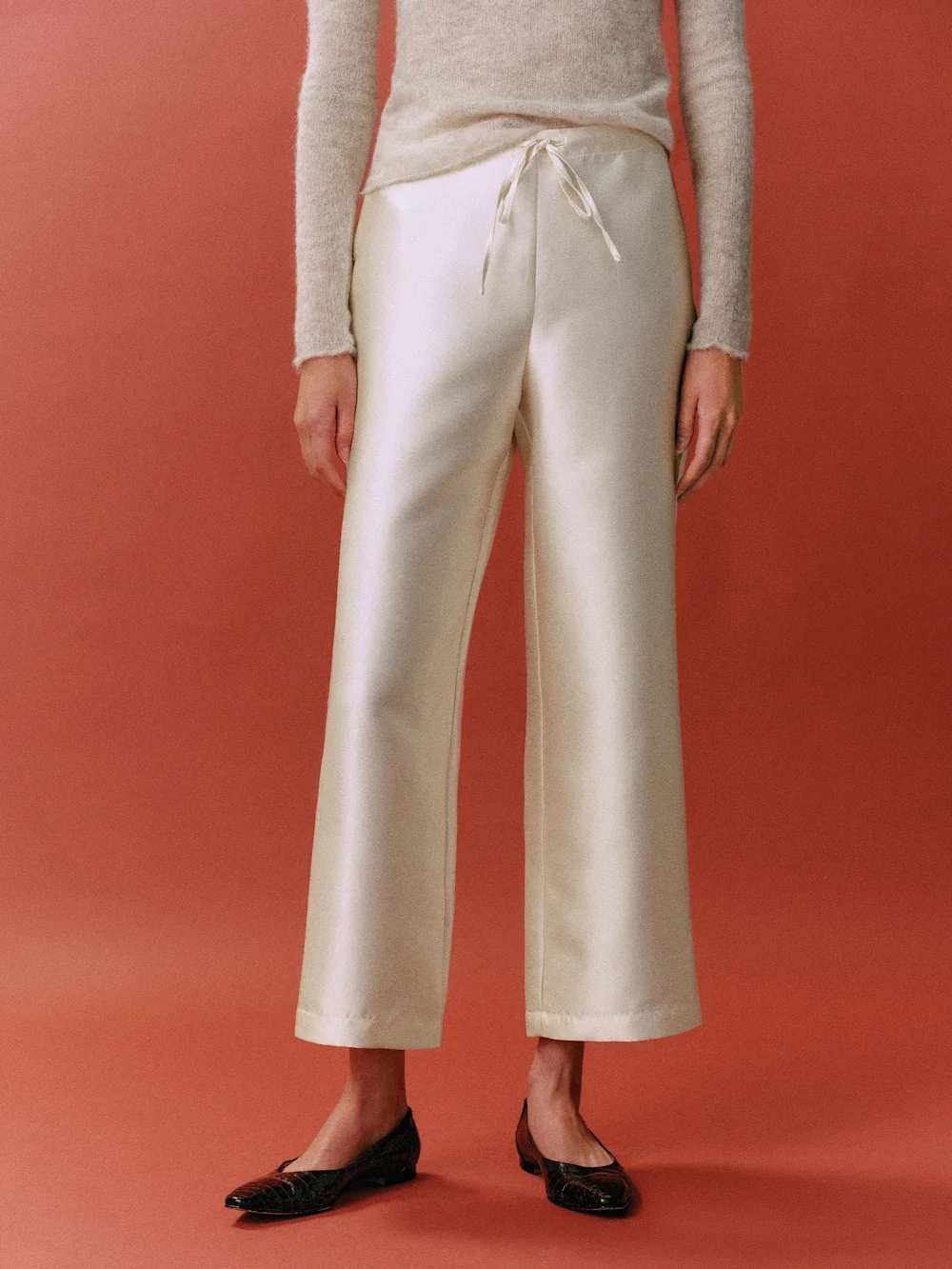
No hem needed!
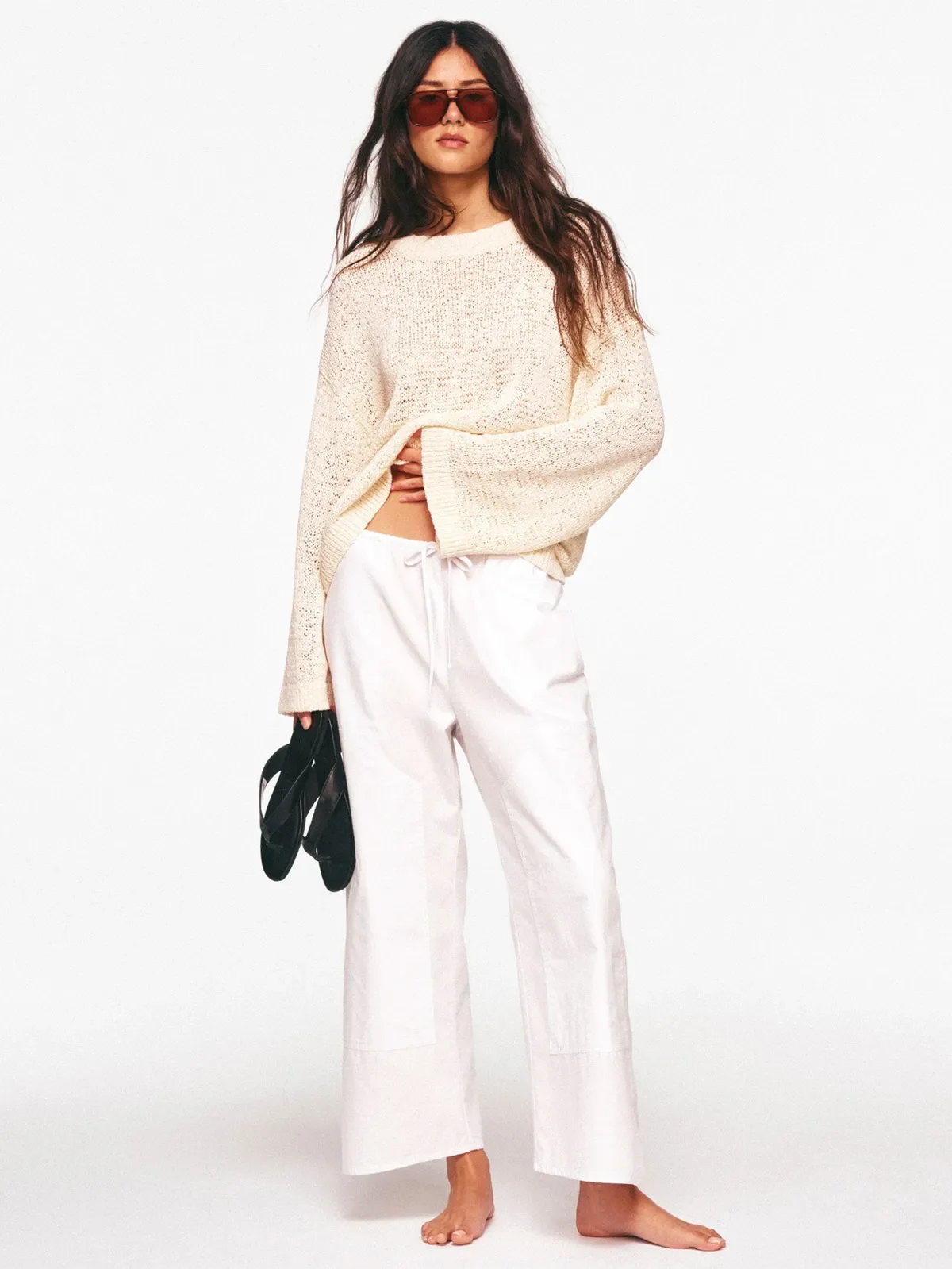
Currently wearing these over a bikini.
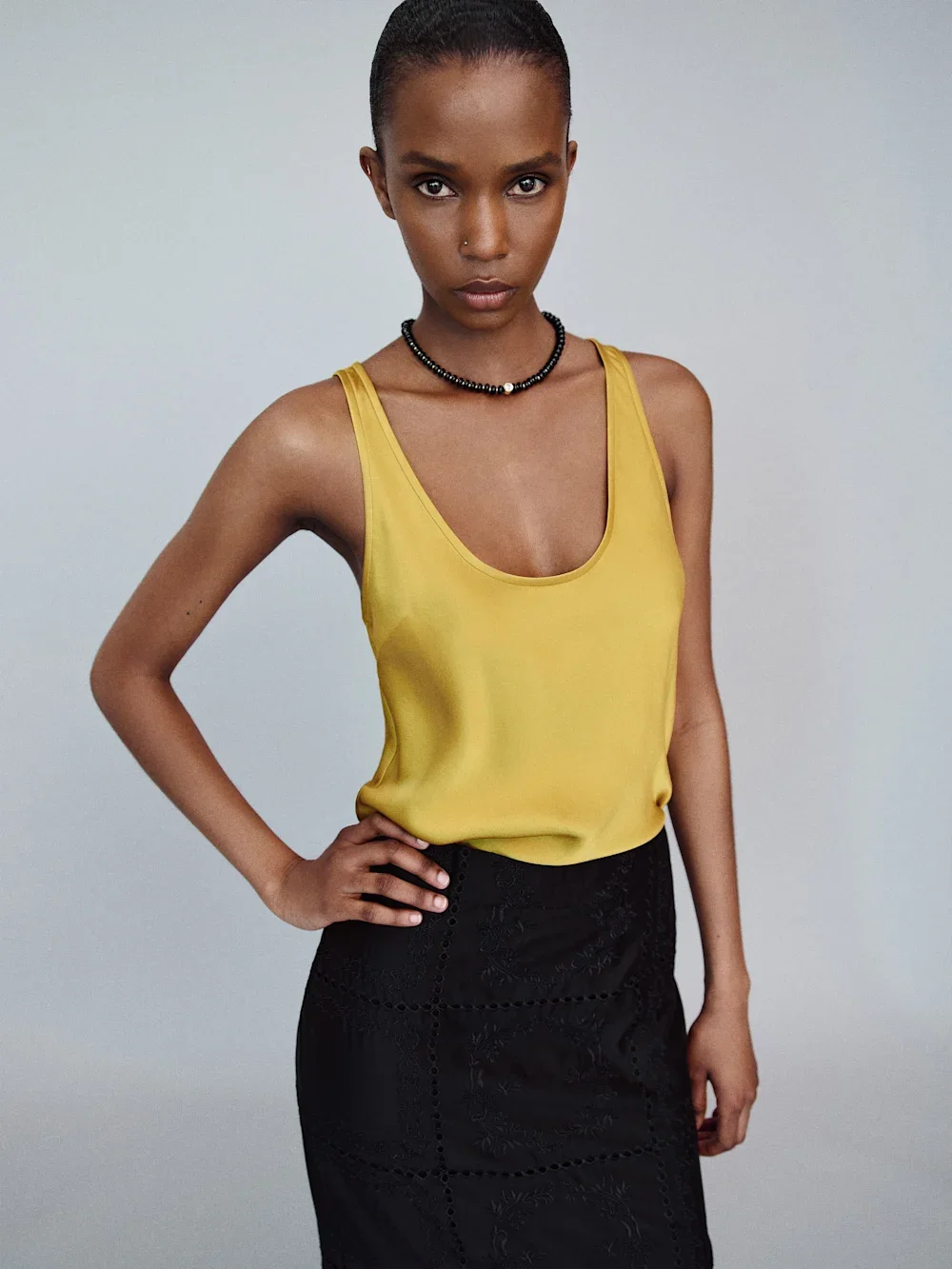
So flattering.
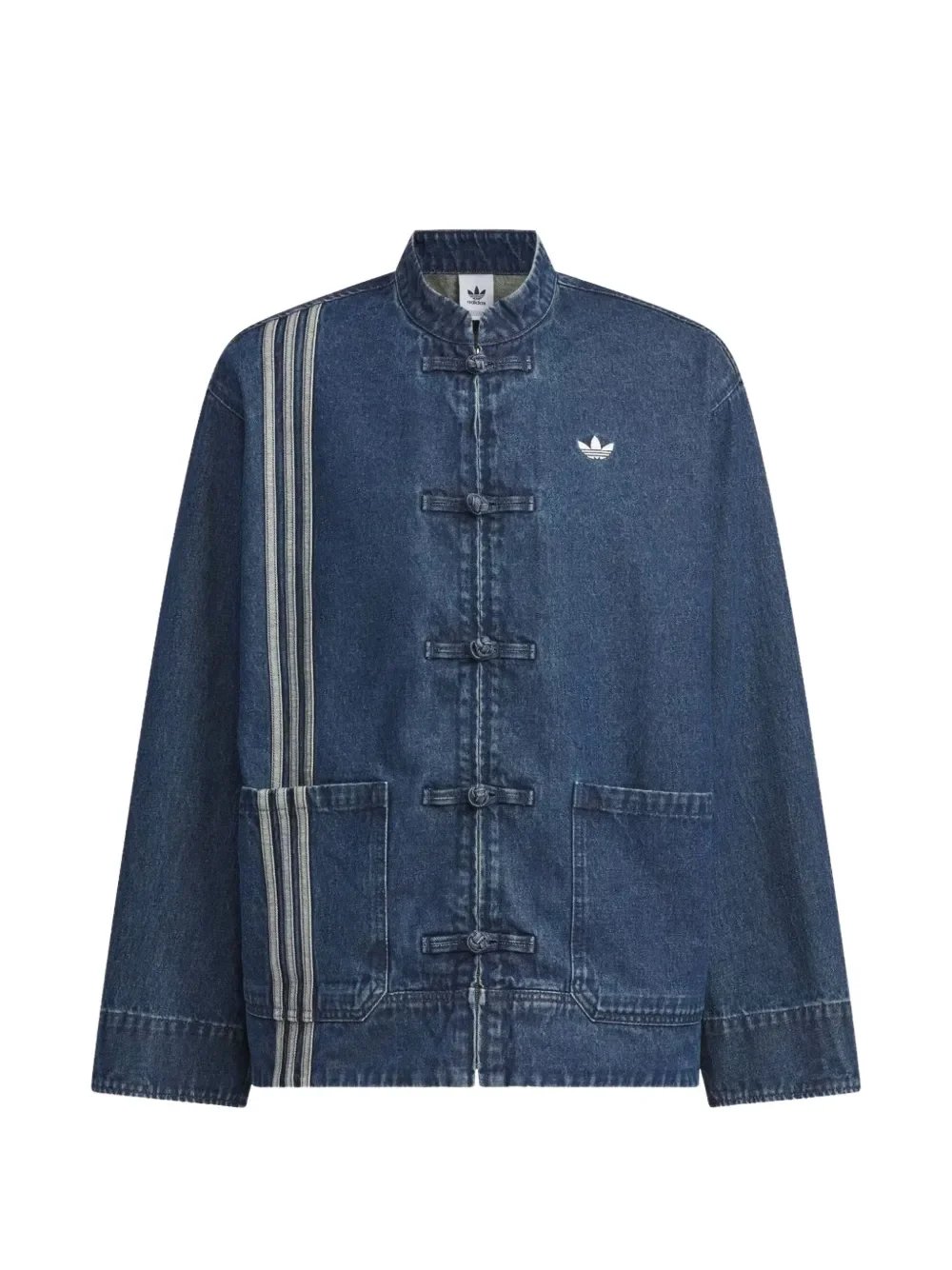
This is a neutral to me.
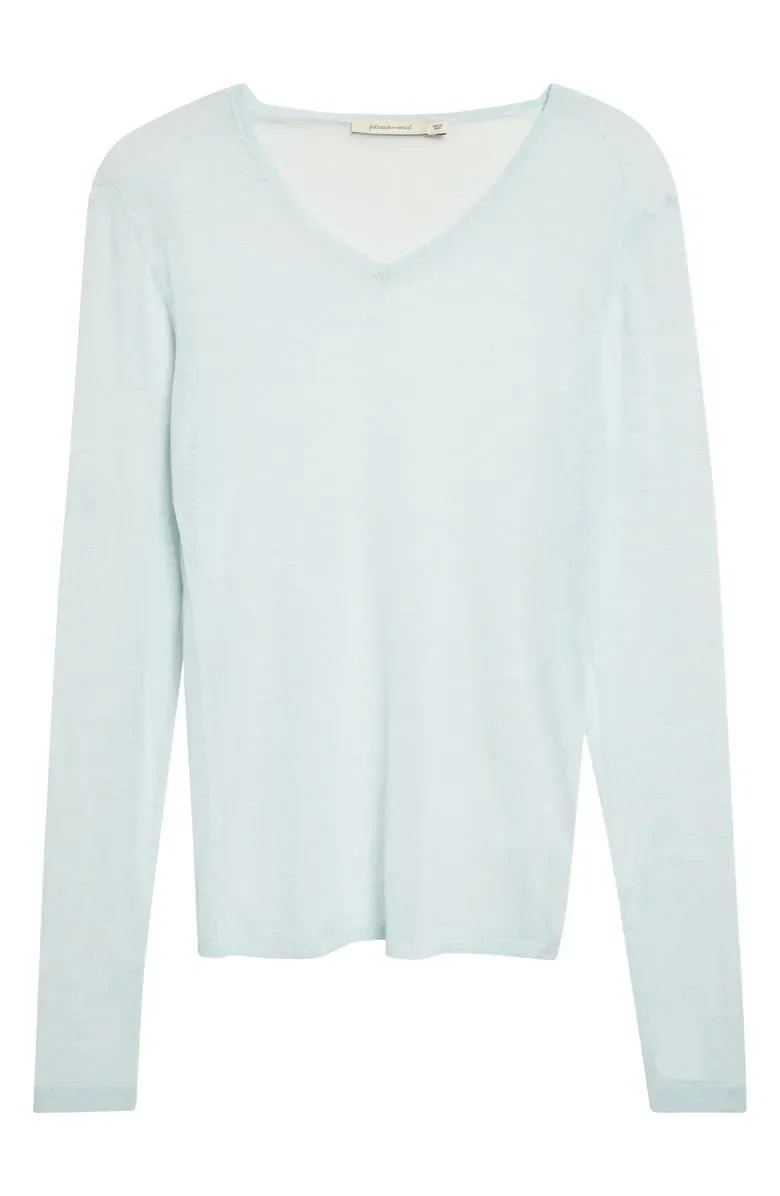
Perfect layering piece.
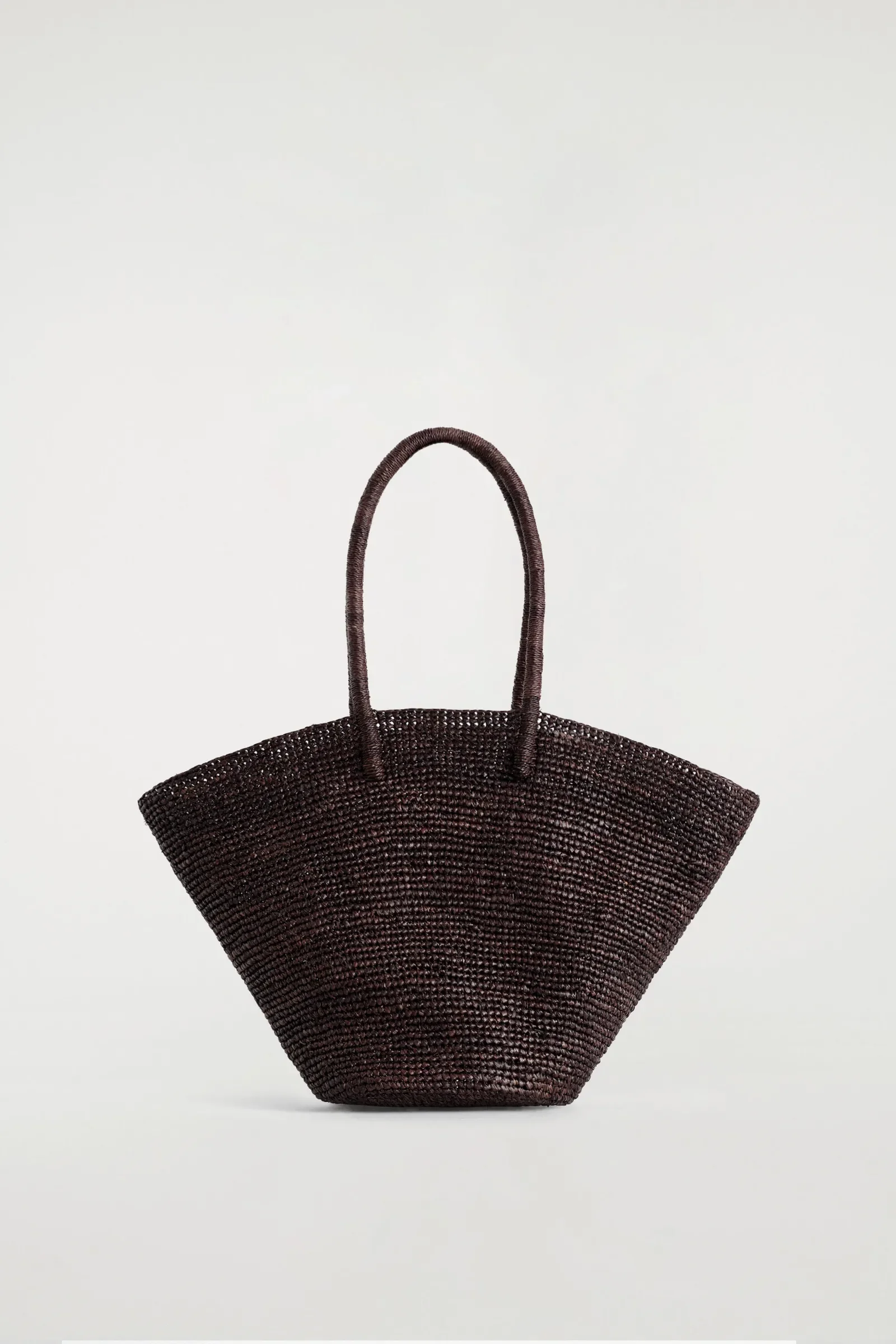
Wearing this around the city as if I am going to the beach.
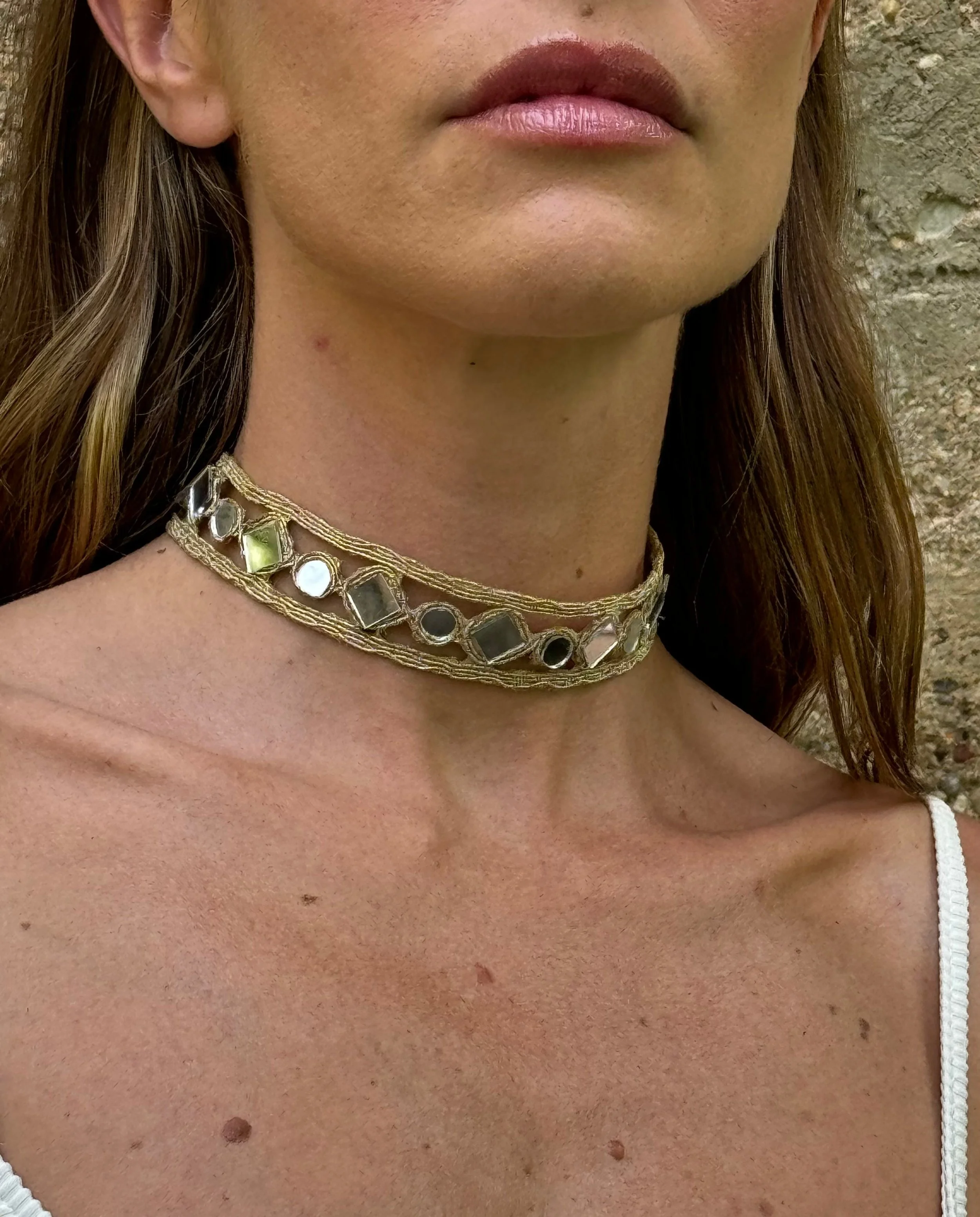
I pair these chokers with EVERYTHING.
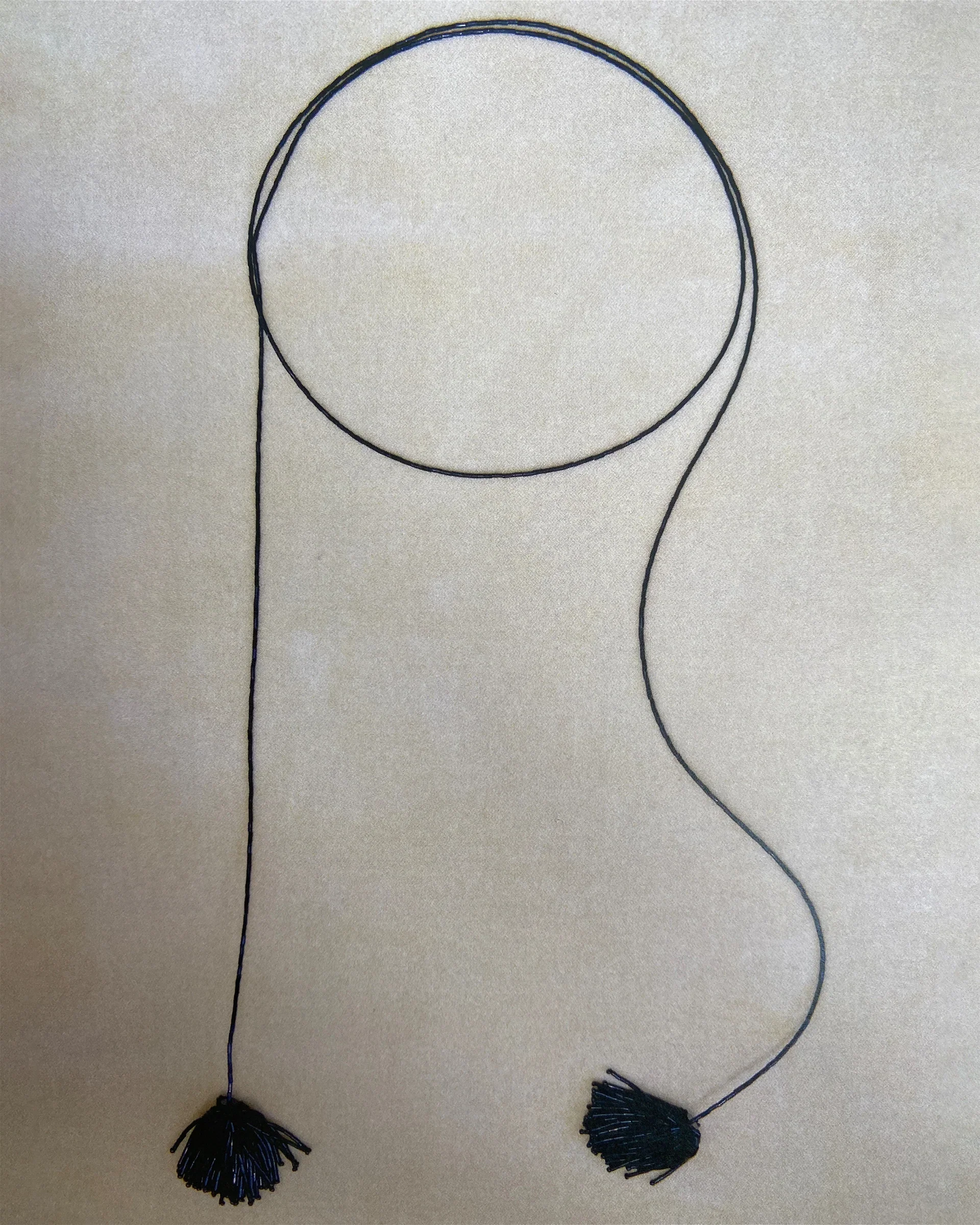
I saw this on a Substack once and now I am seeing it everywhere.
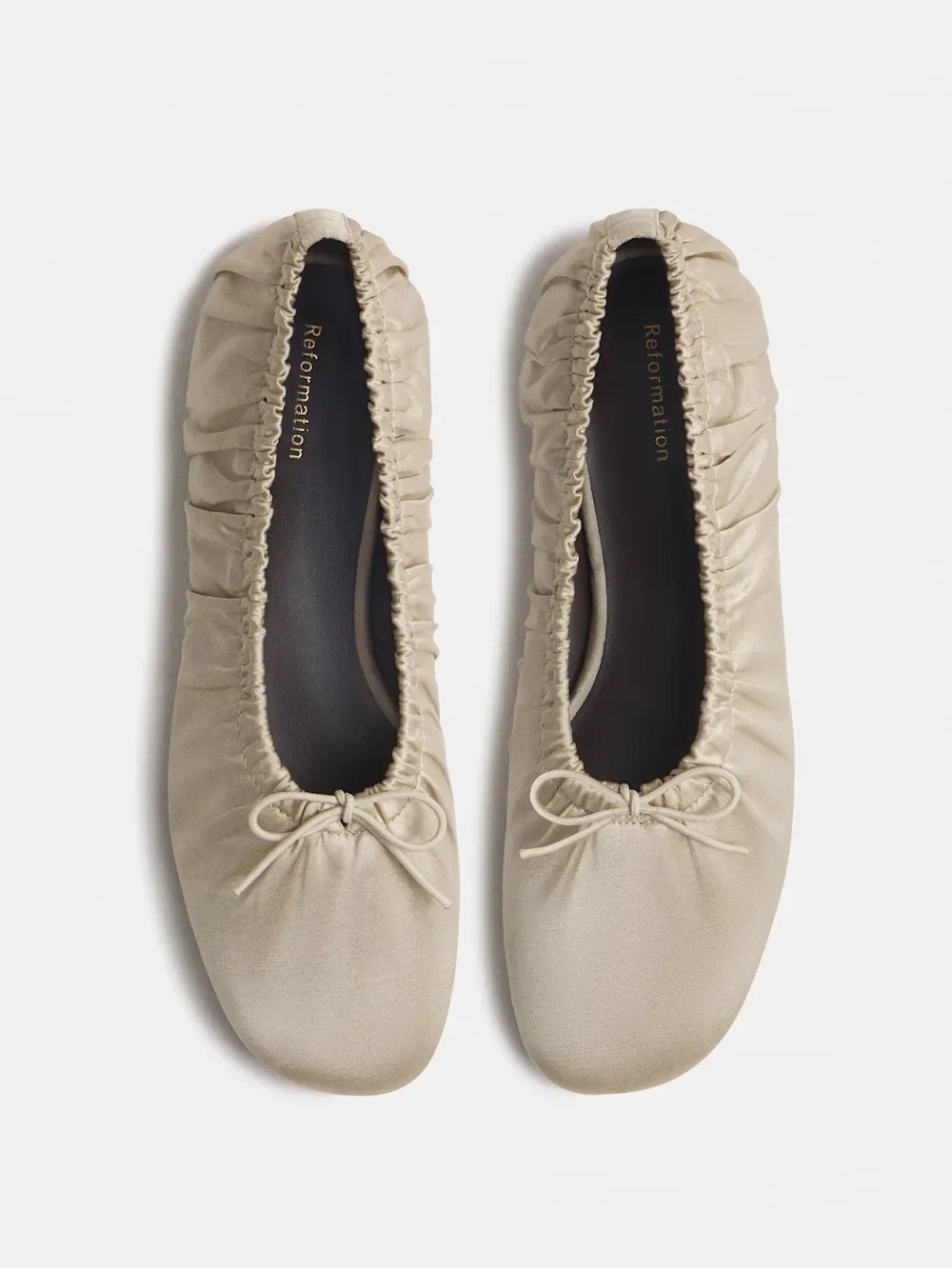
These do something to me.
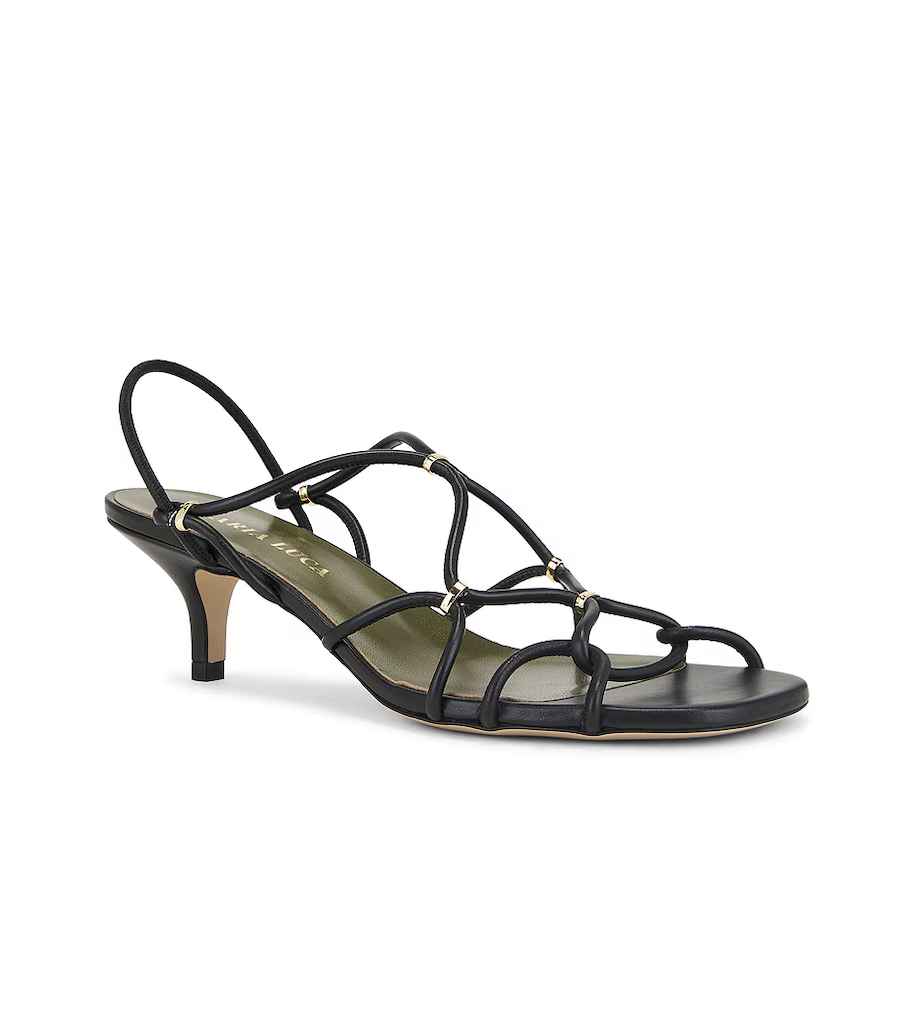
Wearing these for Euro summer.
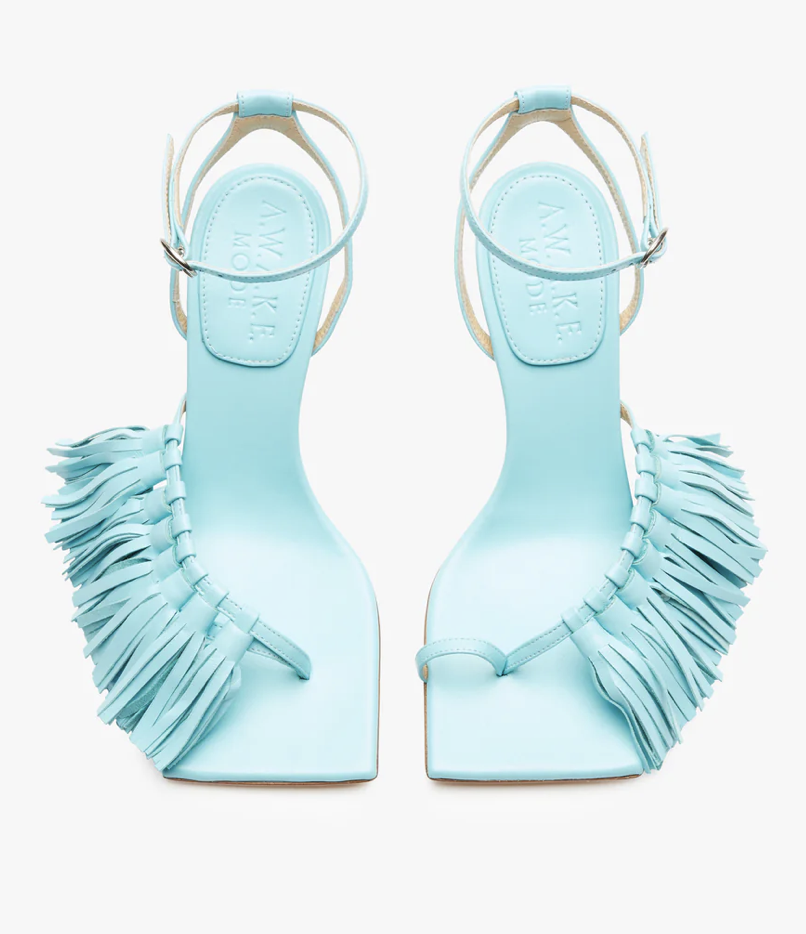
ISO!!!! These are sold out and I need them more than food or water.
I am feeling so inspired by all of these picks. Whether you are getting a post-work apperitivo anywhere or flying across the world, these are such fun looks to mix into your summer wardrobe.
That’s all for now! See you next week.
Xoxo,
Annie
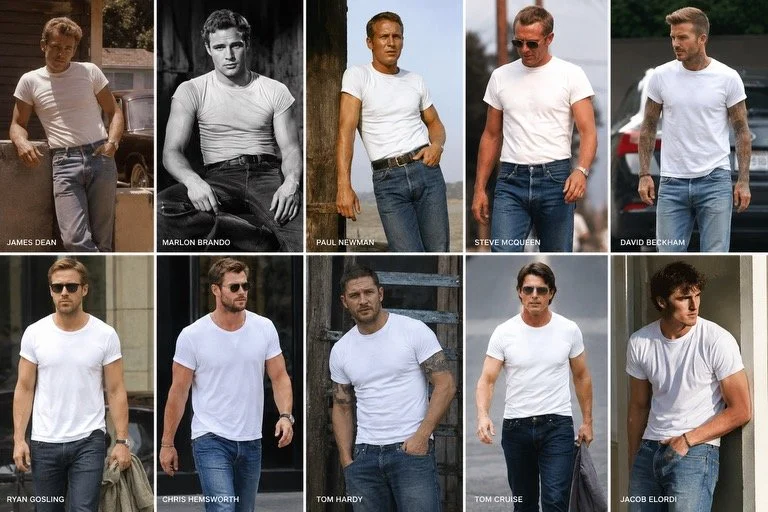
What Two Items Does a Man Truly Need In His Wardrobe?
This week's post is all about getting the basics right. The outfit most men wear every single day is also the one most men get completely wrong. Seb knows this better than anyone, so we toured the NYC stores, tried everything in person, and put together a definitive list of the best picks for 2026. I'll let him take it from here.
At some point, every man is told he needs two things in his wardrobe: a good suit and a good pair of shoes.
And yes, they matter. But for most men, that advice feels more like a social rule than a reflection of how they actually dress. Because when you are alone, when no one is watching, when you are not going to a wedding, a job interview, or some painfully formal dinner, you are probably not reaching for a suit.
You are reaching for jeans and a T-shirt.
And that is exactly where things often go wrong.
For something so simple, jeans and a T-shirt might be the most poorly executed outfit in the average man’s wardrobe. The jeans are badly sized, cheap, overwashed, and hanging on for dear life. The T-shirt is either shaped like a cardboard box, stretched beyond recognition, or covered in some strange graphic from an event you went to ten years ago and still cannot really explain.
And please, for the love of God, if you are reading this and thinking, “But it’s comfortable,” just know that comfort is not an excuse for looking like you got dressed during a fire drill.
Because when done well, jeans and a plain T-shirt are not lazy. They are not boring. They are one of the best outfits a man can wear. They make you look relaxed without looking careless, masculine without trying too hard, and stylish without screaming for attention.
If I may interject, I have some quick opinions on what makes the t-shirt and jeans combination attractive. A well-made t-shirt and quality jeans will flatter you in a way that no amount of effort can fake. It really is about the fit. A t-shirt that skims the shoulders and sits cleanly around the chest really does something unfair to a man’s silhouette. Paired with dark or mid-wash jeans, minimal detailing, and zero distressing, and you’re gold.
The truth is that if it fits well, you do not need anything else. Extravagance is easy, but wearing something simple and wearing it well actually takes understanding.
Think of it this way. Every woman understands the power of a little black dress. It is not covered in hardware or logos. A good black dress is a perfect, simple concept that, when it fits the way it is supposed to fit, turns heads.
The t-shirt and jeans are that for men. If done well, it transcends season, trend, or occasion.
Ok back to the professional.
Xoxo,
Annie
After years of making every possible mistake, outfits that were too elaborate, badly fitted, too trend-led, or just downright ugly, I have come back to the simplest answer. A plain T-shirt and a good pair of jeans is the outfit I trust more than almost anything else.
Brunch, lunch, dinner with friends, a walk in the park, a date, lounging at home, travelling, grabbing coffee, this outfit can do all of it. It is casual enough to feel natural, but if the fit, fabric, and proportions are right, it can still look incredibly considered.
That is what makes these two items so interesting. Neither began as fashion. Jeans started as workwear, built for miners, cowboys, railway workers, and labourers who needed something durable. Over time, they moved from utility into culture, becoming associated with rebellion, youth, film stars, rock music, and eventually everyday style.
The T-shirt has a similar story. It began as an undergarment, worn beneath uniforms and work clothes because it was practical, light, and easy to wash. Then, through figures like Marlon Brando and James Dean, it became something else entirely: a symbol of ease, confidence, and understated masculinity.
So this is not really an article about dressing up. It is about dressing well. It is about taking the outfit most men wear the most and making it look as good as it possibly can.
After walking around New York, trying things on, judging fits, debating washes, fabrics, collars, sleeves, and all the tiny details that make a simple outfit either brilliant or terrible, Annie and I have put together our favourite jeans and T-shirts for 2026.
These are the two items we believe every man truly needs in his wardrobe.
Jeans:
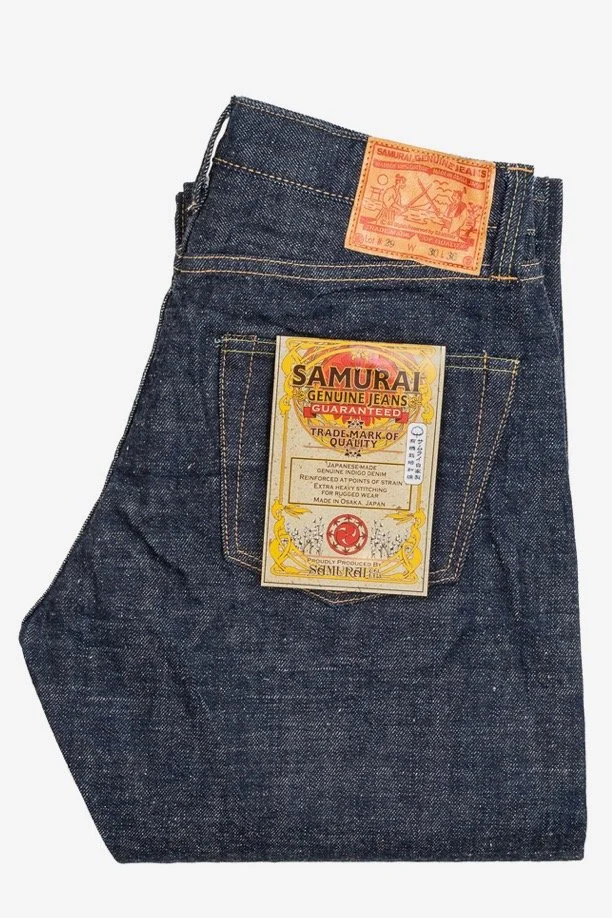
Samurai S510HXII Straight Leg- $377
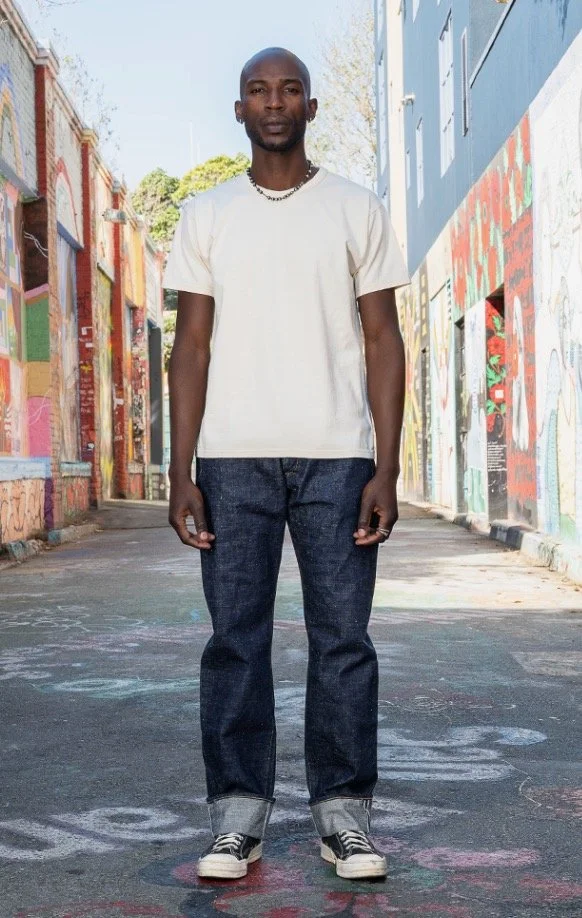
Samurai is one of those denim brands that, once you get into jeans properly, you start hearing about everywhere. It is a Japanese brand known for making serious denim: heavy fabrics, old-school construction, beautiful fading potential, and jeans that feel like they were built to outlive you.
These are hands down the best jeans I have ever owned.
I personally own the Samurai S510HXII 15.8oz Samurai Cotton GL3 Denim Jean, which does not exactly roll off the tongue, but it might be the perfect straight-leg jean. The first thing you notice is the quality. They are stiff, structured, and substantial. Not in an uncomfortable way, but in a way that makes you realise how bad most jeans are.
I hate cheap denim. You can spot it instantly. The leg flaps around the ankle, the shape collapses, and after a few washes it looks like the jeans have completely given up on life. These are the opposite. They hold their shape beautifully. They feel strong. They make a simple outfit look better because the fabric itself has presence.
The fit is what makes them so good. They sit well at the waist, have enough room through the leg, and avoid that skinny, strangled look that I think men should have left behind years ago. The straight leg feels classic without looking old-fashioned.
The denim itself is a rinsed 15.8oz selvedge denim woven on vintage GL3 shuttle looms. That basically means it has texture, weight, and character from the start. It blends Texas cotton in the warp with Samurai’s own cotton in the weft, giving it a deep indigo colour and a rugged hand feel that will only get better with wear.
I chose this colour because it works all year. It is dark enough for winter but not so dark that it feels too formal in summer. Wear it with a white T-shirt, a shirt, loafers, trainers, boots, whatever. It just works.
If you could buy one pair of jeans and wear them forever, this would be my pick.
3sixteen NY RS-100xk Relaxed Straight Leg- $290
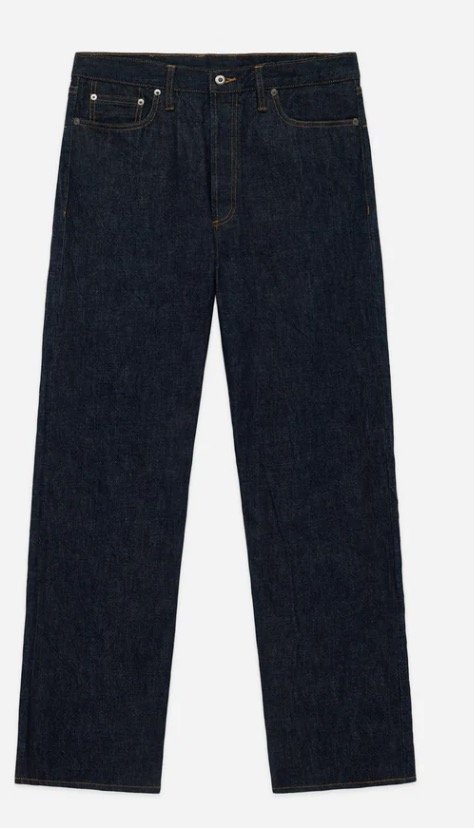
3sixteen is a New York-based brand that sits in that perfect space between denim nerd and genuinely wearable. Some raw denim brands feel like they are made exclusively for people who want to discuss fabric weight in a dark corner of the internet. 3sixteen manages to make serious denim that still feels modern and easy to wear.
The RS-100xk is their relaxed straight fit, and I love it because it gets the proportions right. It has a higher rise, more room in the thigh, and a wider leg opening, which makes it feel relaxed without looking sloppy.
What really draws me to this pair is the rinsed indigo. It looks different without trying too hard. You are not flashing a giant logo or screaming, “Look at my $300 jeans.” But people can tell they look better. That, to me, is the whole point of good menswear. The best simple items should look quietly expensive, not obviously expensive.
The denim is custom woven for 3sixteen by Kuroki Mills in Japan. It starts as loomstate raw indigo selvedge denim and is then rinsed to reduce shrinkage and bring out the texture of the fabric. The result is a jean that has character from day one but still has plenty of room to age and fade over time.
This is the pair I would recommend to someone who wants to get into better denim but does not want anything too intimidating. They are still proper jeans, but the relaxed fit makes them comfortable, wearable, and easy to style.
They look best slightly broken in, with a clean cuff or a little break over the shoe. Simple white T-shirt, good trainers, maybe a jacket over the top. Done.
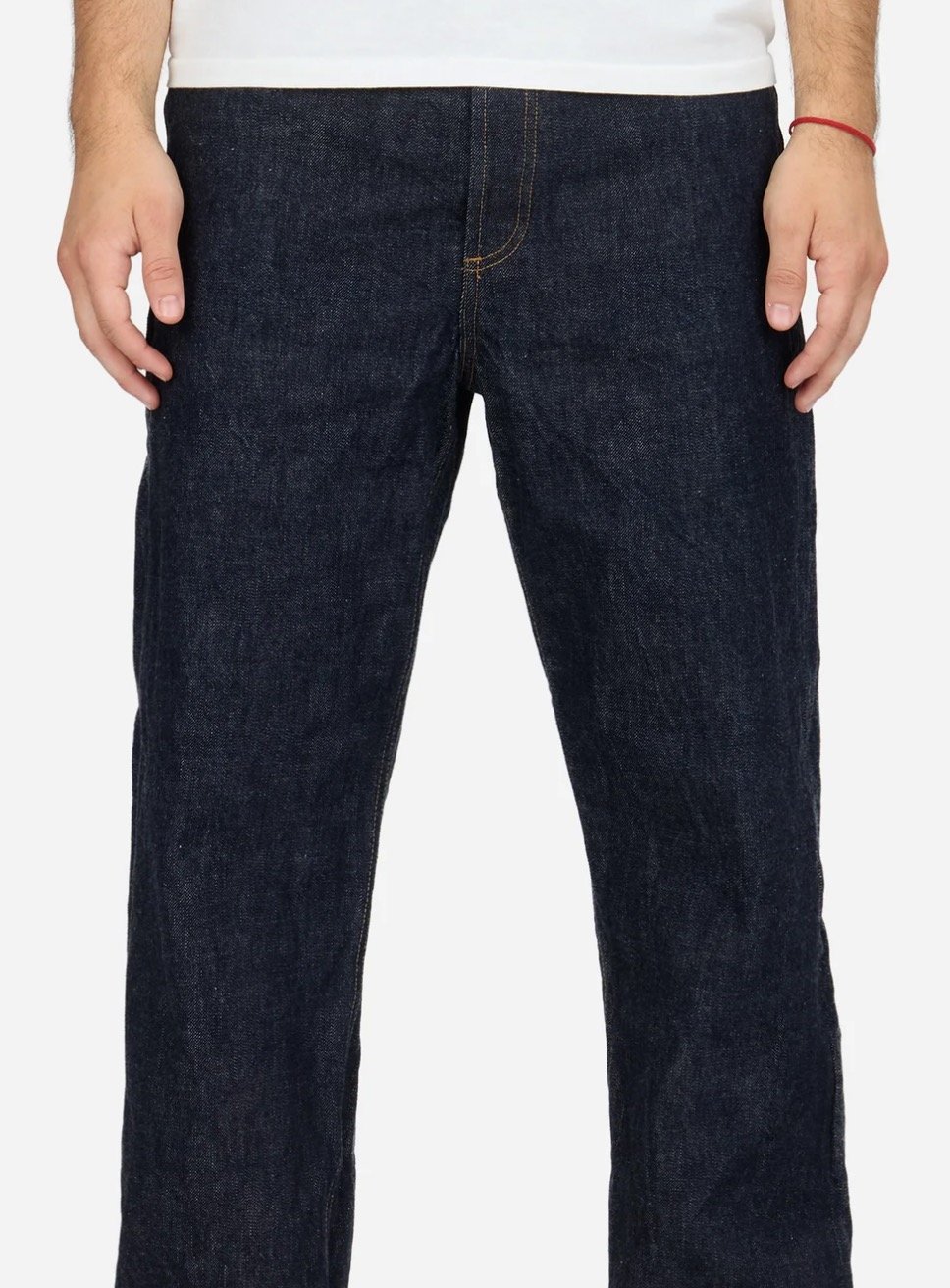
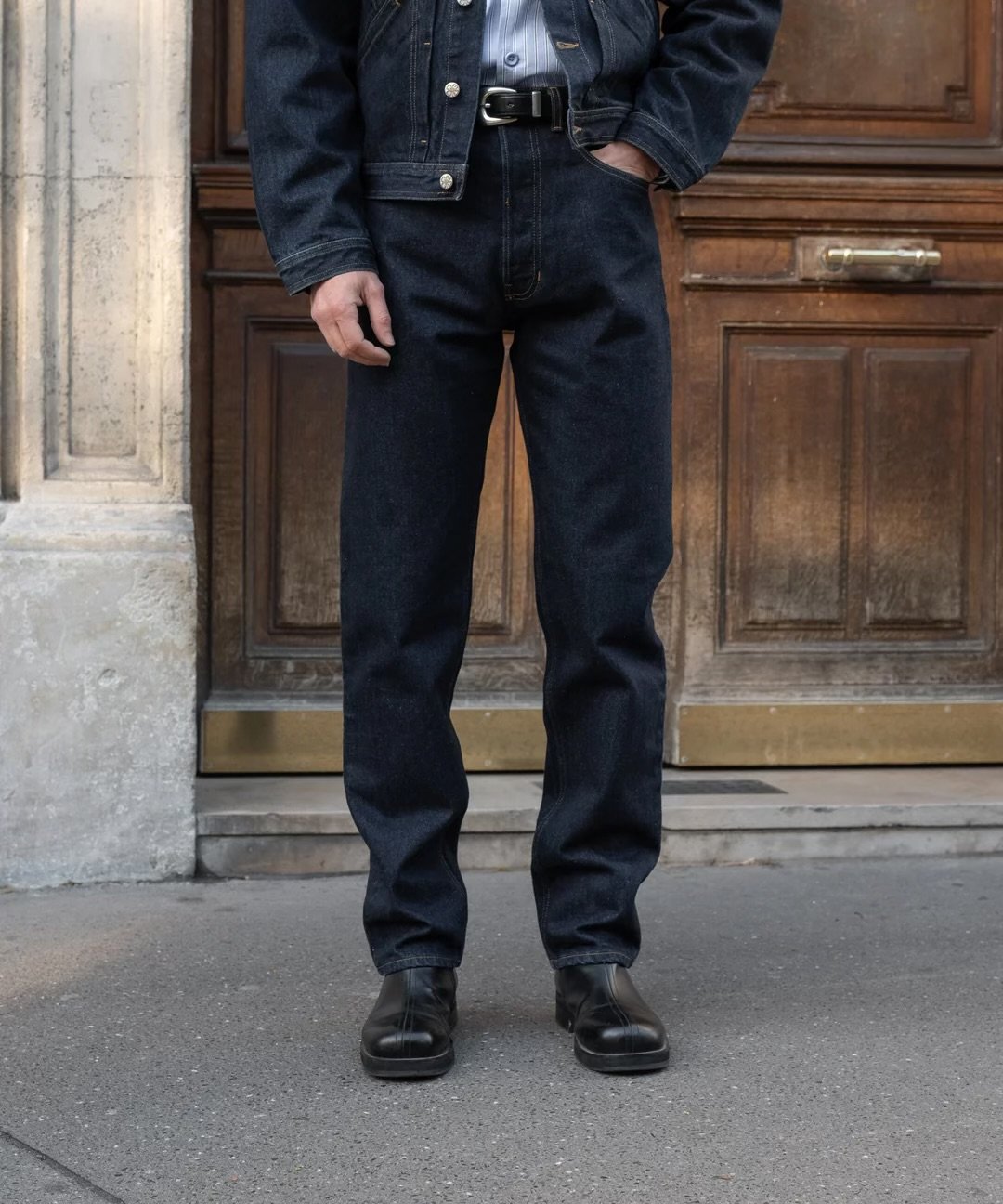
Brut Archives The Best Denim- $225
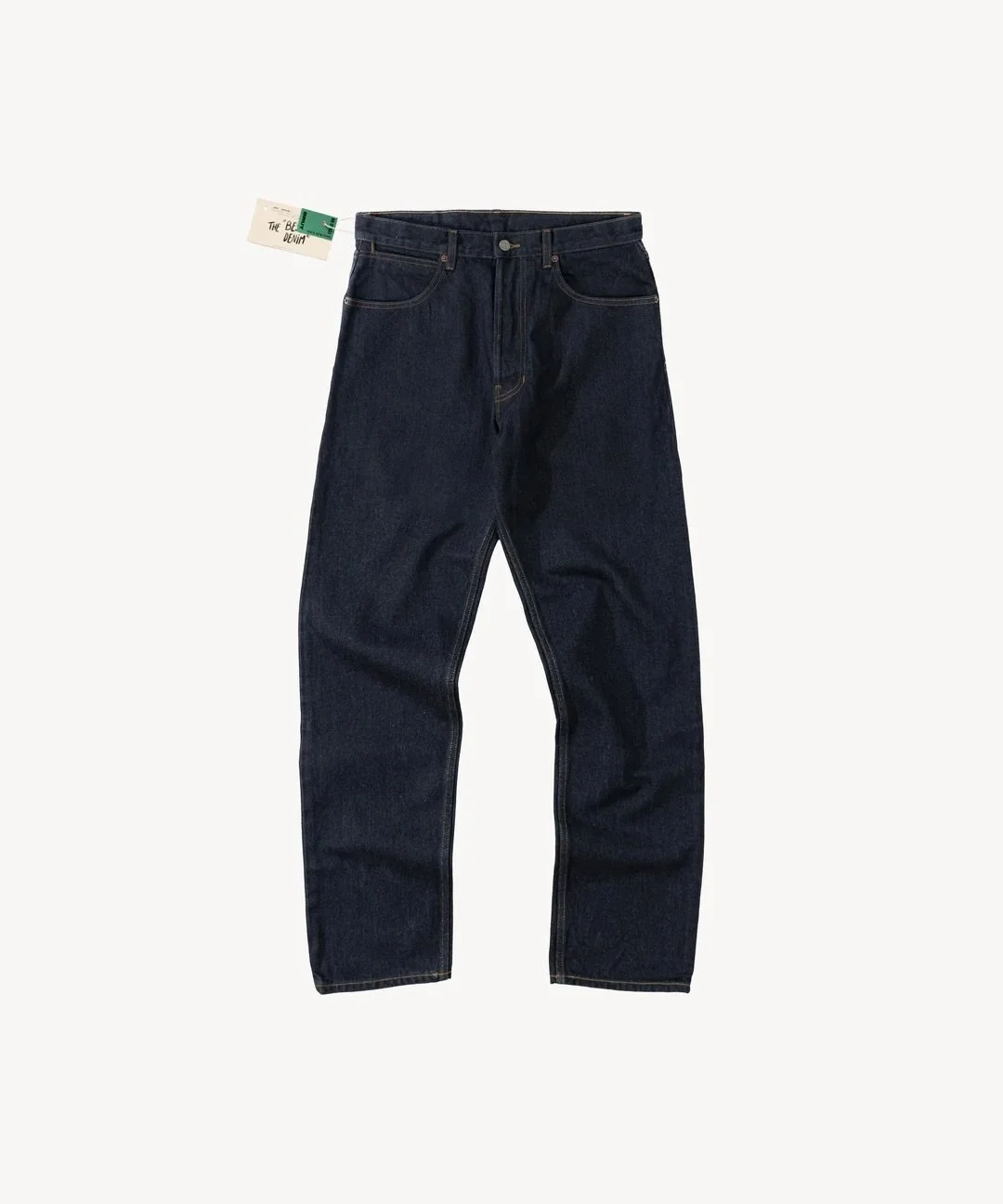
Brut Archives is such a cool brand. It is Paris-born, New York-inspired, and built around the idea of taking vintage and archival clothing seriously without turning it into costume.
The brand came from Paul Ben Chemhoun’s obsession with French workwear. Before Brut became a clothing brand, it was a private archive of old uniforms, workers’ jackets, military clothing, outdoor garments, and denim. Over time, that archive became a reference point for major fashion houses and brands looking for historical accuracy and authenticity.
That background matters because these jeans feel considered. They are not just another pair of dark denim jeans. They have that sense of history and design behind them.
These are my “smart casual” jeans. The dark colour and clean fabric make them perfect for when you need to throw together an outfit that looks sharper without becoming formal. I like the relaxed feel, but they still look polished. They are the kind of jeans you could wear to dinner, drinks, or anywhere you want to look like you made an effort without looking like you tried too hard.
Unlike the Samurai or 3sixteen pairs, these are softer from the start. That makes them easier if you do not want to deal with the whole raw denim wearing-in period. No painful first few weeks. No walking around like your legs are trapped in cardboard. They are ready to go immediately.
The fit is high-waisted with a tapered leg, which gives a clean silhouette without being tight. They also have a button fly, five-pocket design, and an upcycled synthetic back tab. It is simple, but with enough detail to make them feel different.
This is the pair I would buy if you want a darker jean that can do casual and smart casual equally well.
Honourable Mention:
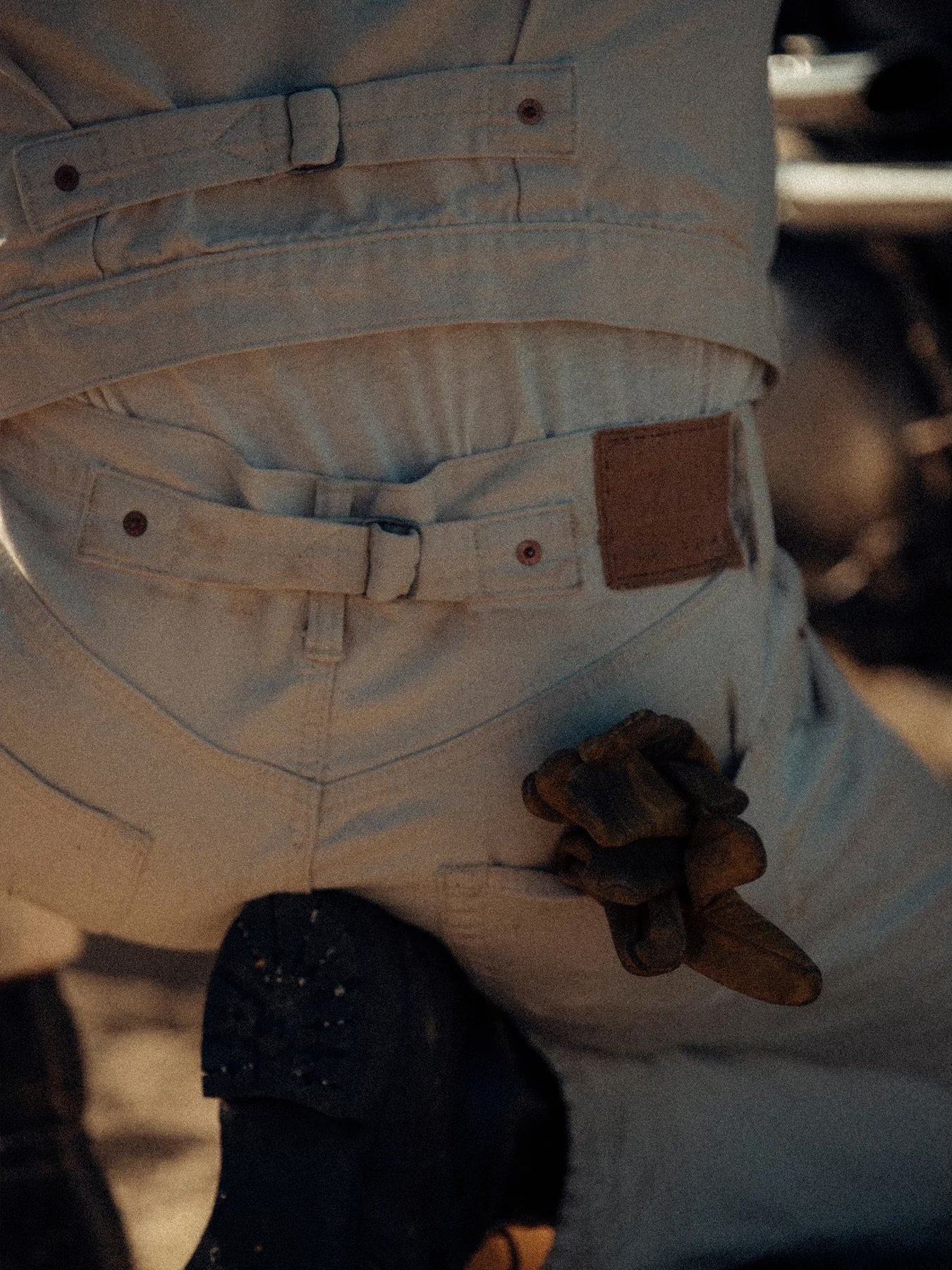
Buck Mason- Buckleback Big Jean
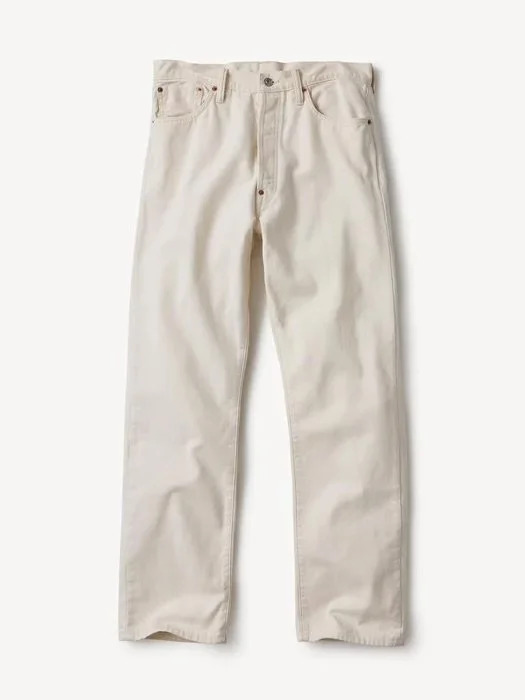
Buck Mason is one of those brands I keep coming back to. If you have spoken to me about clothes before, you probably already know I love it.
To me, Buck Mason does western-inspired clothing with a slightly preppy twist incredibly well. It has that rugged Americana feeling without becoming fancy dress. I also think it often gives you the feeling of brands like RRL, but at a price that feels a bit more reasonable.
The Buckleback Big Jean is just awesome. I picked these up recently while Annie and I were exploring the best jeans, and I knew immediately they were going to be a summer staple.
The straight leg is perfect because I cannot think of anything worse than a tight pair of white jeans on a man. That is not a look. That is a cry for help.
What I really like is that they are not a bright, pearly white. They are more natural, more off-white, and much easier to wear. This is also helpful because, let’s be honest, you are eventually going to spill something on them.
The buckle-back is the detail that makes them special. It takes a very simple pair of jeans and gives them just enough character. That is exactly what I look for in good basics: not loud, not overdesigned, just a little bit better.
T-shirt’s:
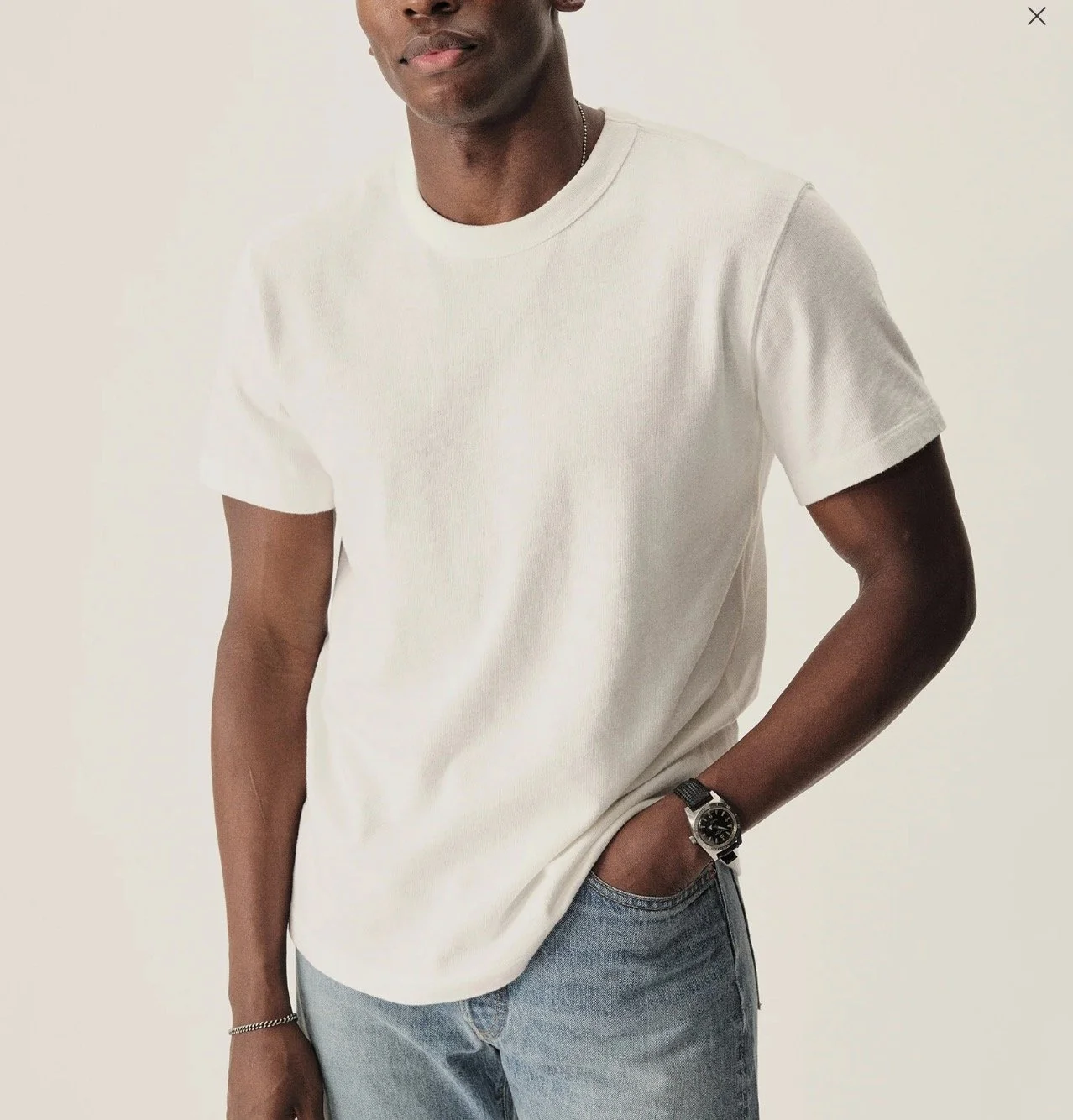
Buck Mason Field-Spec Cotton Heavy Tee- $62
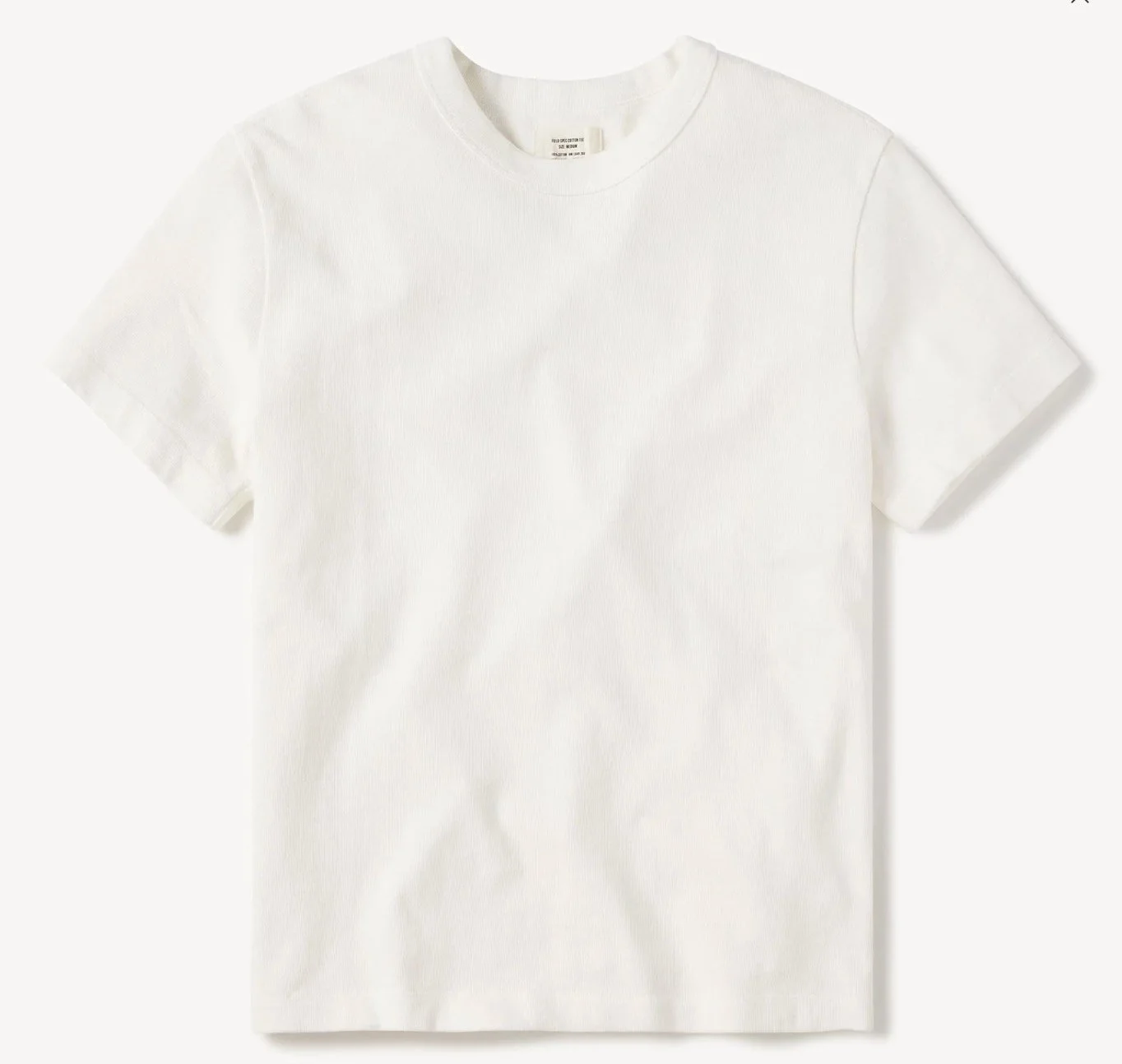
To me, this is the definitive best T-shirt in the world.
Never has a piece of clothing I own been complimented more, which I do not know whether to find encouraging or deeply depressing considering how much money I have spent on more elaborate pieces.
I have been wearing these T-shirts for over a year now, and as many men know, white T-shirts usually do not last very long. After constant washing, pit stains, red sauce, sweat, and general life, most white T-shirts are finished after three months.
These are still going strong.
They wash incredibly well and, do not tell my mum, but they barely need ironing. The fabric has enough weight to sit properly on the body, but it does not feel like you are wearing a sweatshirt. It fits the body without being tight. It shows just the right amount of bicep. It sits well around the shoulders. The neck is loose enough that you do not feel strangled, but not so loose that you look like you are trying to show the world your chest.
The length is also perfect. It is not so short that gaining two kilos suddenly turns it into a crop top, but it is not so long that someone might mistake it for a dress. It sits exactly where a T-shirt should sit.
This is the T-shirt I would tell almost anyone to buy first. It is simple, durable, flattering, and genuinely worth the money.
As long as Buck Mason keeps making it, I will keep buying it.
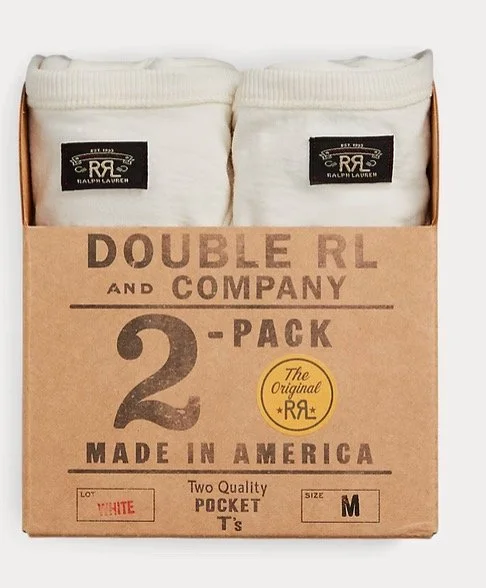
RRL Garment-Dyed Pocket T-Shirt 2-Pack- $175
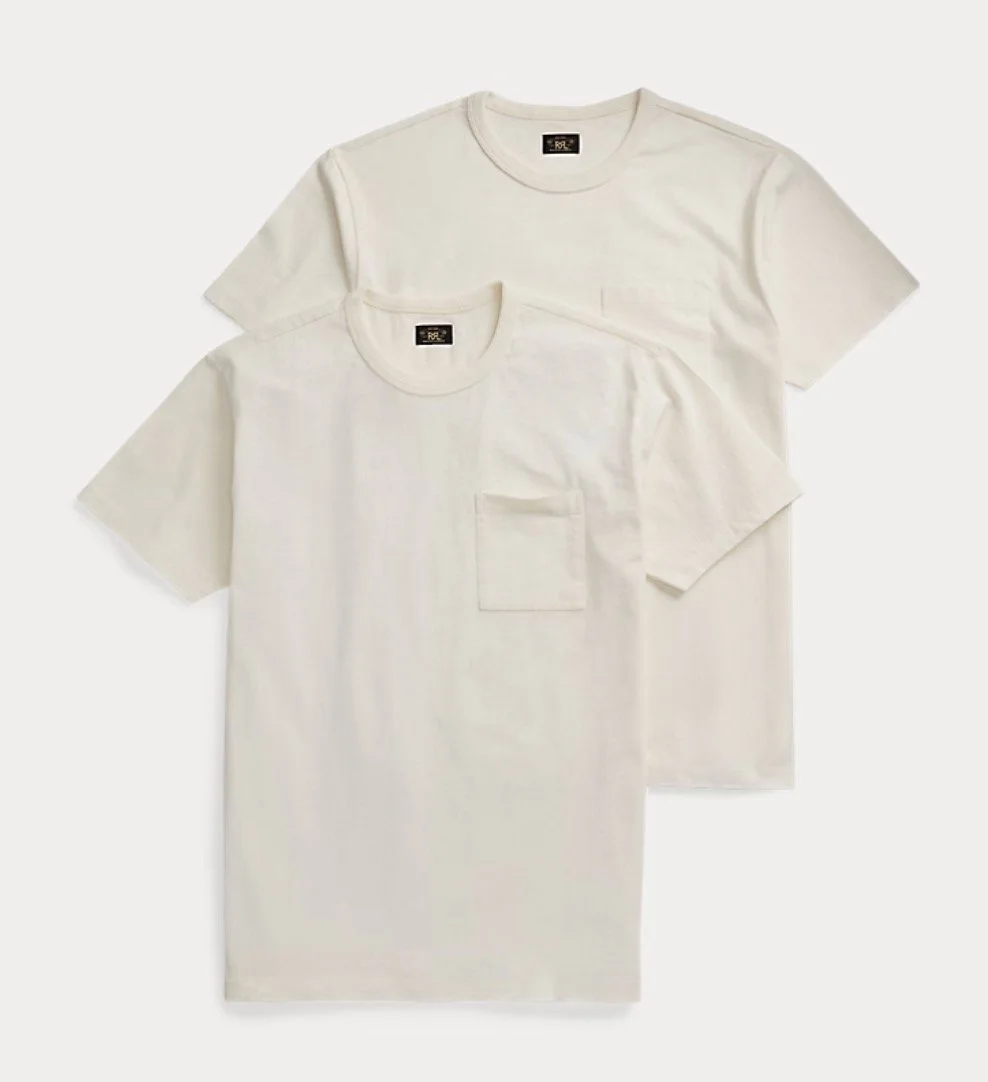
If you have ever spoken to me about fashion, you will know that RRL is probably my favourite brand.
I love everything about it. If I could make my house look like the RRL Soho flagship store, I would do it tomorrow. The brand was born from Ralph and Ricky Lauren’s love of the American West after they bought their ranch in Colorado, and it draws heavily on western wear, workwear, military clothing, and the Ralph Lauren archives.
But the brand also has a more personal meaning to me. RRL was the first brand my mum designed for when she began her career at Ralph Lauren, so I have always had a bit of a soft spot for it.
This T-shirt is exactly what RRL does so well. It is rugged, slightly worn-in, and not a perfect bright white. That gives it a different feeling from a standard white T-shirt. It looks like something you have owned for years, but in the best possible way.
The pocket gives it a slightly preppy feel, which makes it incredibly versatile. You can wear it with jeans, chinos, shorts, a denim jacket, or under an open shirt. It feels casual but still considered.
The fit is also excellent. It compliments your body rather than clinging to it like a needy ex. The sleeves hit at the right point on the arm, showing just enough bicep to suggest you may have done curls before the date. The body sits nicely at the belt, which helps make your legs look longer.
Yes, it is expensive for a T-shirt. But it comes as a two-pack, it lasts, and it is one of those items you will reach for constantly. To me, that makes it a good fashion investment.
Because realistically, you can have all the statement pieces in the world, but if your T-shirts are bad, your outfits will never fully work.
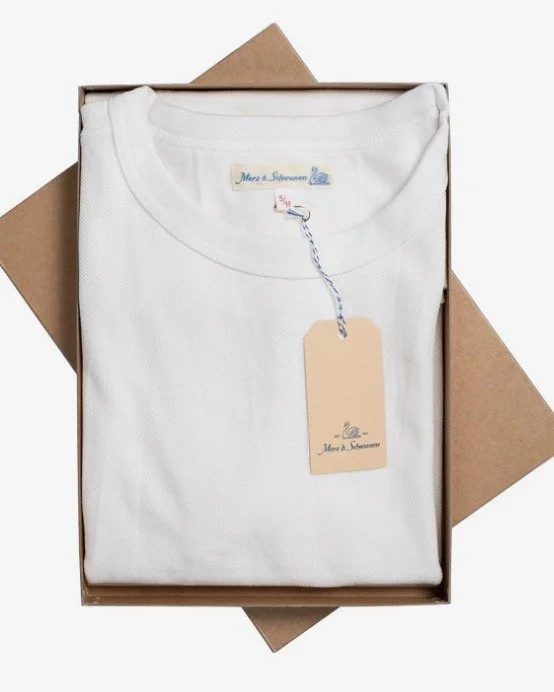
Merz b. Schwanen THREAD HEAVYWEIGHT T-SHIRT - COTTON PIQUE WHITE- $135
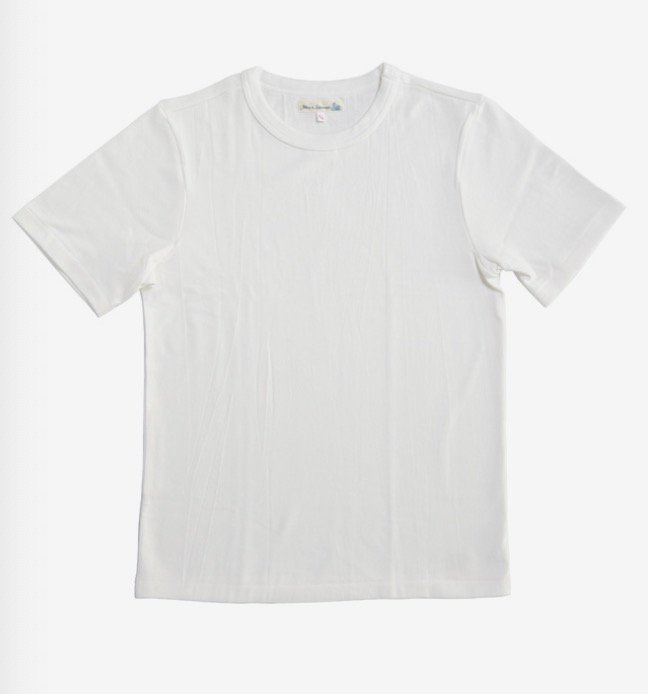
I am not going to lie to you. This is expensive for a T-shirt.
Merz b. Schwanen is a German brand famous for making old-school loopwheeled basics. Loopwheeling is a slower, traditional method of knitting fabric that creates a softer, more durable garment with a natural shape. It is the kind of thing that sounds ridiculous until you actually try on a T-shirt that has been made properly and realise there is a reason people care.
The brand became especially famous after Jeremy Allen White wore the Merz b. Schwanen 215 T-shirt as Carmy in The Bear. Suddenly, everyone wanted the perfect white T-shirt. And honestly, fair enough. It looked incredible.
The version I am interested in here is the heavyweight cotton pique T-shirt. What makes it interesting is the texture. It is still a white T-shirt, but the pique fabric gives it more depth and structure. It is not flat or flimsy. It feels more substantial, but because of the texture, it should still work in warmer weather.
This is the kind of T-shirt that makes sense if you already own the basics and want something a bit more special. It is not the first white T-shirt I would tell someone to buy. But if you care about fabric, construction, and fit, this is exactly the sort of piece that quietly elevates everything else you are wearing.
I cannot wait to add one to my closet.
Uniqlo Supima Cotton T-Shirt- $25
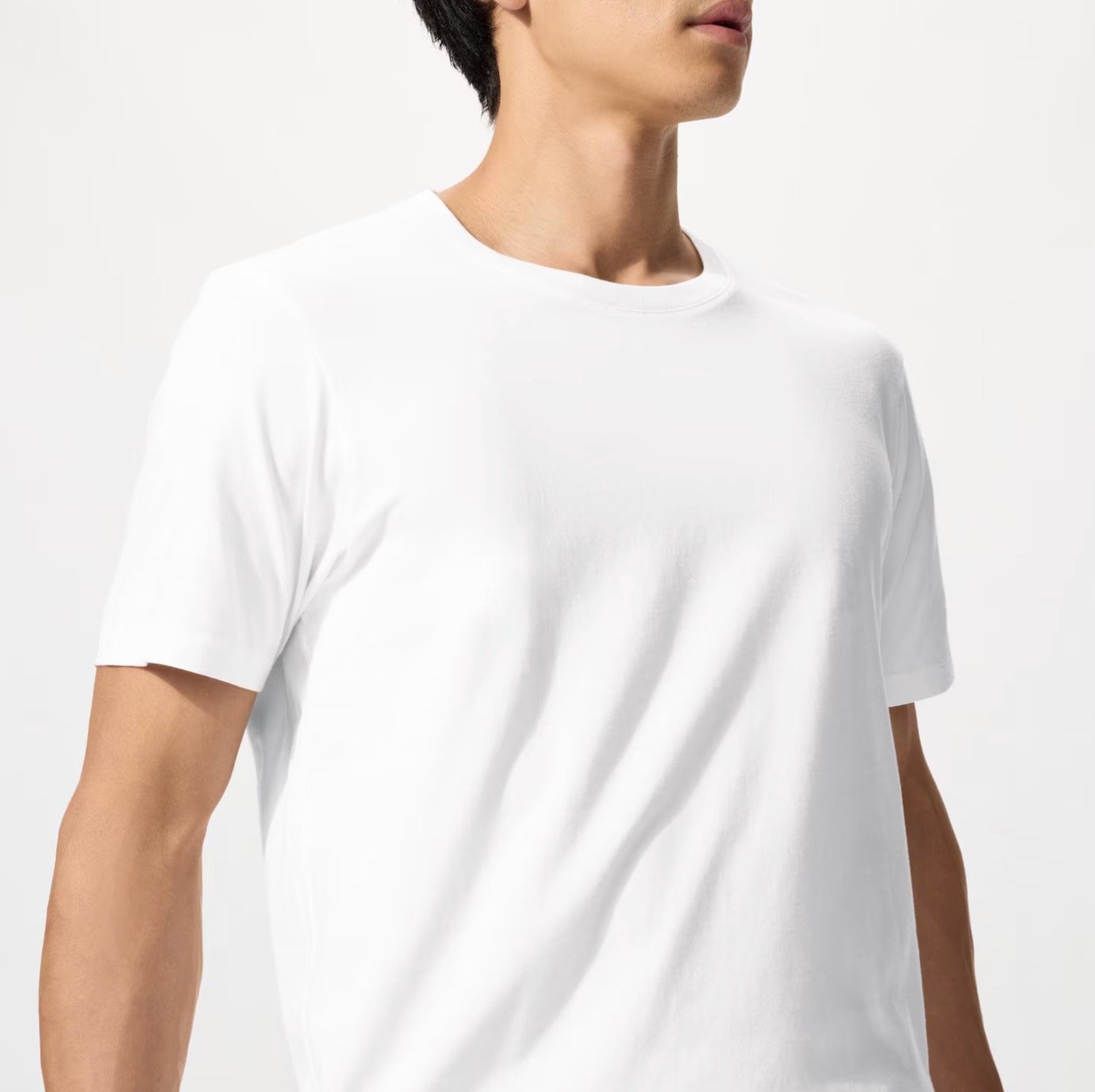
While it is not exactly niche, I do think the Uniqlo Supima Cotton T-shirt deserves a place here.
Not everyone wants to spend serious money on a white T-shirt, and honestly, that is very understandable. A white T-shirt is one of the most vulnerable items in your wardrobe. It gets washed constantly. It gets stained. It gets worn hard. So if you want something reliable without making a big investment, this is a great option.
For the price, it is surprisingly good. Mine have survived my washing machine for the last six months, which is more than I can say for plenty of more expensive T-shirts. The cotton feels nice, the arms fit well, and it does the job.
That said, it is not perfect. I do not think the shape around the body is as good as the Buck Mason or RRL options, and the length is slightly too long. That matters because a T-shirt that is too long can make your legs look shorter and throw off the proportions of the whole outfit.
But for $25, it is hard to complain. If you are looking for a clean white T-shirt and do not want to spend $60, $100, or $135, this is the one I would buy.
It is simple, affordable, and a very good place to start.
Final Thoughts
The point of all this is not that every man needs to spend hundreds of dollars on jeans and T-shirts. That would be ridiculous.
The point is that the clothes you wear the most deserve the most attention.
A suit is useful, but most men do not wear one every day. Expensive shoes are nice, but they are not saving a bad outfit. Jeans and a T-shirt, though, are different. They are the foundation. They are what you wear when you are actually living your life.
And because they are so simple, they leave you with nowhere to hide.
Bad jeans look bad. A badly fitting T-shirt looks bad. But get both right, and suddenly the easiest outfit in the world becomes one of the best.
You do not need a wardrobe full of complicated pieces. You do not need to chase every trend. You do not need to dress like someone completely different from who you are.
You just need a great pair of jeans and a great T-shirt.
As I always say to friends who struggle to look “cool” or feel like they know how to dress, bring it back to basics and everything will fall into place. Forget the overcomplicated outfits, the forced trends, and the pieces that do too much. Start with jeans that fit properly and a T-shirt that actually suits your body. Once you get those right, style stops feeling like something you have to chase and starts becoming something that feels natural.
Start there, and everything else gets easier.
Happy shopping,
Seb
Five Men’s Sunglasses Worth Actually Buying
If you have been in my DMs asking for menswear content – this one’s for you. I have been getting more requests for it than I can keep up with, and the honest answer is that it is just not yet in my ballpark. I know what looks good on a man, but I do not always know where to find it. So I decided to recruit someone who does.
Sebastian Auld is a London-born student at Boston University, with an extensive background in fashion. He has some incredible opinions about menswear, and he wears all of them extremely well. He is going to be writing a series of menswear pieces for the blog, so consider him your new source for all the goods. This piece is a result of his own personal style, experience, and boots-on-the-ground NYC journalism (we spent all day shopping “for content”).
Thank you Seb for the recommendations. You guys are in for a treat!
Xoxo,
Annie
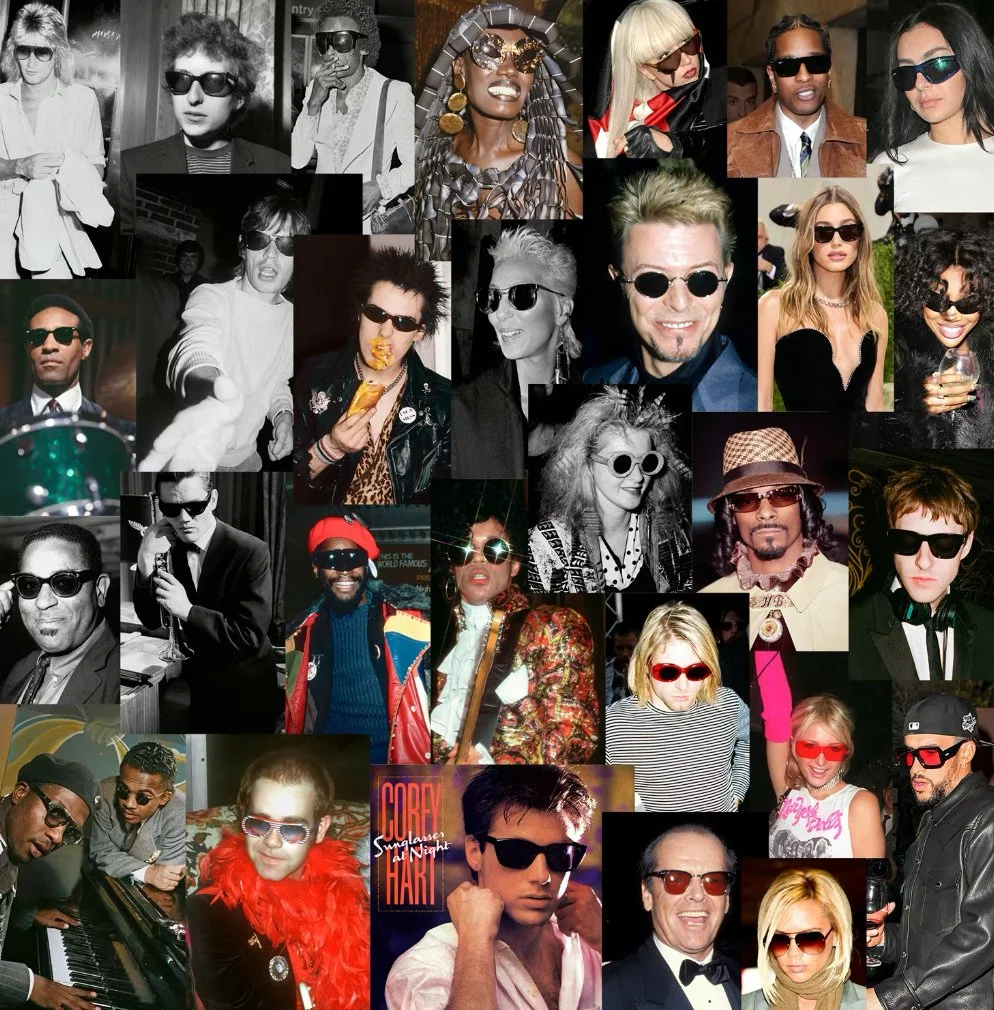
Do I own too many sunglasses? I don’t know if that is possible when you have such a variety of frames, sizes, shapes, and brands. After years of experience, I have discovered the sweet spot of sunglasses.
You can be wearing the simplest combination in the world: a white T-shirt, good jeans, clean shoes. Then the right sunglasses go on, and suddenly it all comes together. They give the outfit shape and your face a frame. A good pair is going to do more work than most people give it credit for.
Some people can wear tiny silver aviators, oversized wraparounds, or strange architectural frames and somehow look incredible. I am not one of those people, and frankly, I envy anyone who is. For most men, the safest and best sunglasses are not the ones that scream for attention. They are the ones that elevate you without the extra noise.
A great pair of sunglasses should enhance the person wearing them, not become the whole outfit. They should feel classic enough to wear for years, but distinctive enough to make you feel like you have taste. After a lot of trial and error, these are the five pairs I think every man should know about for summer 2026.
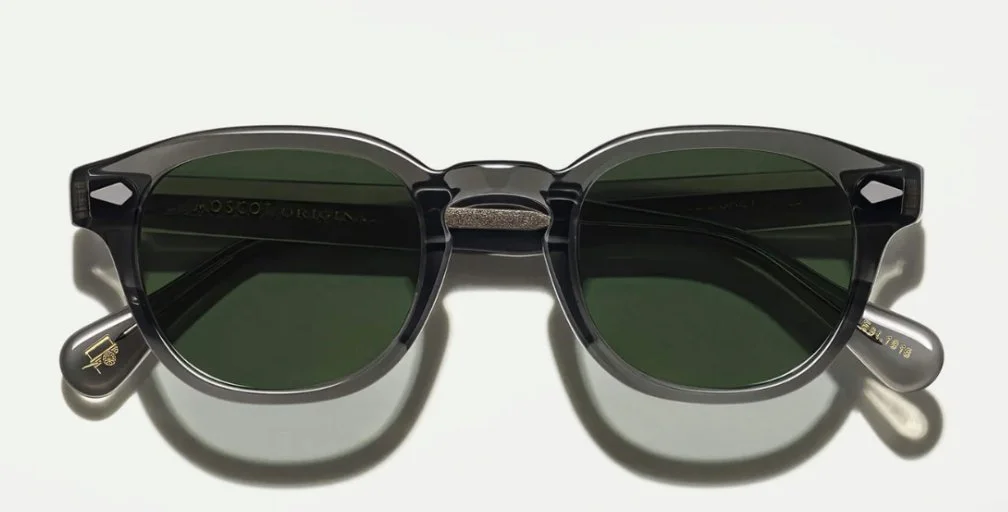
The Moscot Lemtosh is my personal go-to. I own four pairs in different colours, which probably says enough. What makes it genuinely good is that it works on almost everyone, which is so rare. Part of that comes from its balance. It is round, but not too soft. Chunky, but not costume-like. The brand has a Lower East Side history that goes back to 1899, and the Moscot family still runs the brand. It has survived because it is truly a good brand.
That heritage gives the Lemtosh real credibility. It does not feel like a trend piece invented by a marketing department. It feels like something that has survived because it works.
It comes in multiple sizes, which matters more than people realise. Most sunglasses that look bad do look that way because of the fit, not necessarily the design. It is also beautifully solid. My first pair is three years old and has been properly used, thrown in bags, worn constantly, and generally abused, yet the frame and lenses still look almost new. They feel sturdy in a way that makes them easy to trust.
This is the pair I would recommend first to almost anyone. They are classic, stylish, wearable, and they do not feel like they are trying too hard. Start here.

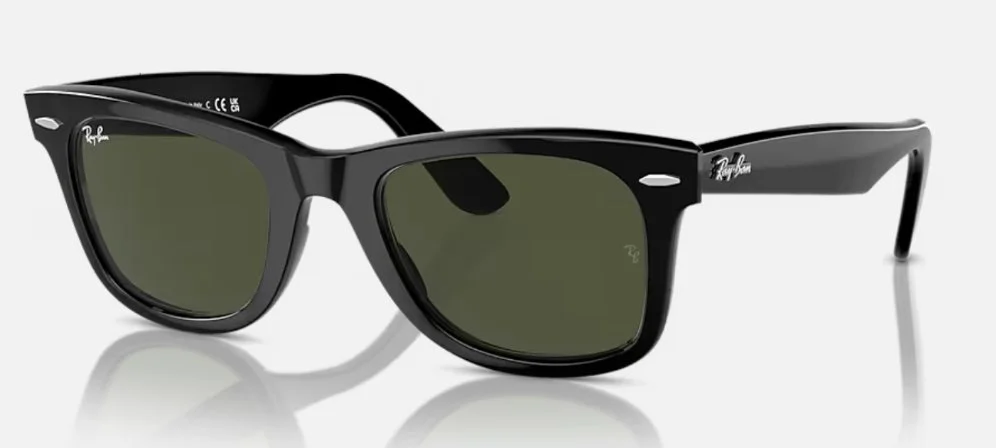
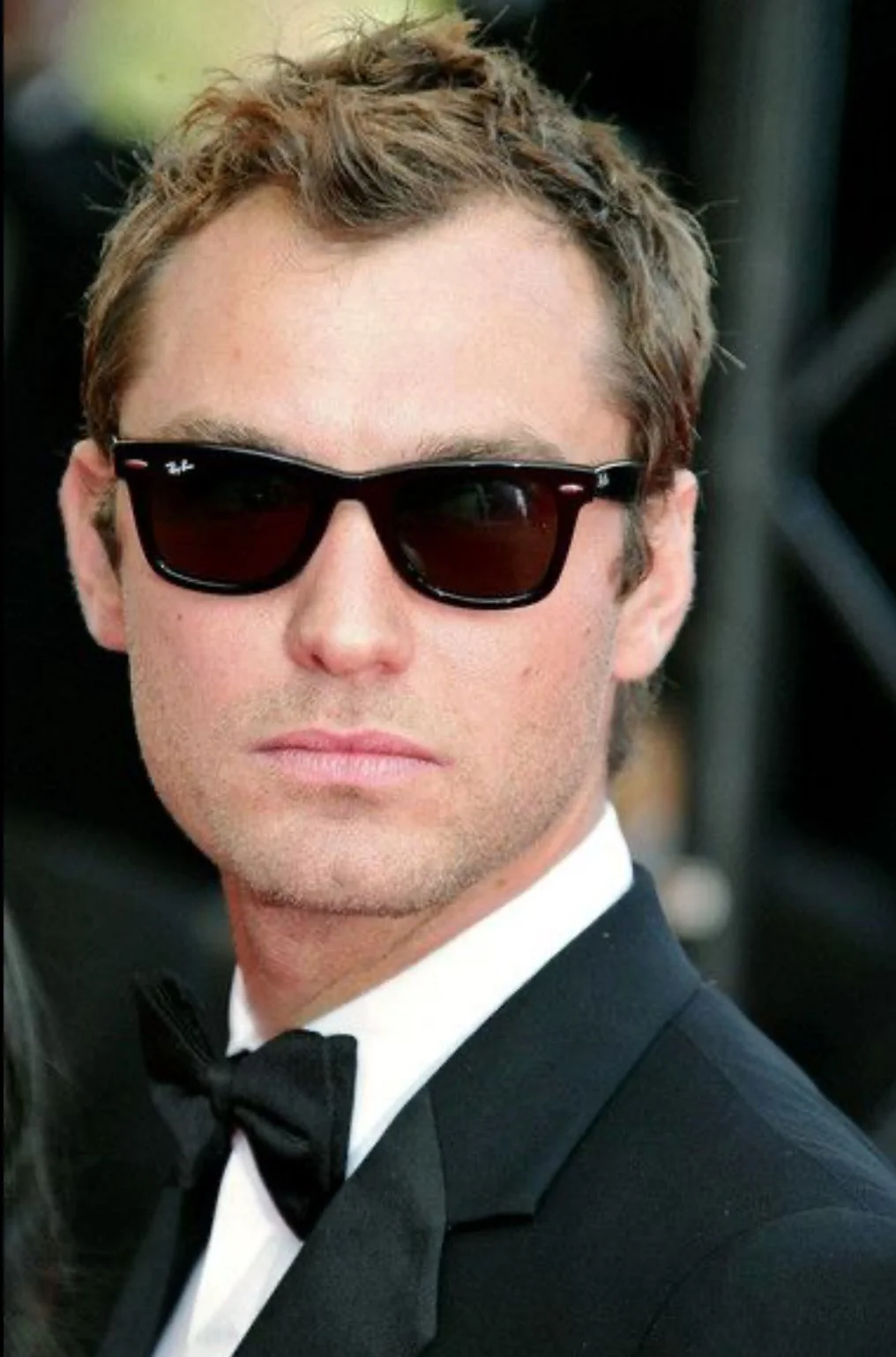
The Ray-Ban Wayfarer is one of those rare objects that has moved beyond fashion and into cultural memory. Even if you do not know the model name, you know the shape.
Originally introduced in 1952, the Wayfarer helped define the look of post-war American cool. It was sharper and more modern than older metal sunglasses, with a bold plastic frame that felt rebellious without being ridiculous. Over the decades, it became associated with film stars, musicians, and that slightly careless kind of confidence that never really goes out of style.
The square frame gives structure to the face, especially if you have softer features or want something a bit more masculine and defined. It looks good with a T-shirt, a suit, a linen shirt, or swim shorts. It is one of the few sunglasses that can feel both casual and iconic at the same time.
Yes, a lot of us probably have terrible childhood photos wearing cheap Wayfarer-style sunglasses. That does not matter. The original shape has come back because it never really left. It just needed people to remember how good it can look when worn properly.
My one note: modern Ray-Ban quality does not quite match what the design deserves. They are not badly made, but they are not in the same world as Moscot, Jacques Marie Mage, or Oliver Peoples. If you wear them constantly, they may start to look tired sooner than you would like.
Still, for pure style-per-pound, the Original Wayfarer remains one of the best sunglasses a man can own. It is direct, confident, and instantly recognisable.
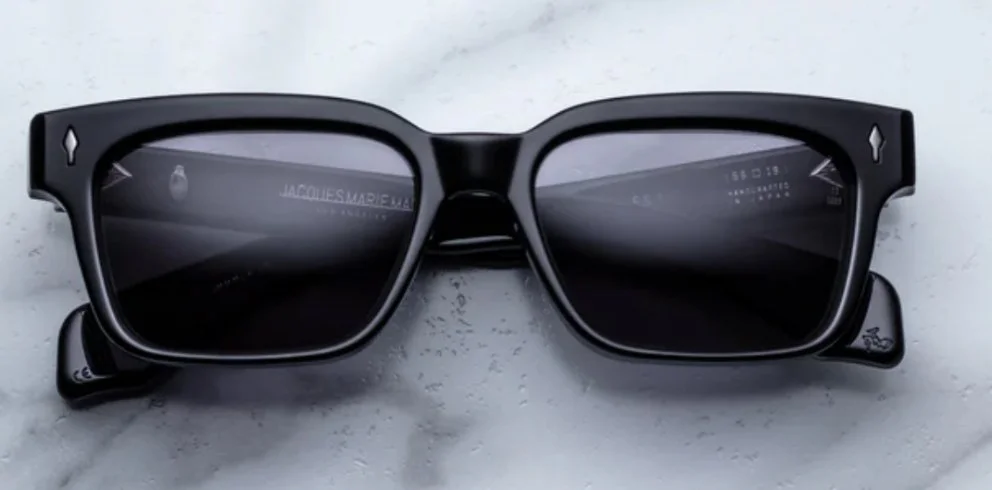
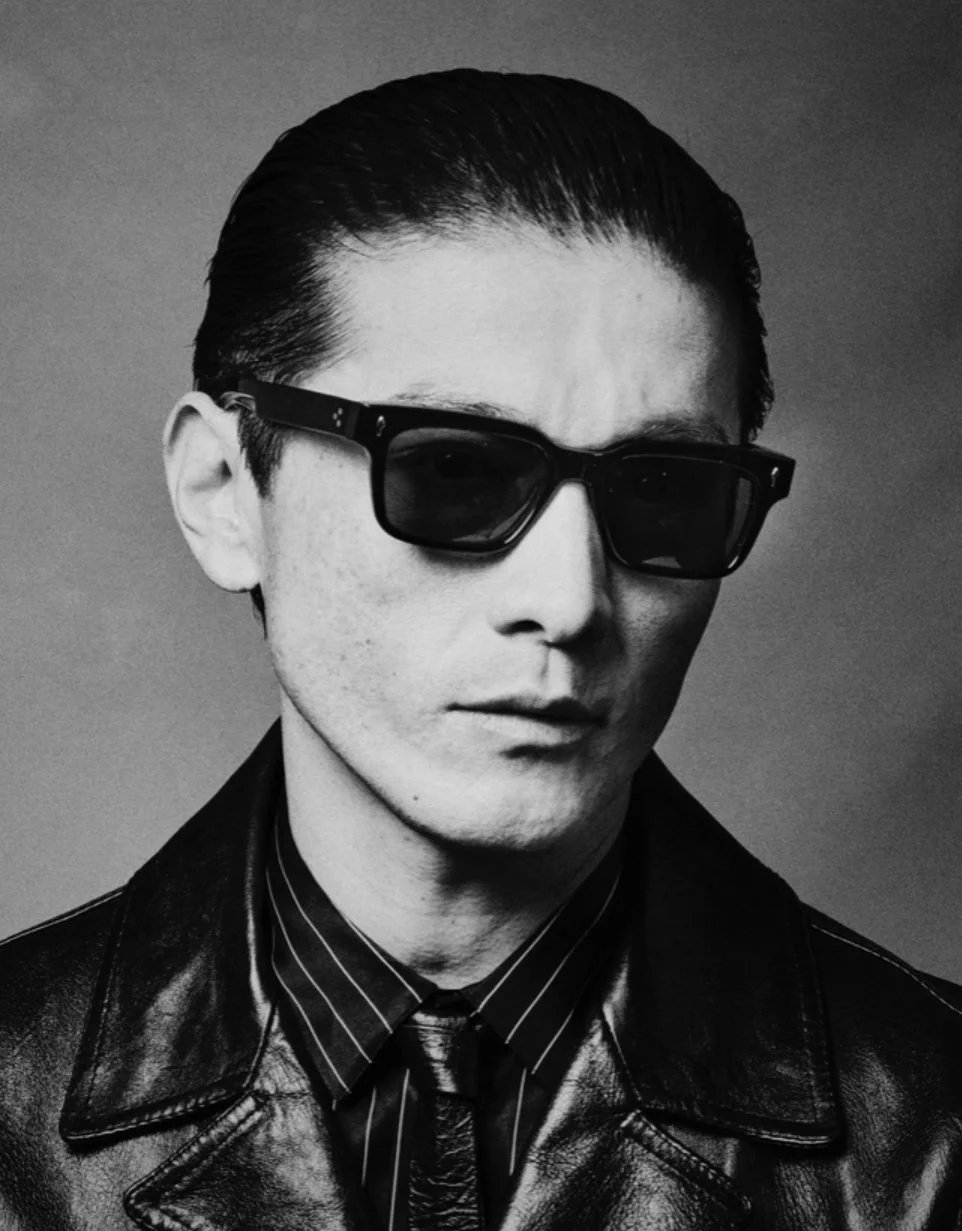
Jacques Marie Mage is the brand I aspire to own. There is eyewear, and then there is Jacques Marie Mage.
The Molino 55 is one of the best examples of why the brand has become so desirable. It is rectangular, 1960s-inspired, and built with a level of detail that makes it feel more like a museum object than an accessory. The brand describes the Molino as featuring subtle beveling and signature precious metal embellishments, and that is exactly what separates it from more ordinary frames.
Jacques Marie Mage makes frames in Japan in limited runs, with heavy acetate and the kind of detailing that makes you understand why the price is what it is. The Molino is rectangular, 1960s in its reference, and restrained by the brand’s standards – making them wearable in a way that some of their more directional frames are not. It is presence without demanding that you dress around it.
The Molino has a kind of rebellious sophistication. It feels like something a film director, artist, or incredibly well-dressed architect would wear. It is not loud in the obvious sense, but people who know sunglasses will notice.
These are expensive, obviously. But if you want one pair that feels special, considered, and genuinely luxurious, this is the pair. The Molino is the holy grail piece.
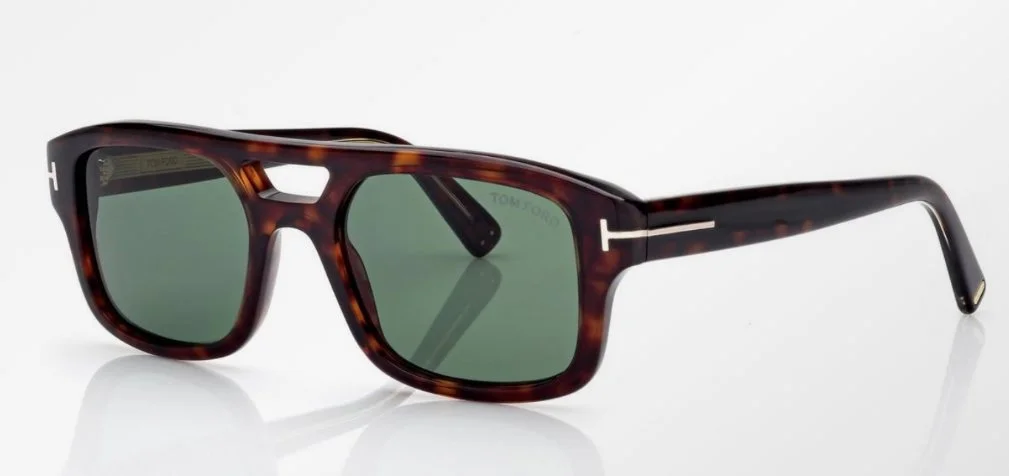
The boldest pair on the list.
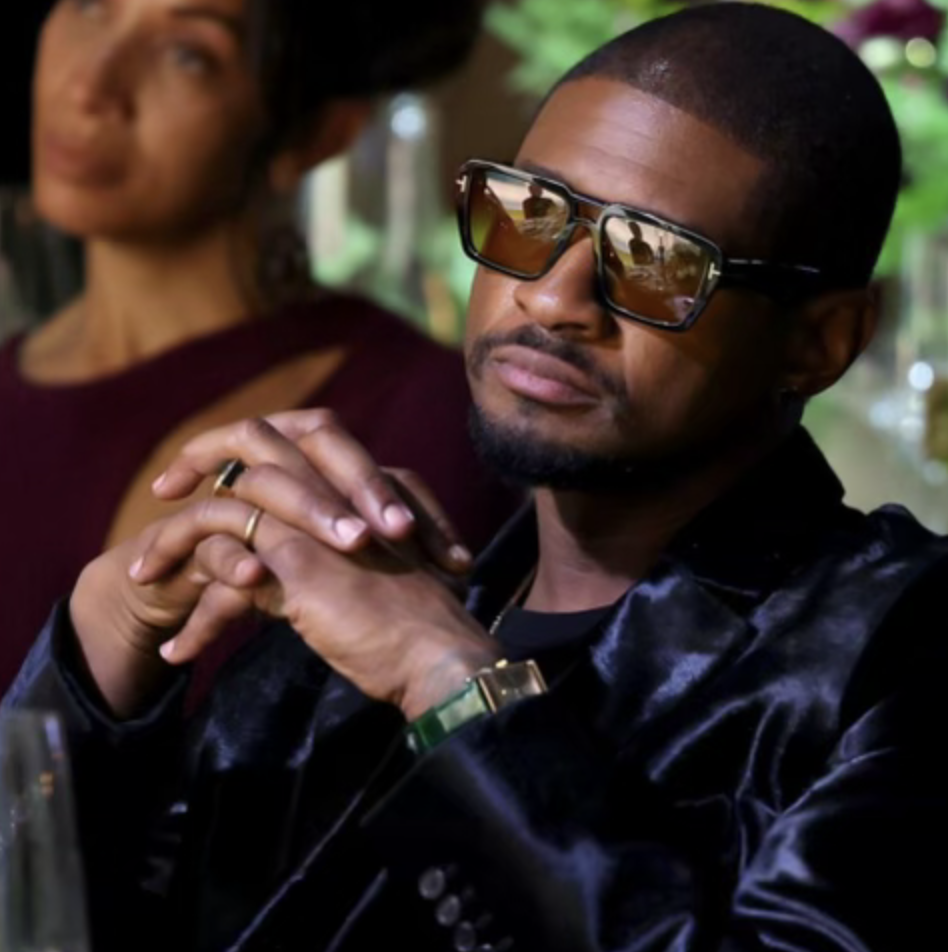
Tom Ford eyewear has been produced in partnership with Marcolin since the brand’s beginning in 2005, and the Icon Navigator reflects the wider Tom Ford language: glossy acetate, sharp lines, Italian construction, and the signature metal “T” detail at the temples. The current Icon Navigator is listed with Zeiss lenses, 100 percent UV protection, and Italian production.
If the Lemtosh is your everyday intellectual frame and the Wayfarer is your classic cool frame, the Tom Ford Navigator is your slightly more dressed-up, evening-in-the-city frame.
It works particularly well if your style leans clean and minimal. A black T-shirt, tailored trousers, loafers, and these sunglasses is an easy summer look. They add polish without needing much else.
The key is confidence. These are not for someone who wants their sunglasses to disappear. They are for someone who wants a stronger frame that gives the face structure and makes the outfit feel intentional.
If you want one pair that feels modern, masculine, and a little bit cinematic, the Tom Ford Icon Navigator is a very good option.
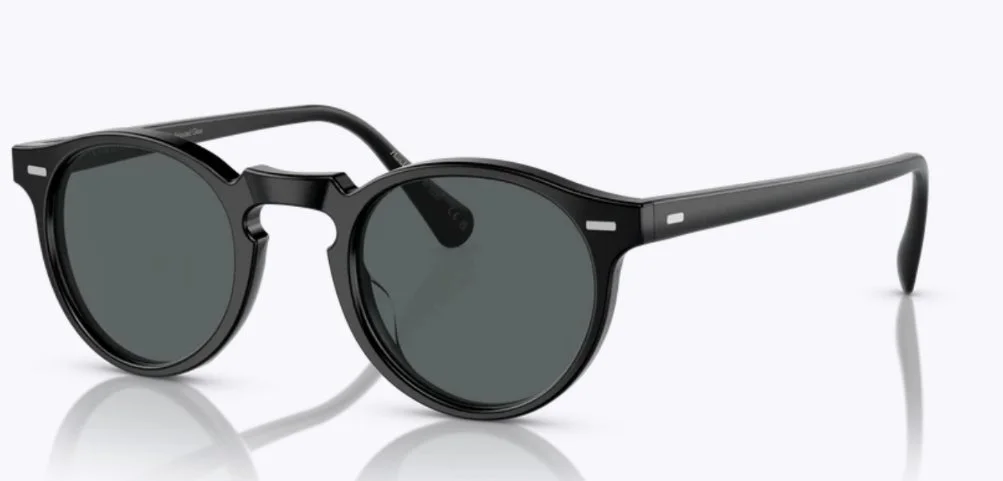
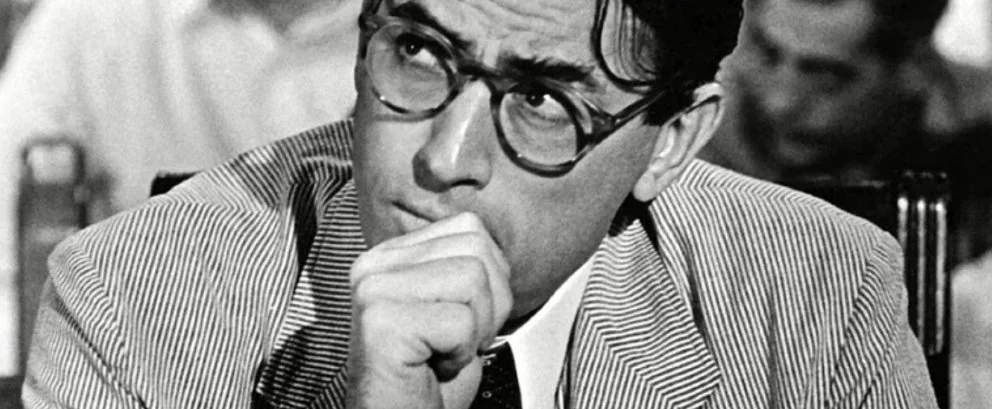
The Oliver Peoples Gregory Peck Sun is the quietest pair on this list, but possibly the one with the longest shelf life.
Made with the Pack Estate, based on the frames Gregory Peck wore in To Kill a Mockingbird, Oliver Peoples has built their reputation for frames that rely on proportion, acetate quality, and getting the small details right. The Gregory Peck is round and refined – perfect for subtle dressing. Oliver Peoples has always been good at subtle luxury. These are truly the perfect pair for people who want sunglasses that look expensive without looking flashy.
The Gregory Peck Sun works especially well with more relaxed summer dressing: linen shirts, knit polos, neutral trousers, suede loafers, or even a plain white tee. It gives everything a softer, more thoughtful feel.
This is the pair for someone who finds the Lemtosh a little too much, and the Wayfarer a little too well-known. It is the perfect pair the most interesting man in the room.
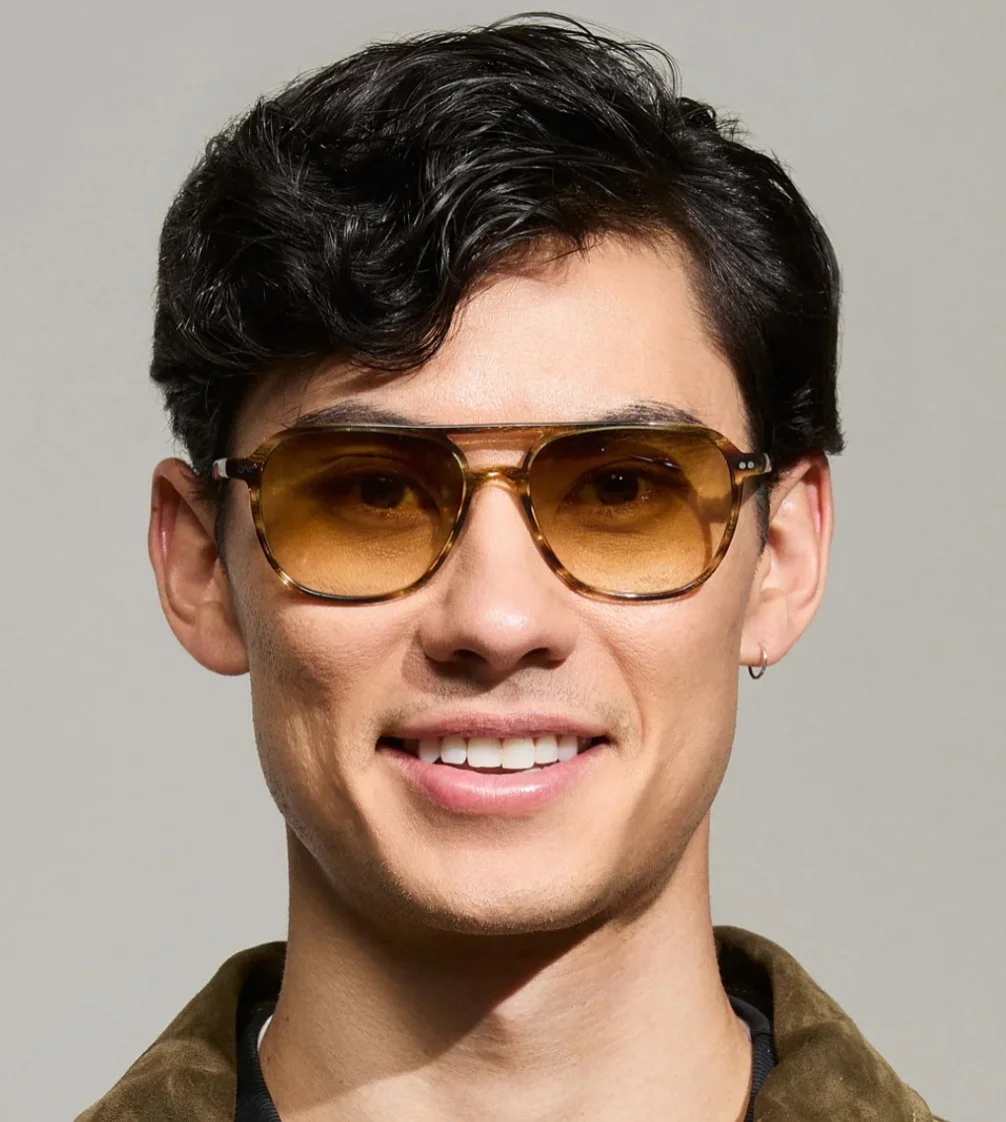
Honourable Mention: Moscot Bjorn Sun- $370
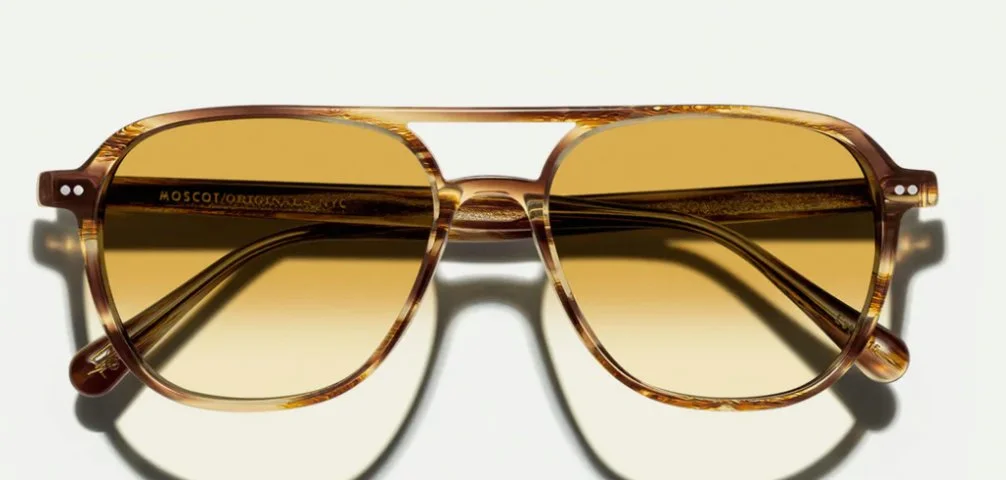
I could not write this list without including another Moscot. I can't help myself.
The Bjorn Sun deserves an honourable mention because it gives you a slightly sleeker alternative to the bigger navigator-style frames. It has that same classic, masculine feel, but it is a little more discreet than the Tom Ford. Less Hollywood. More downtown.
Moscot, for me, is one of the best brands when it comes to the combination of quality, price, and style. Their frames feel substantial, the designs are wearable, and they have enough history behind them to feel authentic rather than manufactured.
The Bjorn is a great option if you want something stronger than a round frame but do not want to go full oversized navigator. It is clean, stylish, and easy to wear for years. Same quality, same prince, different proportion.
Buy Sunglasses That Make You Look Like Yourself, Just Better
The biggest mistake men make with sunglasses is thinking they need the loudest pair in the shop.
They do not.
The best sunglasses are the ones that make you look more like yourself, just sharper. They should suit your face, work with your wardrobe, and feel good enough that you actually want to wear them. A great pair should not feel like a costume. It should feel like the final piece of the outfit.
For most men, that means sticking to classic shapes: round, square, navigator, or soft rectangular frames. It means buying the right size. It means choosing quality over novelty. And it means remembering that sunglasses are not just practical. They are one of the few accessories that can completely change how an outfit feels.
If I had to choose one pair from this list, I would still start with the Moscot Lemtosh. It is the most versatile, the easiest to wear, and the one I think most people will look good in.
But each pair here does something slightly different.
The Moscot Lemontosh is the safest recommendation on the list. Works on almost everyone.
The Ray-Ban Wayfarer is a classic pick for a good reason.
The Jaques Marie Mage Molinos give you luxury.
The Tom Ford Navigators are bold, specific, and strong
The Oliver Peoples Gregory Peck is the most underrated, elegant option.
Summer style does not need to be complicated. Good T-shirt. Good jeans. Good shoes. Great sunglasses.
That is an outfit you can always rely on. And these are glasses you can rely on.
Happy shopping,
Sebastian
Read more of Sebastian’s work on his substack: @sebastianauld
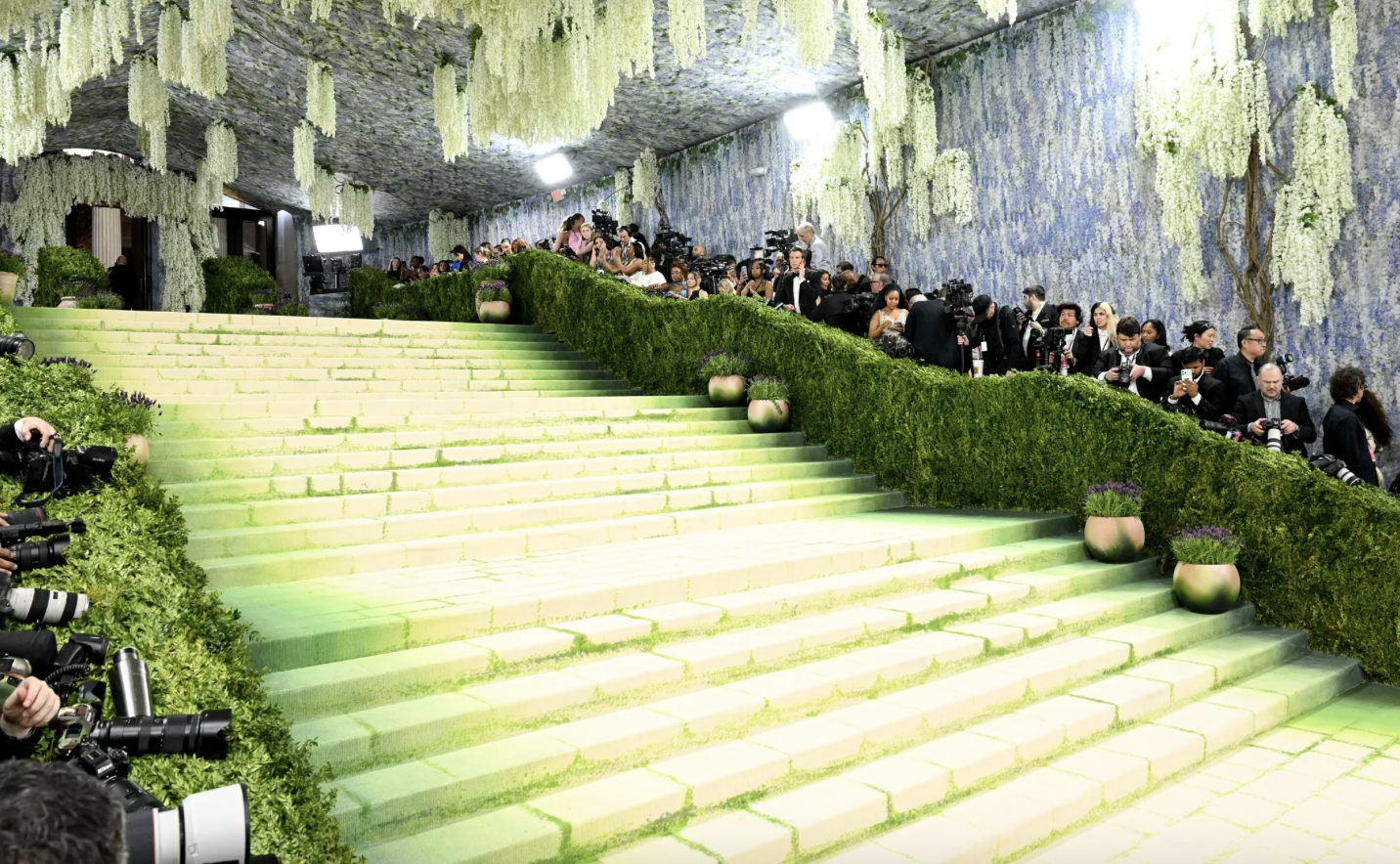
Fashion, Art, and Amazon: Met Gala 2026 Review
In my preview piece, I made the claim that “Fashion is Art” the most loaded dress code the Met had ever issued. These three words, I assumed, looked like an invitation but were actually a dare. I said the theme would demand a genuine point of view. That it would create the most legible dividing line in years between people who actually engaged with the intellectual weight of it and the people who just reached for something involving the architectural body. I did not anticipatejust how the dividing line would appear.
Yes, there was noise around the event this year with the Bezos co-chair situation, protests, and notable absences. Of course, I will get to all of it, but I want to start where the theme itself starts: with the body. That was always the real question on the table Monday night, and it almost got lost in the surrounding conversation.
The accompanying exhibition, Costume Art, is structured around the body itself – from the “Naked Body" to “The Mortal Body,” nearly 200 garments placed in conversion with 200 artworks spanning 5,000 years. Curator Andrew Bolton described fashion as the “common thread throughout the whole museum,” or the connective tissue between every curatorial department that the Met has. His goal was to disband the old hierarchy between fashion and fine art, and establish what he called “equivalency of artworks and equivalency of bodies.”
This is a beautifully radical idea, but also a terrifying belief to hand to a celebrity red carpet.
“Fashion Is Art" asks its audience to have a position on the body, and on what the clothing does, says, reveals or conceals about being human. Most dress codes let you interpret your way into a pretty dress. This one asked for an argument.
Best Dressed
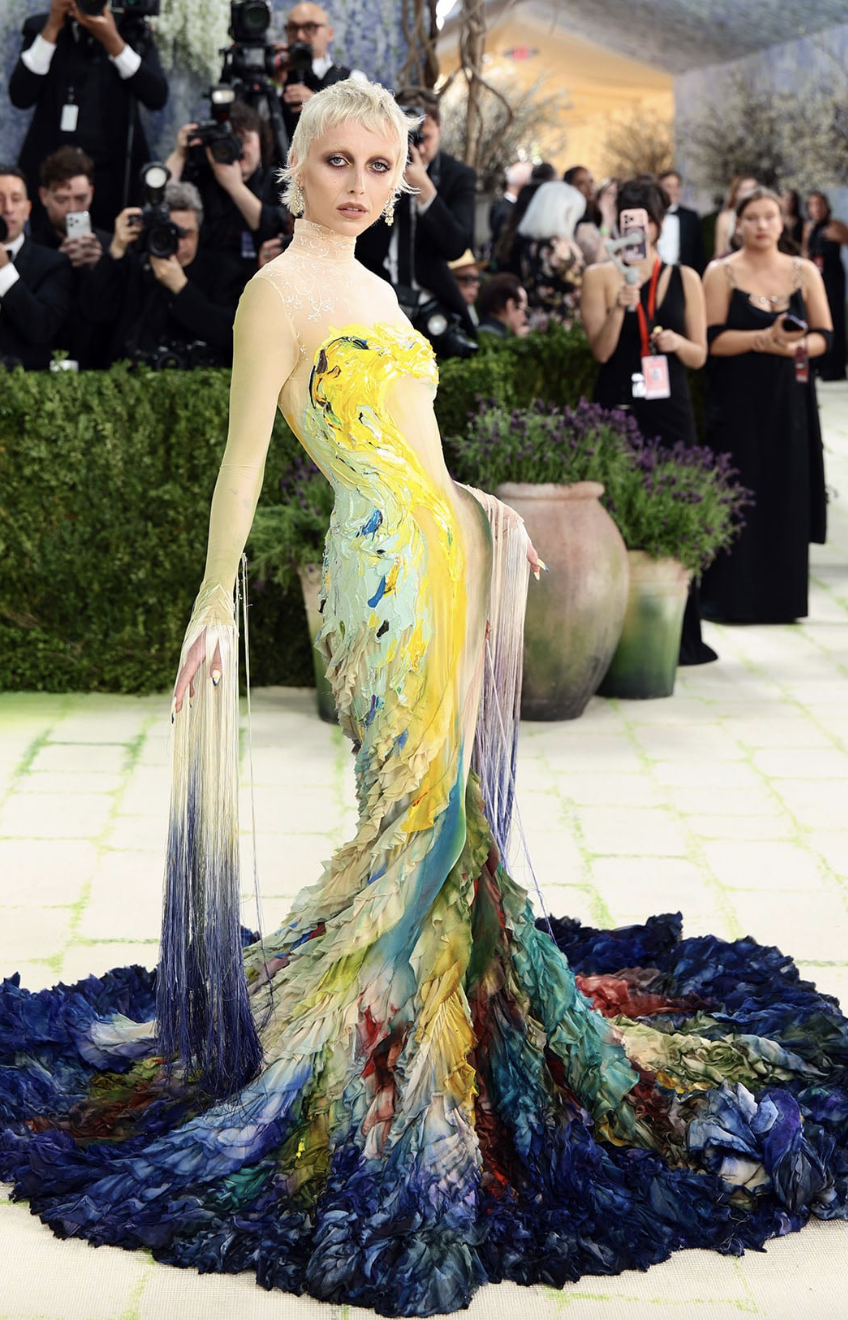
The first look I saw was Emma Chamberlain who opened up the steps with my favorite look of the night. I absolutely adore when a Mugler looks like a Mugler. Castro Freitas and Anna Deller-Yee’s hand-painted design is reminiscent of a dripping watercolor effect as if a wake of paint was to follow her up the steps. The idea of embodying the visible brushstrokes of the Impressionists managed to turn her body into a walking canvas.
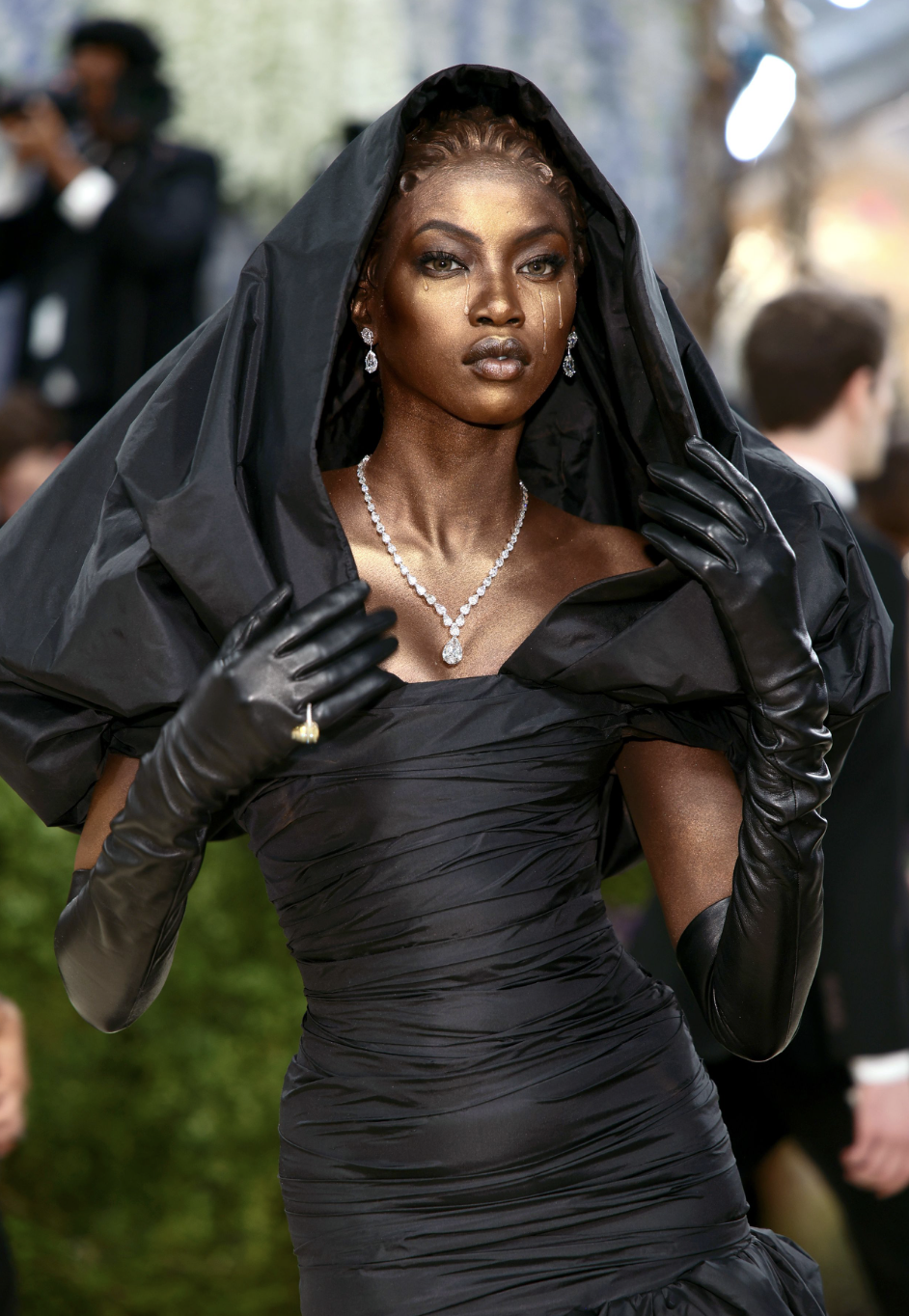
Anok Yai in Balenciaga by Pierpaolo Piccioli was another look of the night that genuinely had me glued to the screen. She arrived as the Black Madonna, having built the concept herself as a hopeful response to the tense climate of the world. The prosthetic hair and gold tears running down her face were sculpted to create the impression of an etched statue of devotion. This looks really means something as a form of protest art, worn on a body with its own story.
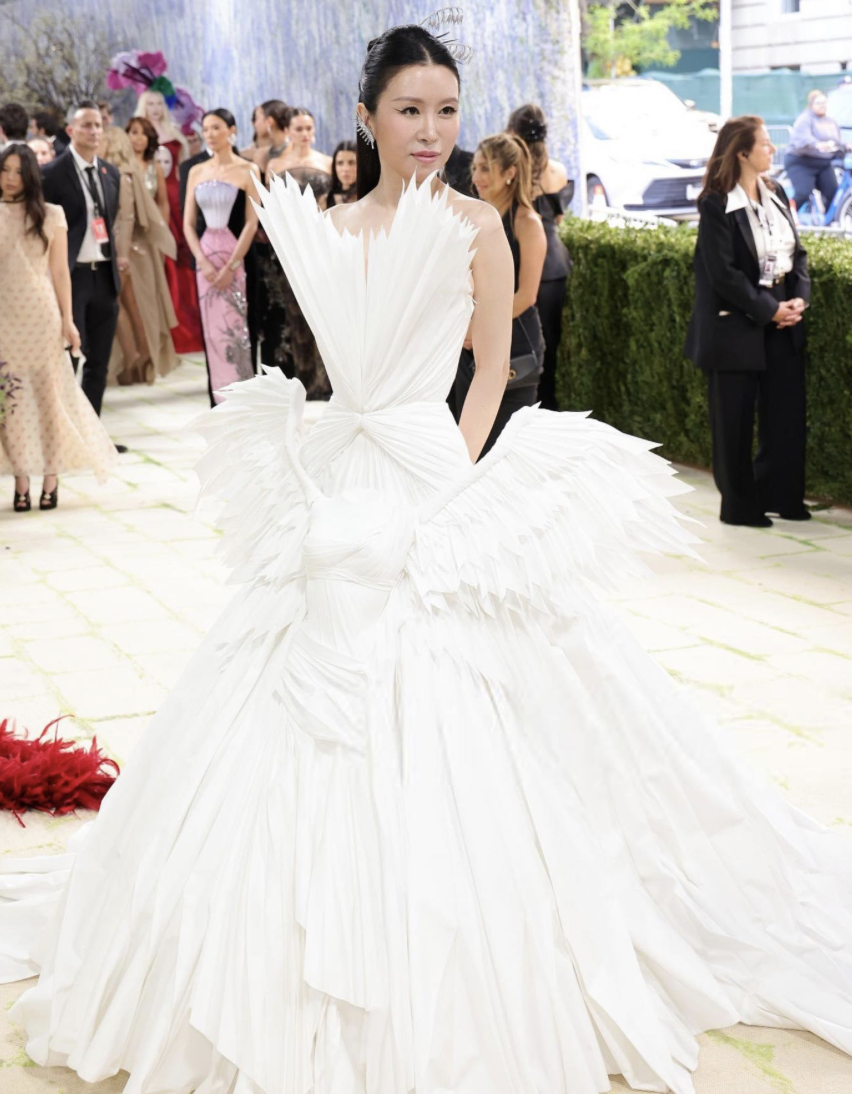
Yu-Chi Lyra Kuo arrived in Jean Paul Gaultier as the Winged Victory of Samonthrace. This headless, wingless Greek goddess of Nike was brought back to life and given a head again, The white sculptural gown with its sharp fan-like neckline and layered pleated skirt gave the statue incredible movement. What the original lacks – a head, arms, and a future – Kuo restored. This is the kind of reference that enters into dialogue with art history. This was the cleanest silhouette and most intellectually satisfying look of the night.
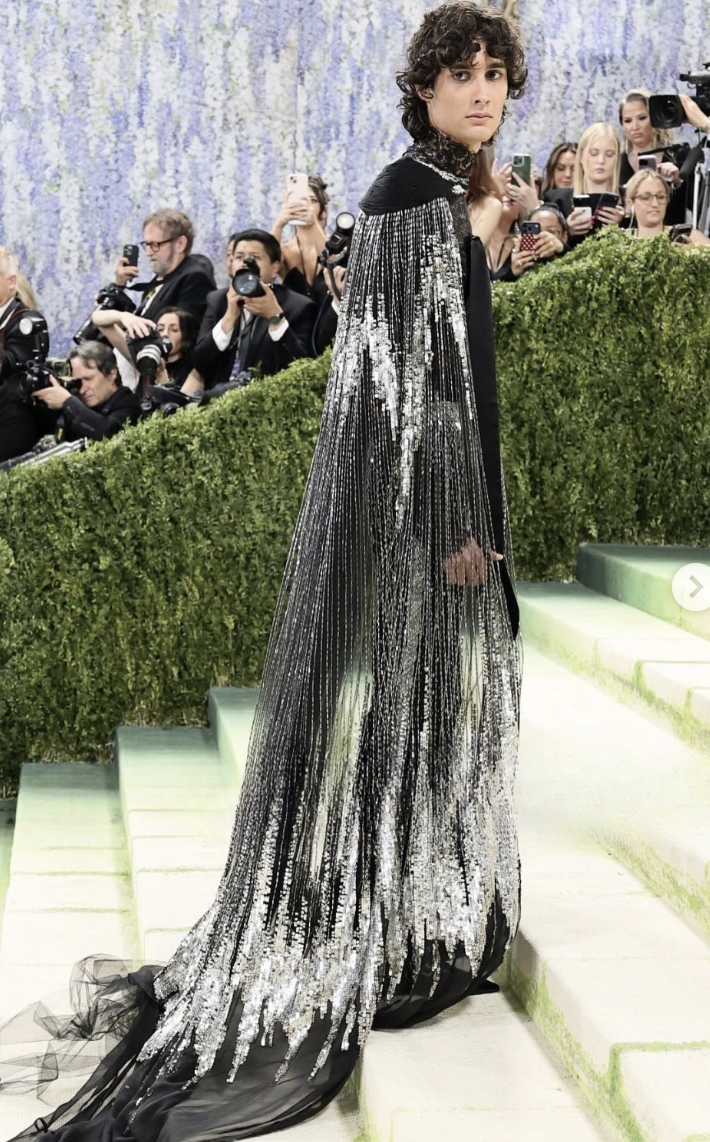
For his Met Gala debut, Sombr arrived in a custom Valentino by Alessandro Michele. A crystal-dotted cape over gothic black lace panels and large shoulder pads looked like a medieval altarpiece adapted for a modern pop star. This look made the sacred feel wearable.
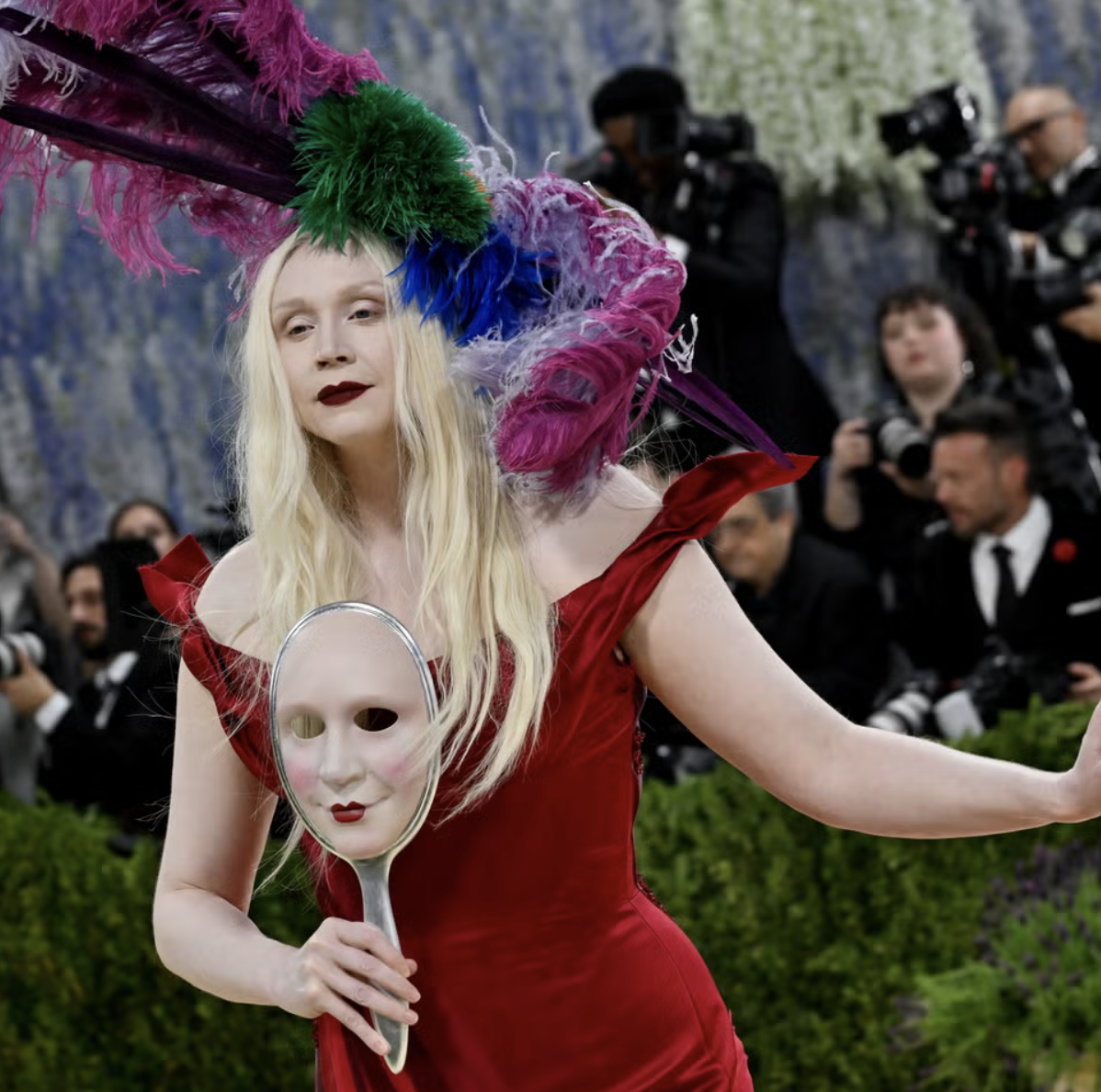
One of my most wild picks of the night was Gwendoline Christie in a custom Giles Deacon gown. This voluminous red look, inspired by John Singer Sargent and Madame Yevonde and topped with a mask of her own face, made performance visible. You cannot look at it without thinking about the nature of image, of celebrity, and of what it means to present yourself at an event of this significance.
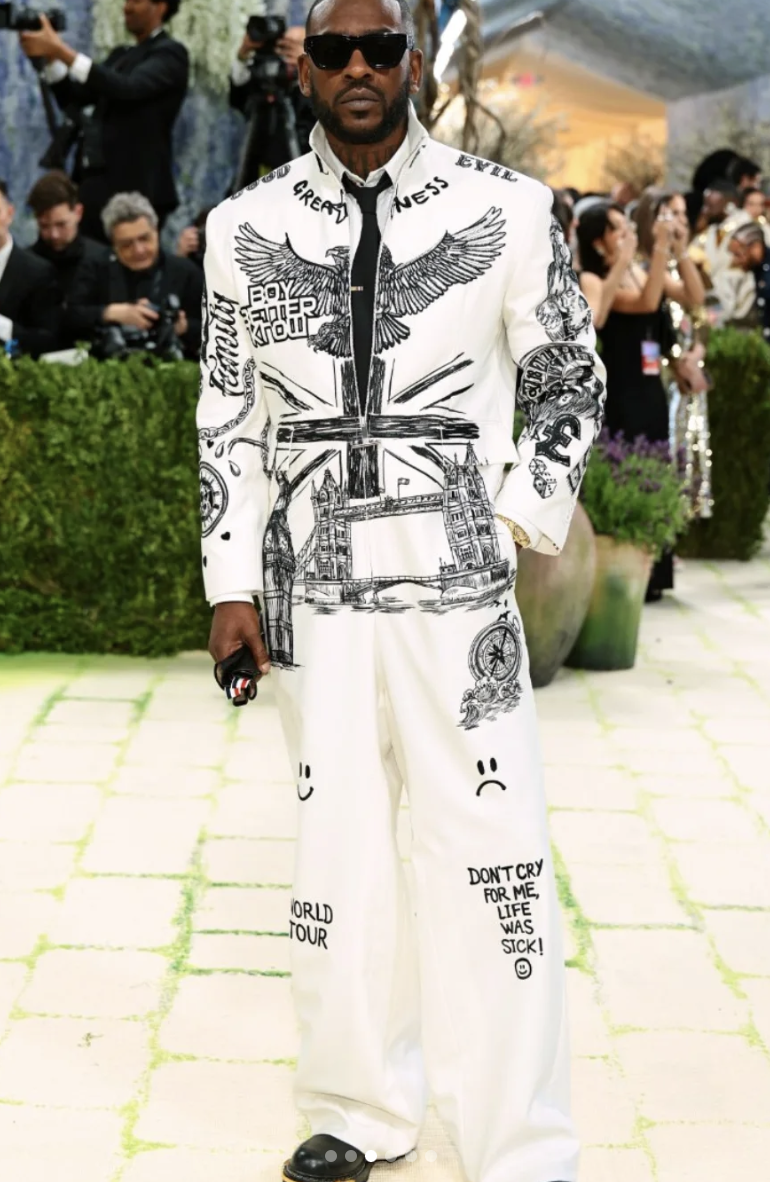
I adore Thom Browne. When I saw Skepta arrive in a Browne custom white wool tailored jumpsuit, embroidered by hand in response to his own tattoos, it inspired so much of this article. The placement of the satin stitching matches his actual body, exposing what is usually under the clothes. The body’s permanent markings, its autobiography in ink, was translated into fabric, Skepta walked on the steps as a man who had already been written on, and then wore that writing for everyone to read.
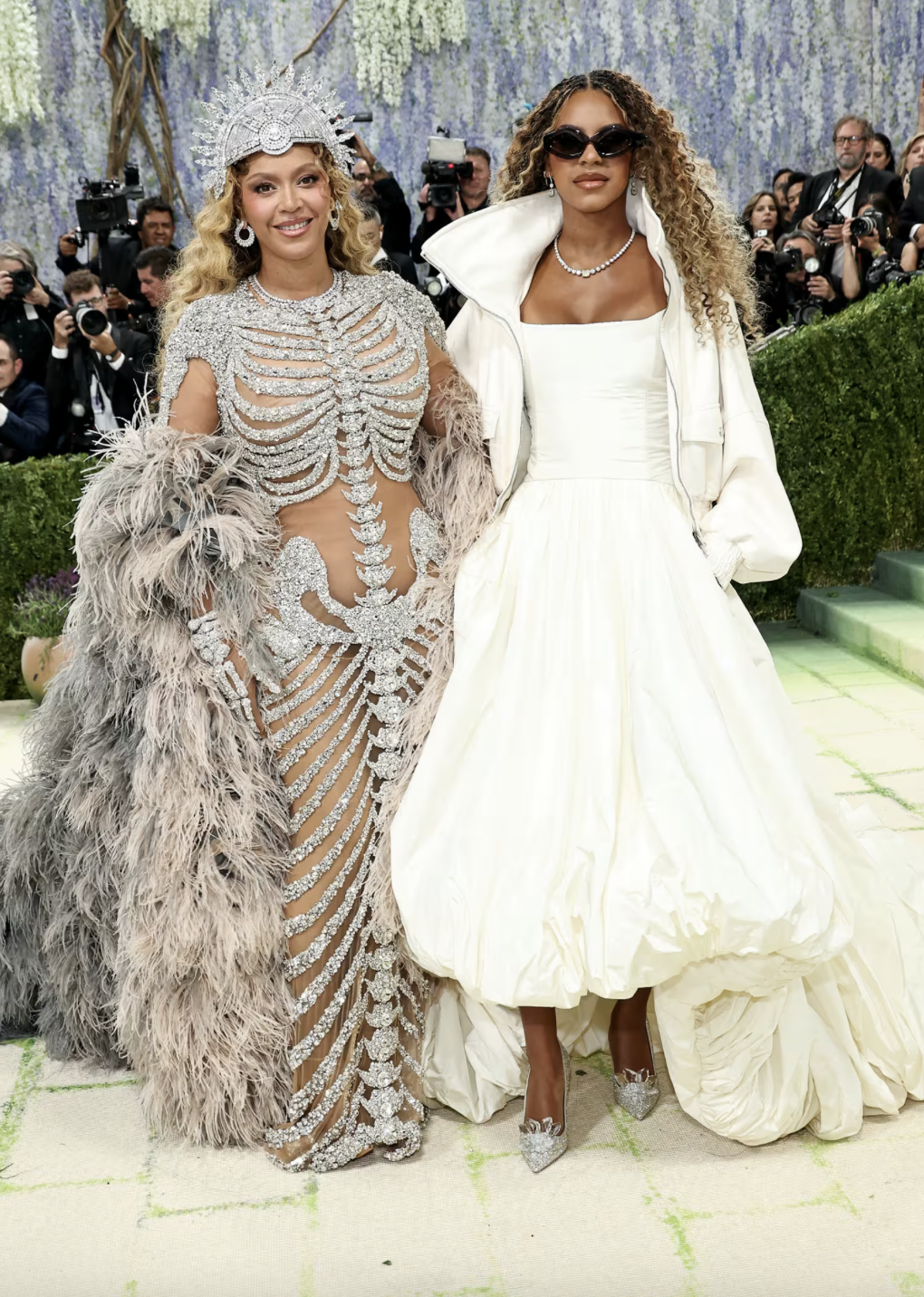
Beyoncé arrived among the co-chairs wearing a sheer Olivier Rousteing gown with diamonds tracing the human skeleton across her body, and an incredibly dramatic feathered coat trailing behind her. She even brought Blue Ivy for her Met Gala debut. In one image of a mother and daughter on those steps, with the skeleton gown catching light, you had the entire exhibition thesis made flesh. The body as canvas, across time, generations, adorned and celebrated.
Other honorable mentions were Jeremy Pope in Vivienne Westwood, Chase Infinite in Thome Browne, Sabine Getty in Ashi Studio, Hunter Schafer in Prada, and Colman Domingo in Valentino.
The Surrealist Wing
Bad Bunny aged himself 53 years into the future via prosthetics and costuming. Heidi Klum came as a breathing statue. Katy Perry arrived fully naked in chrome, identity concealed beneath a Stella McCartney gown.
These are the carnival acts, and I mean that affectionately. Every carpet needs them. The surrealism wing of the Met Gala is a direct line to pieces like Schiaparelli’s Lobster Dress and the legacy of fashion refusing to be merely decorative. While they were not my favorite looks by any means, the body was transformed beyond recognition, and that’s exactly what the theme was asking us to think about.
The Dividing Line I Promised
I said this theme would create the most legible dividing line in years. It did. But I do not think that it was fully between the people who got it and the people who didn’t.
The line was actually between the people who used the body as their argument, and those who used it as a mannequin.
The naked dress contingent mostly fell into the second category. Sheer for sheer’s sake is not the same as sheer with specific intention. There’s a version of “the body as art” that flattens into “skin as spectacle.” The theme asks you to think about the body rather than just revealing it. Those are completely different acts made extremely transparent by this theme.
On the Noise Around the Event
The Bezos co-chair situation, with protests and notable absences of faces such as Meryl Streep and Mayor Zohran Mamdani skipped entirely, is hugely important for the contextualization of this evening.
Jeff Bezos did not walk the carpet, but his wife Lauren Sánchez Bezos did in Schiaparelli. This look was ironically inspired by Sargent’s Madame X, which is either an inspired choice or an unfortunate one depending on your art history recall (Madame X was a huge social climbing scandal). Her husband, the man whose $10 million made this whole record-breaking $42 million evening possible, stayed home.
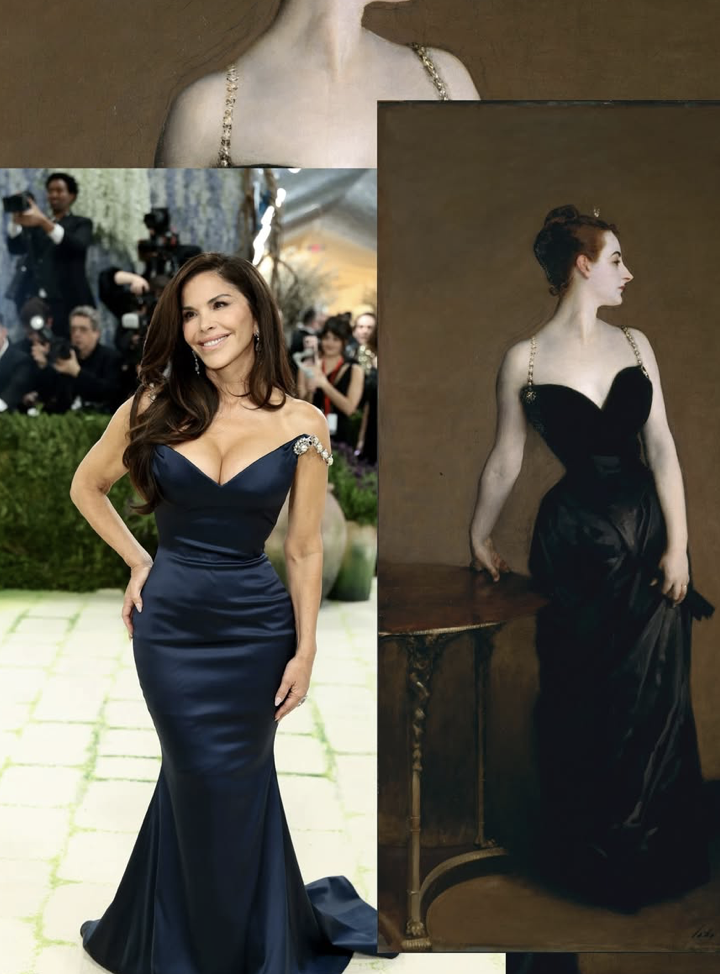
Bezos has actually done this before in 2012, where he sponsored the gala and was honorary chair after being priced at $18.4 billion. Nobody made subway protest posters that year. He went home and spectators moved on. The difference is that the context between 2012 and 2026 is that his excess and repeated political controversies have pushed Americans over their tipping points for good.
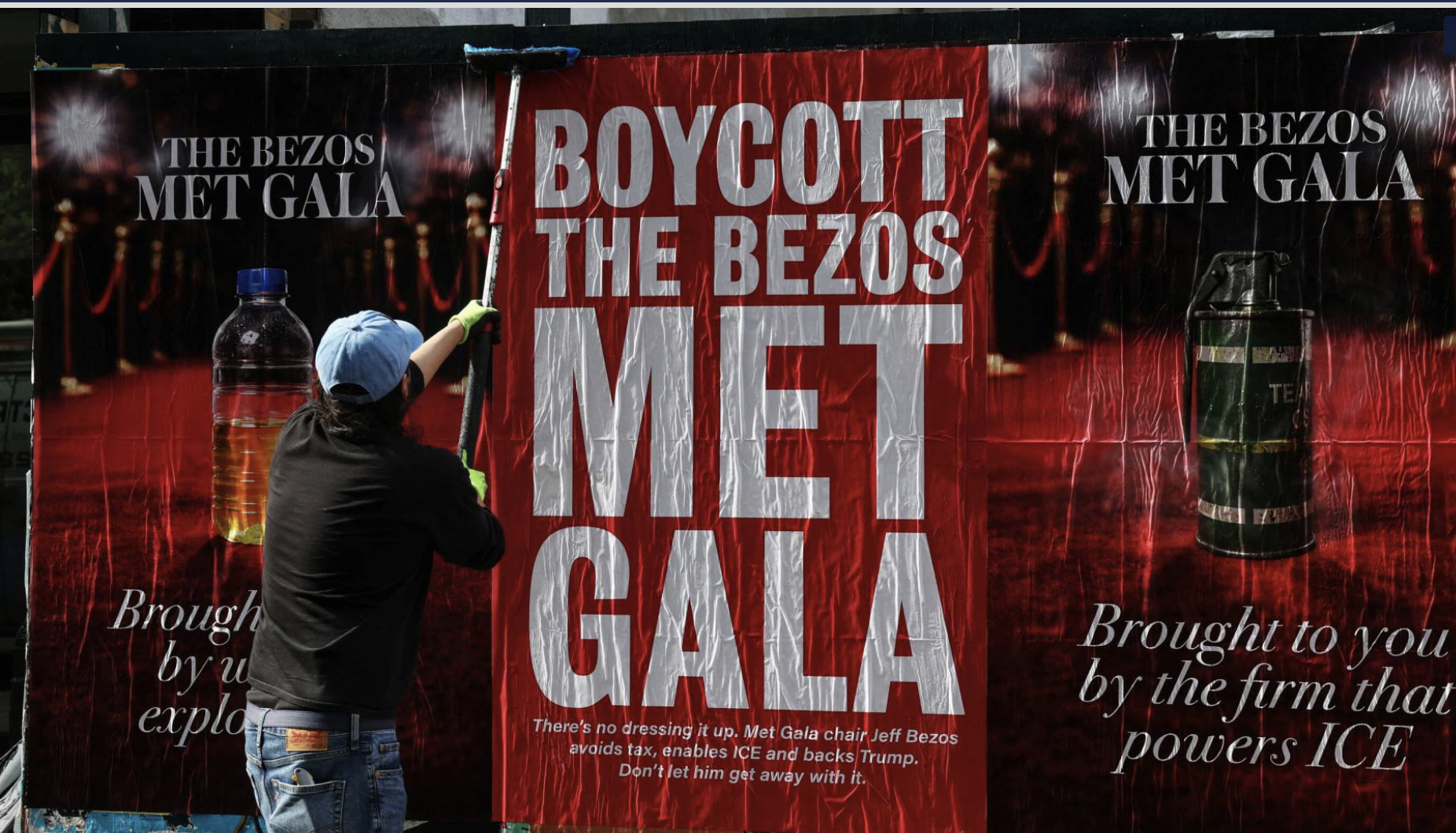
The protest infrastructure that assembled around the gala appeared as guerilla subway ads with “The Bezos Met Gala: Brought to You by the Company that Powers ICE,” plastered all over. By the weekend before the gala, around 300 bottles of fake urine had been placed throughout the Metropolitan Museum of Art, as a reference to the allegations about Amazon’s poor working conditions.
Here’s what I keep coming back to: the protesters outside at the Ball Without Billionaires were actually staging their own fashion show. With emerging designers and a runway, they were making the argument that fashion belongs to everyone, and that it is a meaningful human act. This is really the same theme as that established by Bolton. The inside and outside of the Met on Monday night were, in a strange way, having the exact same conversation from different sides of the steps. Even these protesters admitted that museums let ordinary people see priceless things, face to face.
To be in awe of art is to suspend belief and fix the mind on the intent of the artist’s genius. Despite all of the protests and noise surrounding the event, there was no lack of awe in response to this year’s carpet. This world would no longer allow for a purely innocent event to exist, and neither should it. However, the common denominator between fans and enemies of the Met Gala is the admiration for the fine arts; so much so that fashion and art were used as forms of effective protest.
The Met Gala has always been fashion’s best argument for itself. This year, it really had to prove its case. The theme accomplished what it had set out to do: a profound conversation about fashion’s place in art. Just like a painting, each fashion decision made the spectator analyze, assess, and interpret what the designer, or artist, was thinking and attempting to convey. This year, with a new permanent home, a record-breaking budget, protesters staging their own runway outside, and a carpet that — at its best — genuinely proved the case, fashion earned its place as art.
Xoxo,
Annie
Met Gala 2026
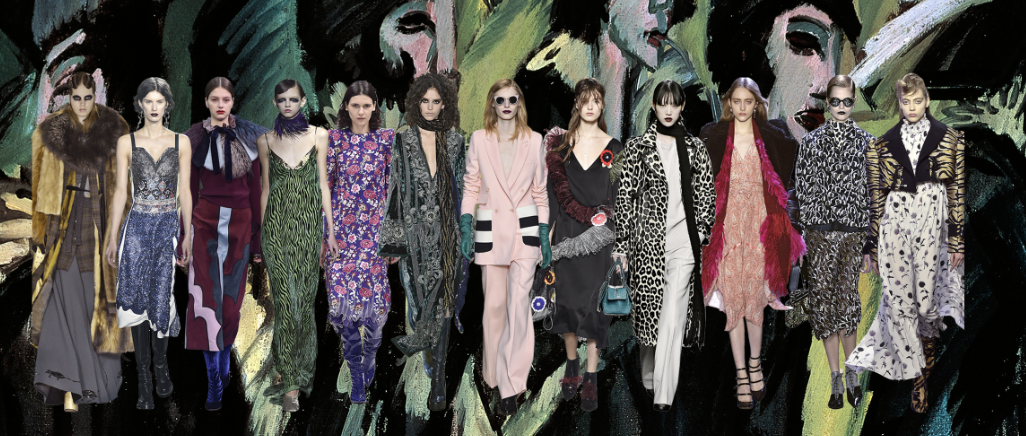
Every year, the Met Gala gives its guests a theme. Sometimes it's specific — Camp or Gilded Glamour — clearly separating those who got it from those who definitely did not. Every year, I spend a ridiculous amount of time in the weeks leading up to that first Monday in May analyzing what the theme actually means, and what we may expect to see on the steps.
This year is complicated.
The dress code “Fashion Is Art” is three words. A sentence so simple it could be a bumper sticker, yet so broad that it could mean everything – or in the wrong hands, nothing at all. I just cannot stop thinking about it because underneath the apparent simplicity, this is actually the most loaded dress code we have ever been given.
Right at the center of that contradiction is this: “Fashion is not art. The aims of fashion and art are different and there is no need to compare them.” That is Rei Kawakubo, founder of Comme des Garçons, whose work is currently a centerpiece of the exhibition. The Met heard her opinion and displayed her clothes anyway.
Let me explain what I mean.
The Theme vs. The Dress Code (Yes, They’re Different.)
The exhibition theme – what’s actually going into the Costume Institute galleries – is called Costume Art. It opens May 10th, right after the gala, and it has a greater undertaking than ever before. Nearly 200 garments will be placed in conversation with 200 artworks spanning over 5,000 years of history from the Met’s own collection. Think Greek vessels next to gowns and Dürer next to Vivienne Westwood. The dress code that we will be seeing on the carpet is “Fashion Is Art.” It’s a theme inspired by the exhibition, but with a simpler directive.
The Question Fashion Has Always Had to Answer
Fashion and art have always been in a complicated situationship.
Fashion has always wanted to be taken seriously as art made with craft and vision. The art world has historically responded with this polite condescension reserved for a child who presents you with a drawing and asks you if it belongs in a museum. Lovely! But is it Art?
There have been breakthroughs, of course. The Costume Institute itself was born of this argument. Bolton’s own tenure has been a sustained political campaign on fashion’s behalf. Each exhibition from China: Through the Looking Glass to Heavenly Bodies, has argued a meticulously constructed case for fashion as a legitimate object of cultural and artistic inquiry. Or take designers like Elsa Schiaparelli who spent her career attempting to blur the line between fashion as art with her avant garde designs, like the Lobster and Skeleton Dresses, and partnerships with artists like Salvador Dali. Yet, even as those shows broke attendance records and sent fashion conversation mainstream, there has always been a voice in the media that will never separate fashion from decoration or commercial. For many, fashion is applied art, at best.
What does “applied” mean in that context? It means that it has a function. You can wear it, it’s useful, but it is not real art. Real art exists for its own sake.
To which I say: the only thing separating art and fashion is really the body. I will argue that fashion is more interesting because of the body. Across 5,000 years of collected human civilization, the one constant is dressing themselves and giving them meaning or a language. Fashion lives on a body and moves through the world. It can change depending on who’s wearing it, how they’re walking in it, what they’re feeling. It is completed by the person inside it.
This is why I find this theme so provocative . Fashion is art but it is always doing something that art cannot technically do. What’s really going to be important this year is to ask ourselves, what kind of art is fashion exactly? What does fashion do that other art forms can’t? Fashion creates a mood and ends up in the laundry worn again differently the week after. Fashion creates a mood and changes how a stranger treats you on the street. This tension is what makes fashion interesting. How thrilling to see the conversations that will occur in response to perhaps a Gabreiela Hearst or Cristóbal Balenciaga next to a Vermeer!
Costume Art is structured around the body itself. From “The Naked Body” to “The Mortal Body,” the exhibit will document the human physical existence in conversation with physical art pieces at the museum. It will use the greatest hits of art history to assist in our thinking process of what it means to be a person inside of a body in a particular place and time.
The exhibition will also inaugurate the Costume Institute's brand new permanent home at the Condé M. Nast Galleries. This 12,000-square-foot space adjacent to the Great Hall is completely transformative for this battle of art and fashion. To give fashion this location is to finally give it the legitimacy in the conversation it’s been trying to enter for a century.
Back to the Dress Code
“Fashion Is Art.” Most coverage I have seen has called this the most “open” brief the Met Gala has issued in years. While this is technically true, with specific reference era or design vocabulary, I believe that open does not mean easy. To express one’s own relationship to fashion as art is to treat their own body as the subject, and reach deep into the memory of the industry.
This theme asks guests to have a genuine point of view, or perspective on what their outfit is really saying. I believe that this is going to create the most legible dividing line we’ve seen in years between the people who truly have engaged with history and the people who reached for something architectural.
Every year of the Met Gala has that moment that really does the work of art. This year, with the body as the explicit subject, I think that is going to involve the human form in a vulnerable way. This may not necessarily be a naked or illusion dress, but something of the kind of attention a sculptor brings to marble.
I also think someone is going to take the literal route and arrive dressed as a specific piece of art that will send the internet into a two-week art history spiral. The obvious picks are a Botticelli Venus or Van Gogh’s sky. But the look I actually want to see is something uncomfortably brilliant, like the reconstructed doll-body surrealism of Hans Bellmer.
At least one celebrity is going to show up in something that makes body art, with minimal garment and maximum statement. This is going to either be the most talked-about look or a complete misfire. I have a prediction that because Beyoncé is also returning after a 10 year hiatus as this year’s co-chair, she will literally breathe life into this take.
“Fashion Is Art” is also broad enough that most things technically qualify, which means the carpet policing is going to be fierce because of the invisible parameters. One’s “personal expression of art” can look completely different than another, so the interviews are going to be extremely helpful in decoding the designer’s intentions this year.
This year feels different overall because the Met is really pushing the idea that fashion belongs in a museum as a primary art form with five thousand years of history and a permanent home in one of the world’s greatest cultural institutions.
On May 4th, when each invitee poses on those stairs in their stylist’s selection, they’ll be participating in the argument that fashion has been making for decades. Some of them will prove the point, some will muddy it. A few of them might, in a single look, make it more eloquently than any wall text ever could.
Xoxo,
Annie
What to Wear to the Office This Summer
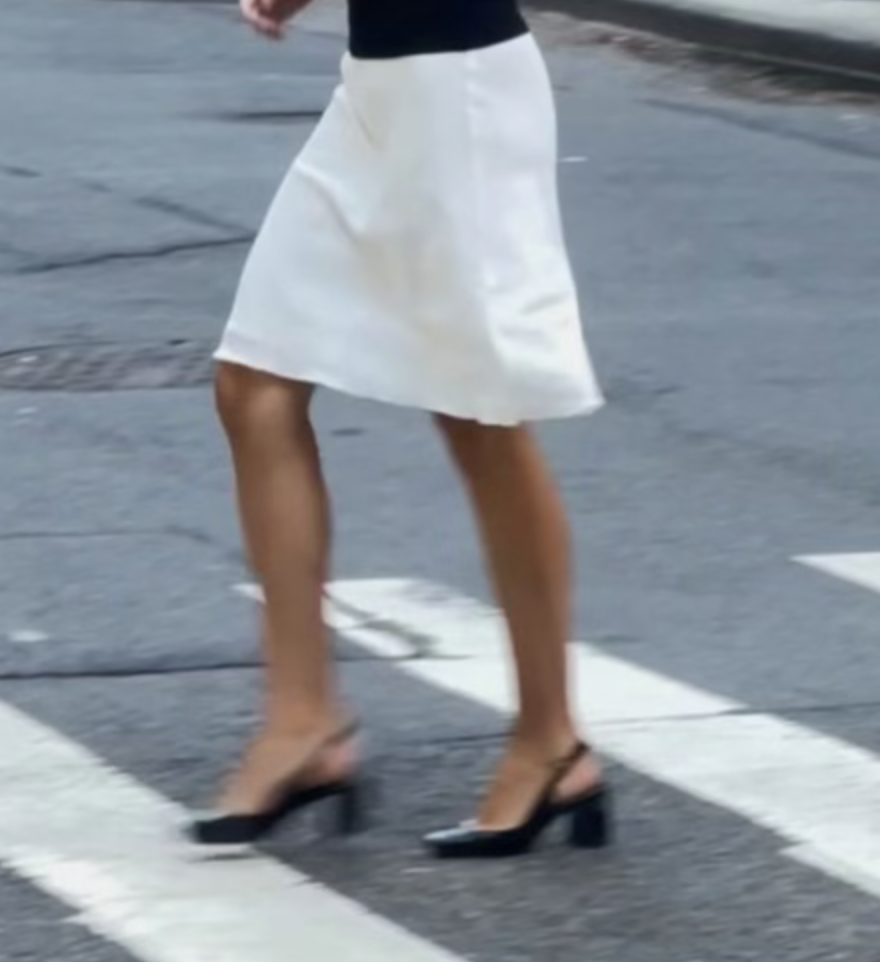
Every summer, New York City welcomes the fresh, innocent faces of a new cohort of interns. They pour off the subway at Fulton Street, Hudson Yards, and 51st and Lex, iced coffee in hand, both thrilled and terrified. This summer, you may be one of them. You’ve made it through the LinkedIn posts and late nights on Excel, and are now about to take on the new challenge of standing in front of your closet at 7am thinking: what do people actually wear to this?
The answer is, thankfully, not a mystery. New York will humble you in approximately forty other ways this summer, from your commute and rent, to the August humidity. So let’s go through this list and take the closet crisis off your mind.
Let’s start with Step One for when you have absolutely no idea what the vibe is. You likely don’t know the dress code yet. You don’t know if you will get fired if you wear jeans. In this scenario the correct move is a Frankie Shop camel crossover blazer and charcoal pinstripe trousers. Add the Margaux Parra flat in black and you’ve cracked the code.
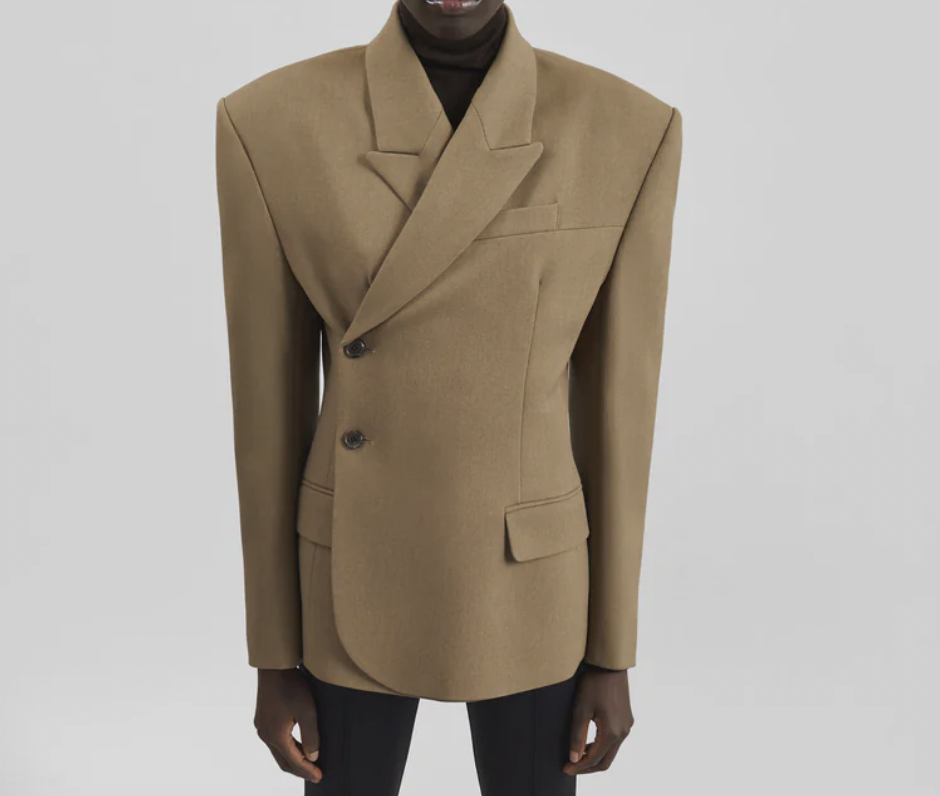
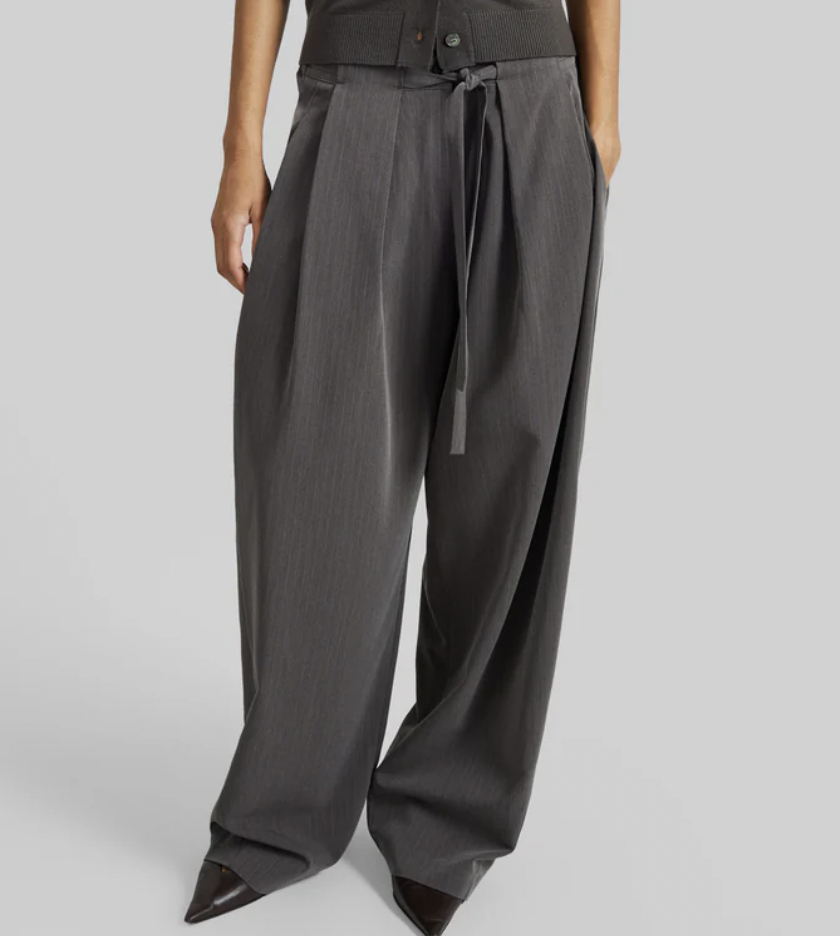
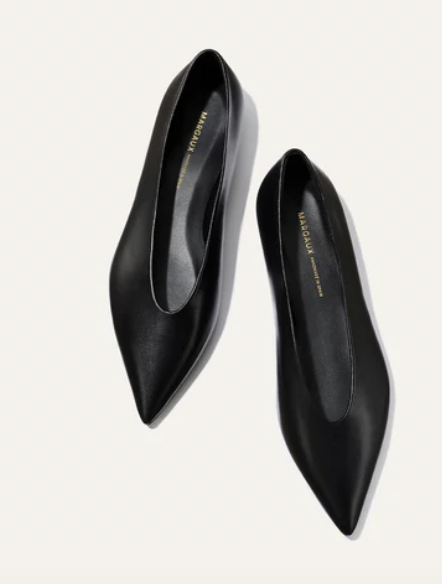
Hot tip: if the crossover front feels too much, too fast for your office environment, add a white tee underneath!
For my girls in PR, fashion, or tech, this next look is essentially a sweater and trousers, but done so well that everyone thinks you’ve cracked some kind of effortless style secret.
The track is a fine-gauge knit that falls in a more elevated way than a simple top. I especially love the WNU Devon Jumper or the Reformation Clara Cashmere Cardigan. Find a balance between fine enough for summer, and warm enough for aggressively air-conditioned conference rooms.The Kookai Ariel Waistband Trouser in dark chocolate brings in a bit of warmth and, crucially, has a waistband that won’t dig into you on an eight-hour work day.
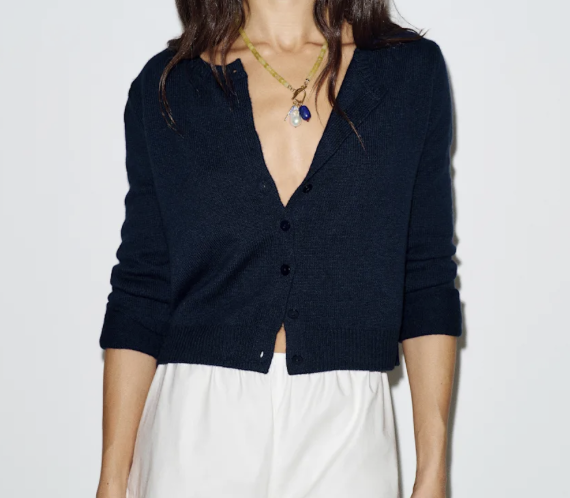
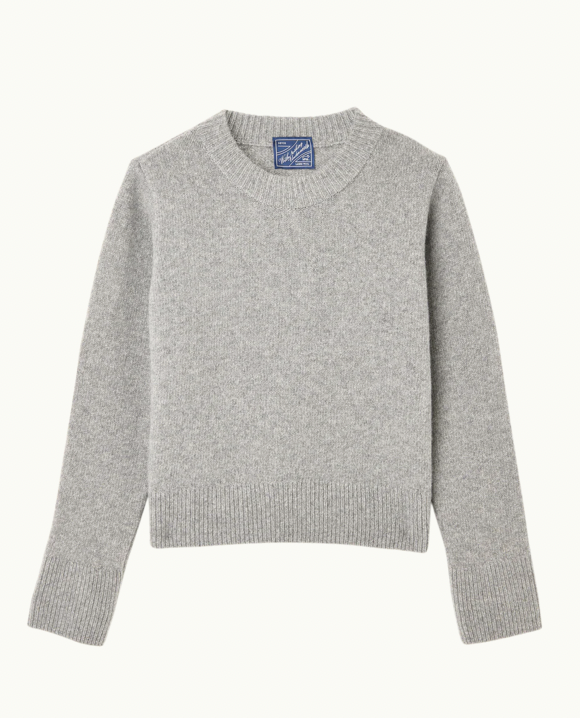
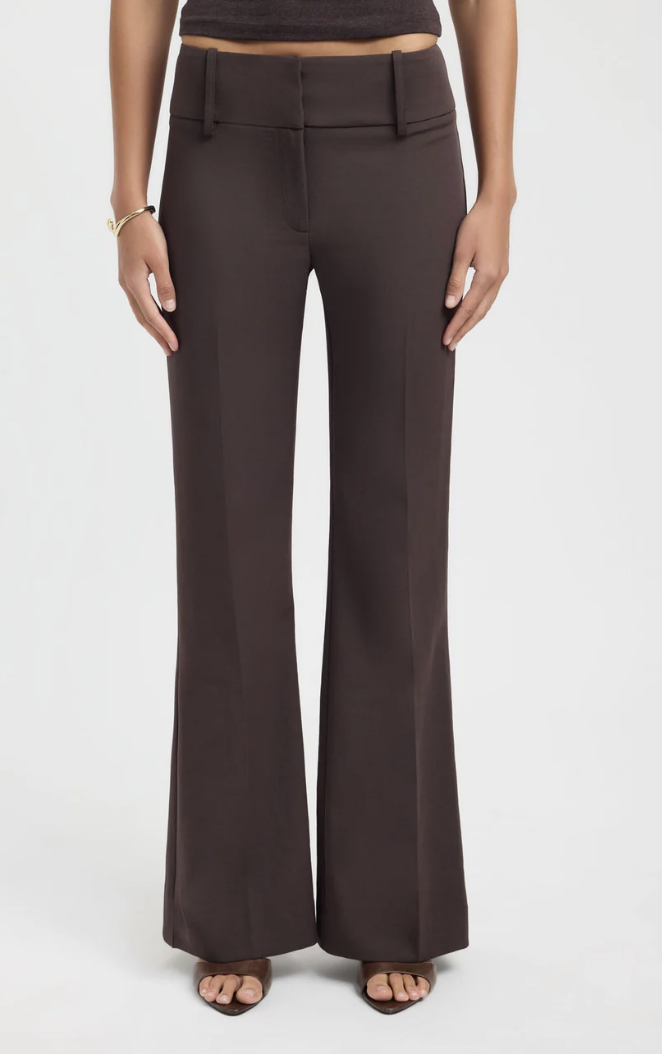
Now for those with decision fatigue after too many notifications before sunrise. The dress is the most underrated item in the intern wardrobe, because you put one thing on and you’re done. One item, out the door. Here are the ones that actually work in an office without a conversation with HR.
The Aritzia Priestly is a classy bodycon perfect with little kitten mules, blazer, and big bag. The fabrication defies gravity which does make it office appropriate. The Reiss Midi is so classy and perfect for layering over the pleated skirt. The Kole Dress by Rue Sophie is brilliantly sophisticated in Heather grey. On the more relaxed side, I love the Kookai Jac Mini Dress. A mini and blazer combo will never fail.
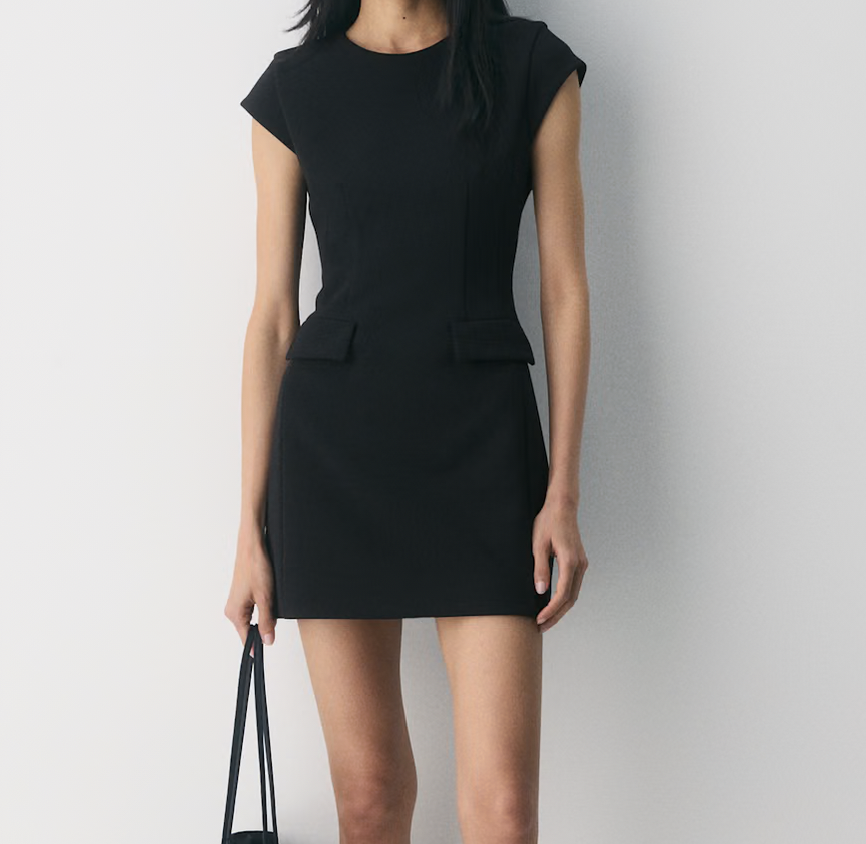
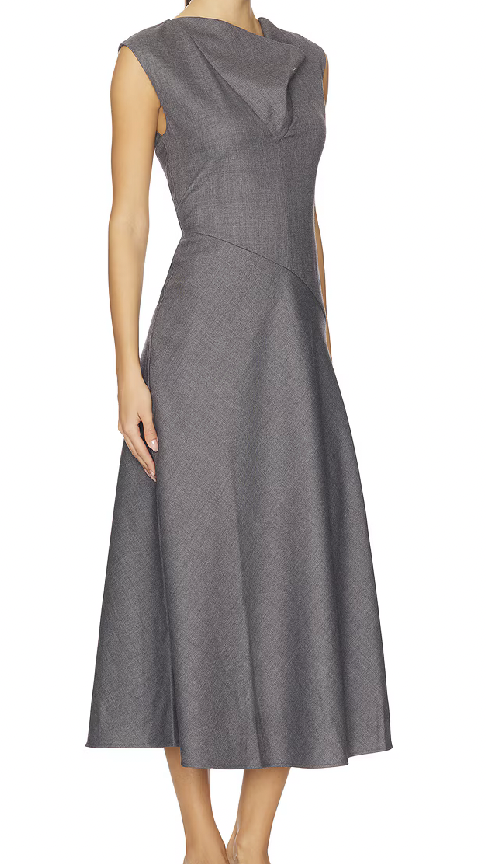
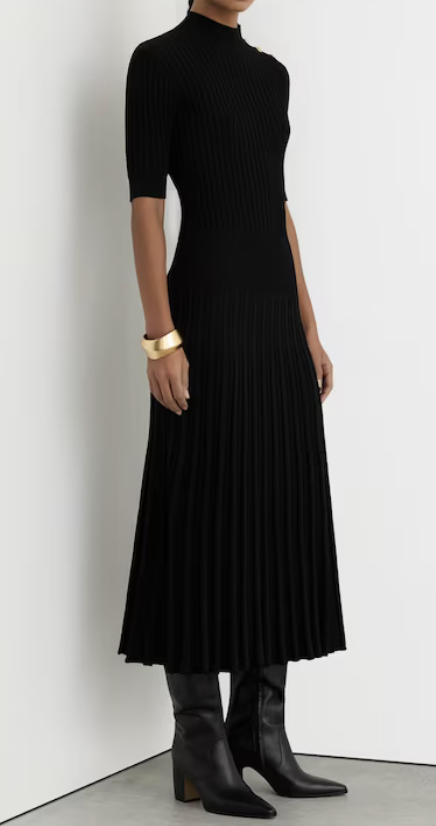
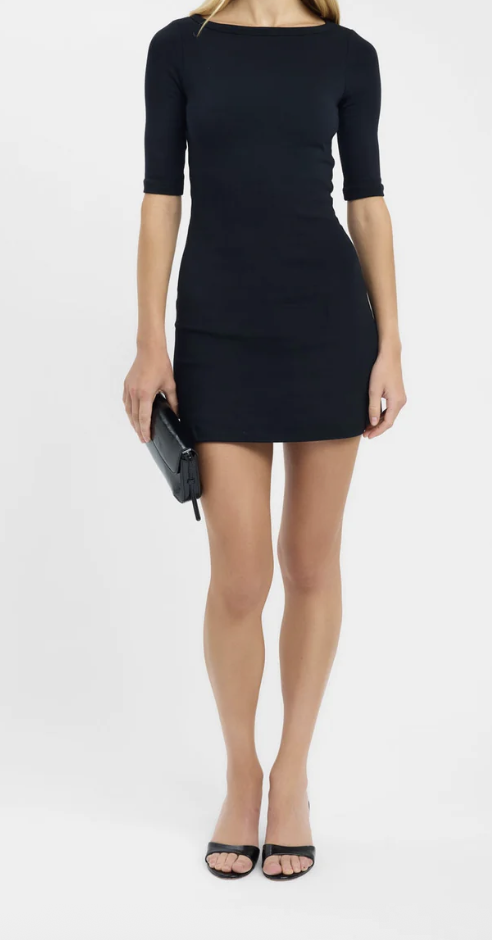
The Great Shirt Theory may be one of my greatest fascinations. Here is a truth that took my maximalist self years to accept: a good shirt is worth more than almost anything in your wardrobe. The J.Crew Étienne Oxford can be worn tucked, half-tucked, knotted, or let loose over a sharp trouser. The Frankie Shop Orsel crossover shirt is honestly more structured than it looks, and the built-in crossover is incredible for quick styling. I need both the silhouette of the Rue Sophie Piquenique Pintuck Shirt, and the pop of color from the A.L.C Dena Top in black cherry for my PR job immediately.
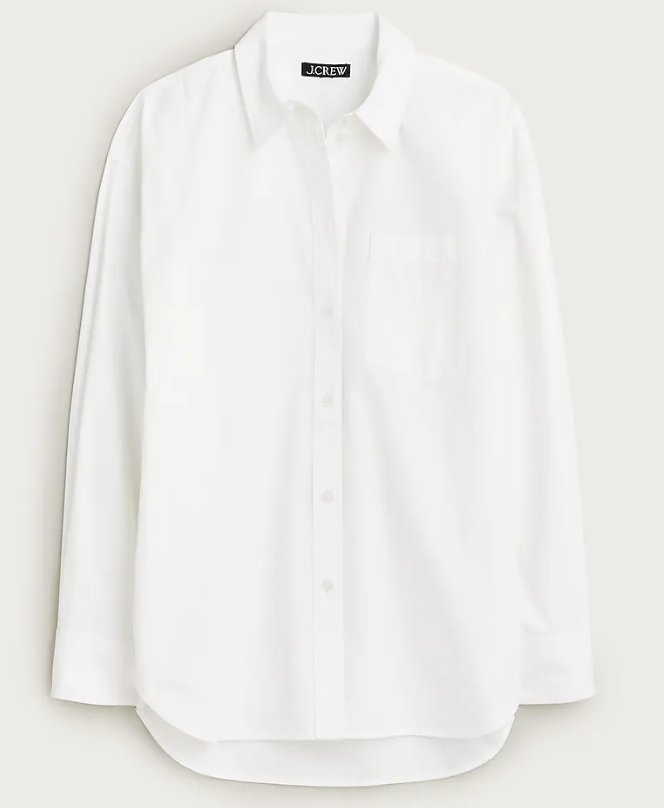
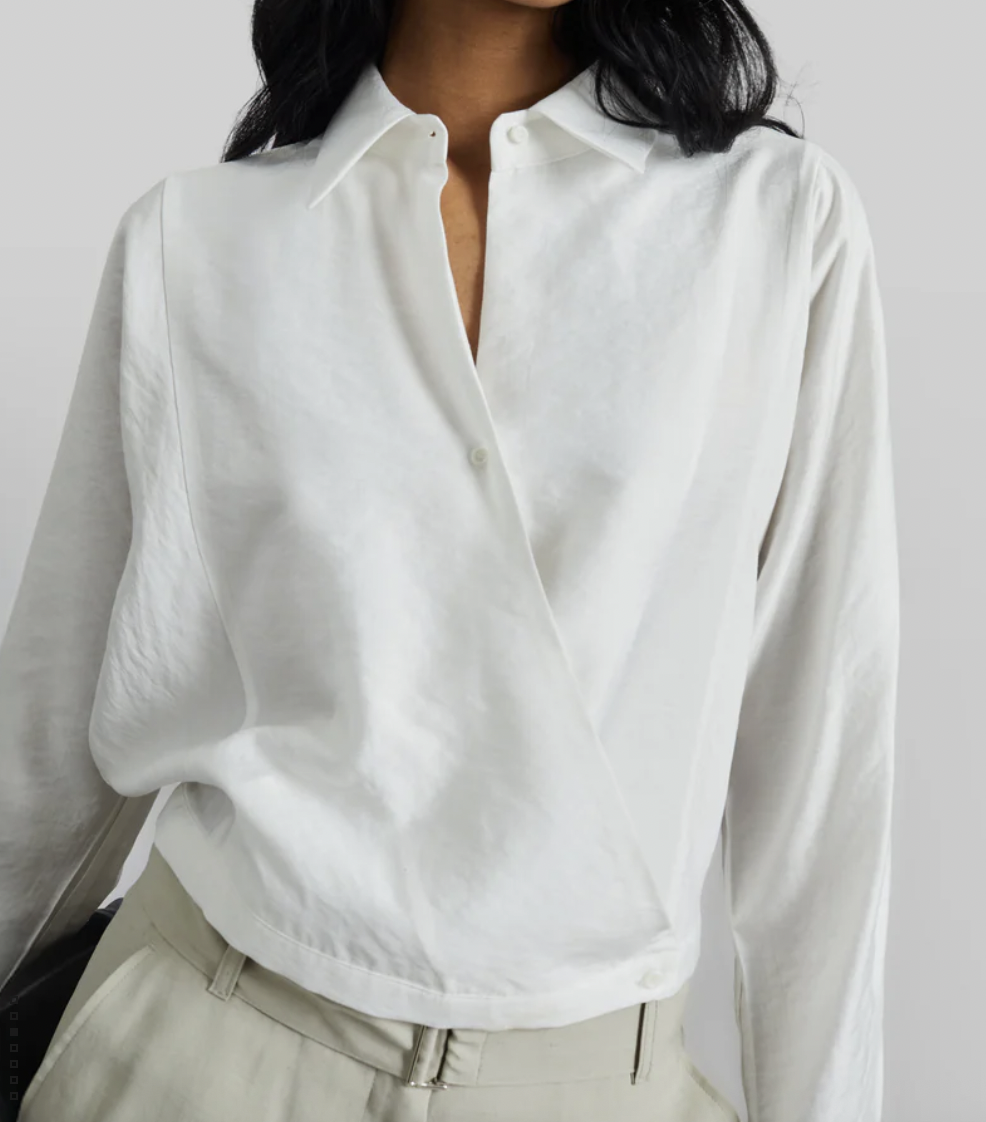
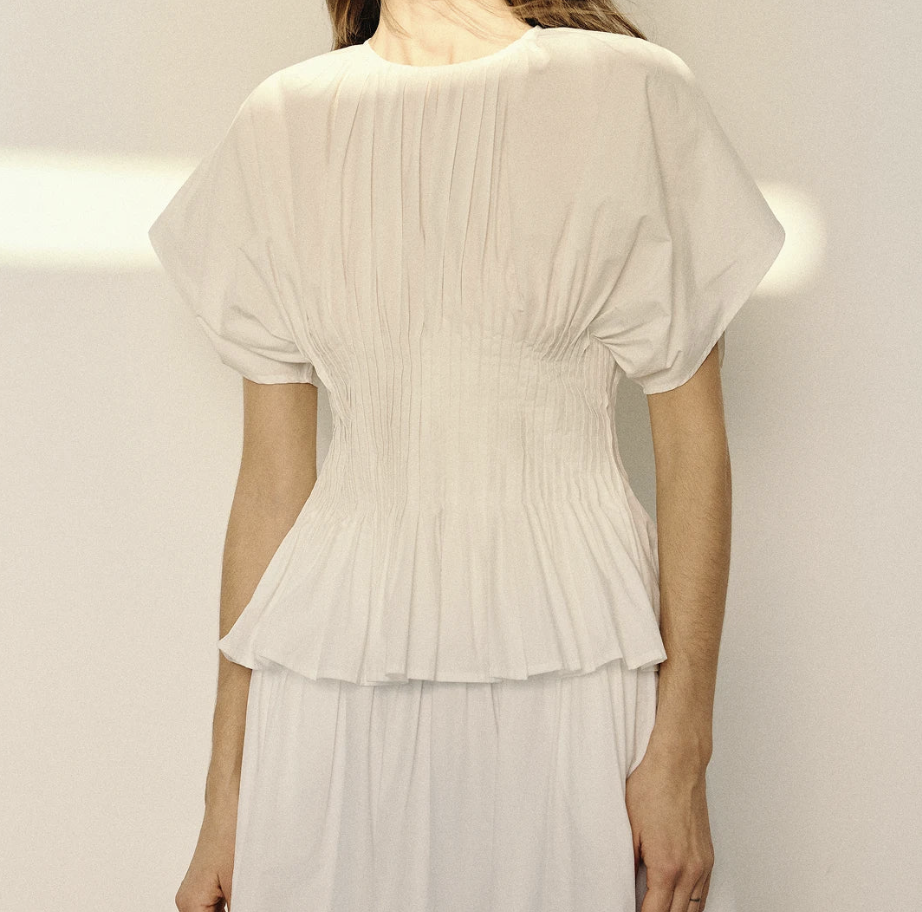
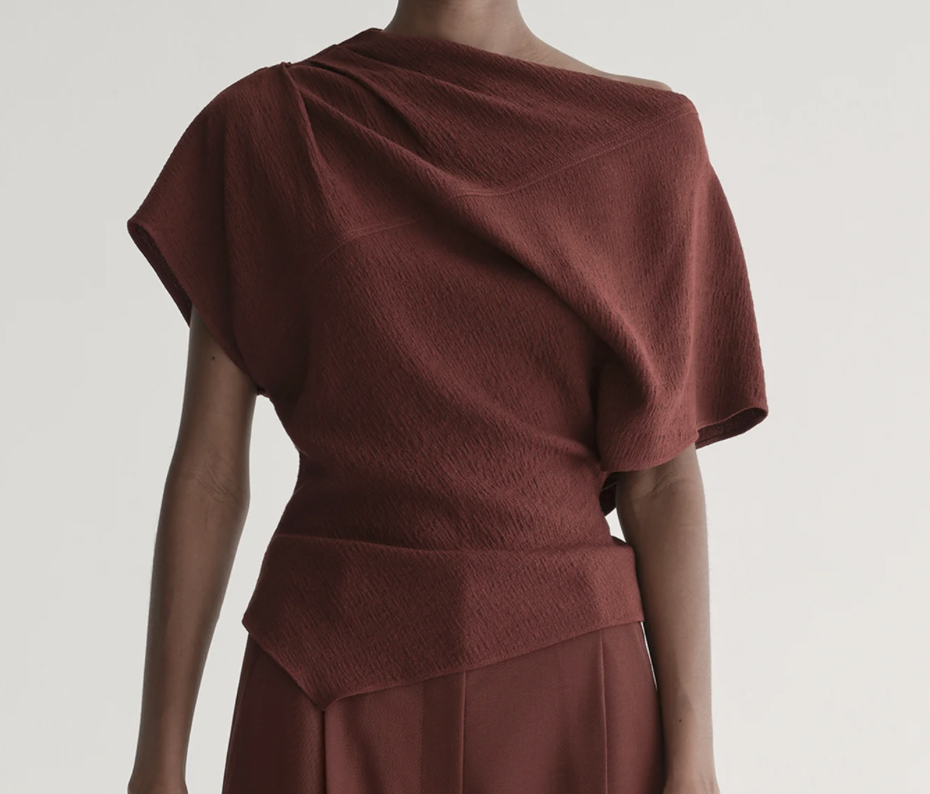
For presentation days and first impressions, the Artizia Domain blazer makes you look like you have been doing this for years. What even is entry level? Pair it with the Aritzia slip skirt in the same off-white colorway and you’ve achieved monochromatic dressing, which requires zero styling effort and looks so put-together. The fabrics are completely different so it looks intentional rather than matchy-matchy. The satin skirt and matte blazer do all the work for you. I also LOVE the J. Crew x Alex Eagle cuffed trouser and as confident anchor pieces. Finish with the Reformation Francine loafer mule, and walk in to own that office.
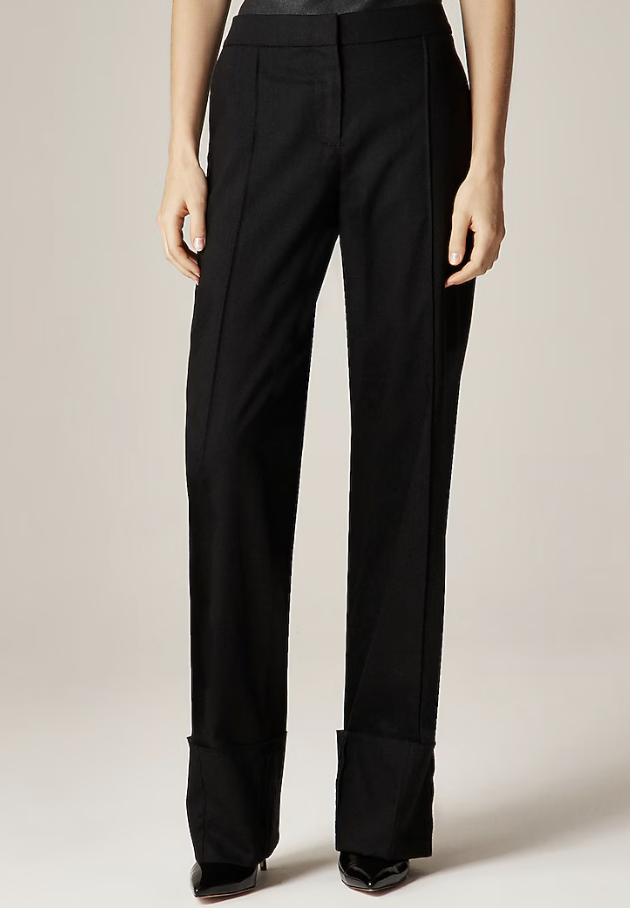
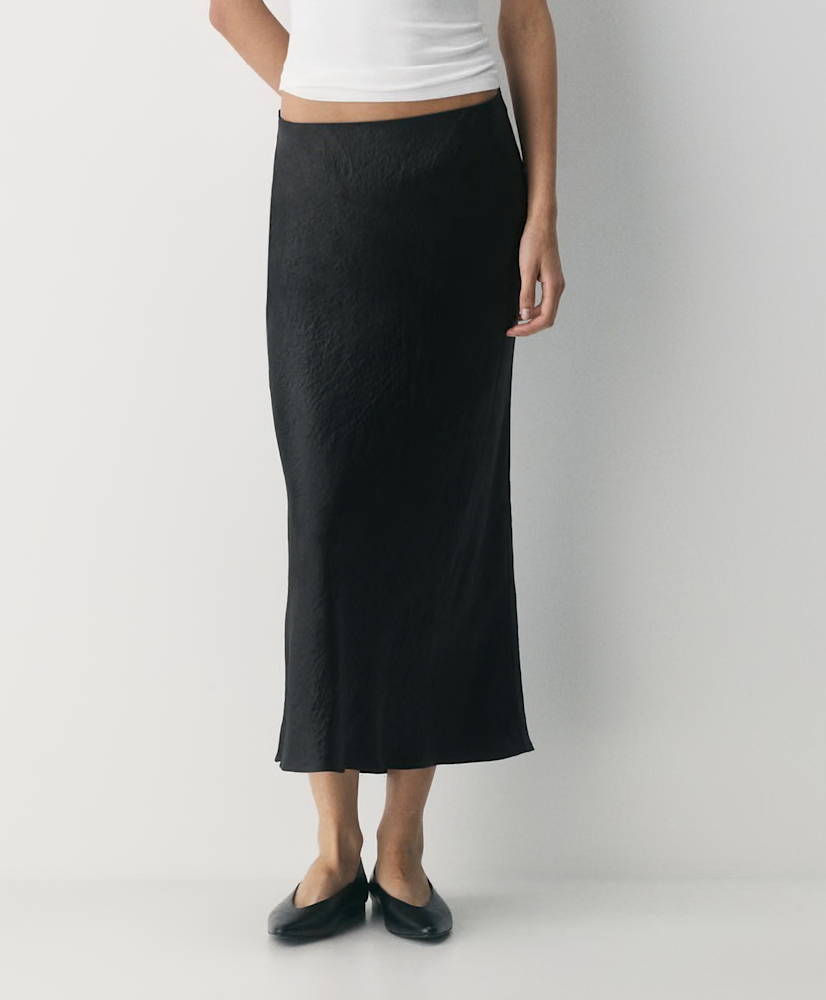
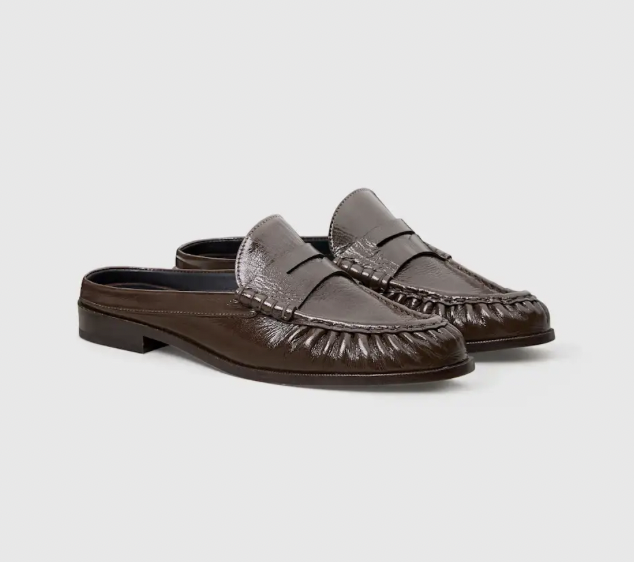
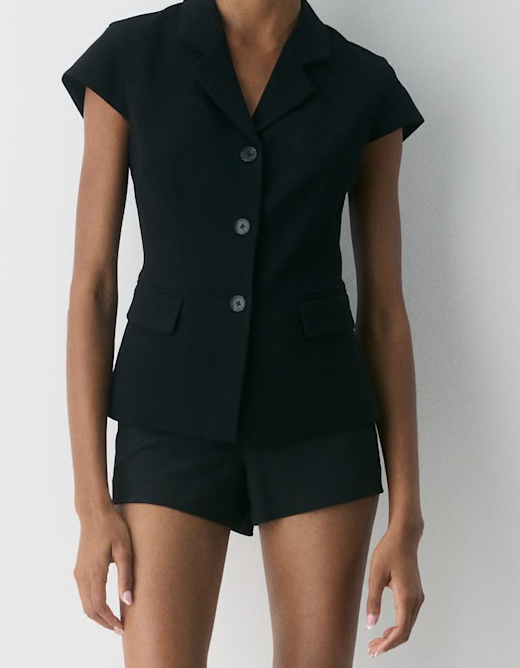
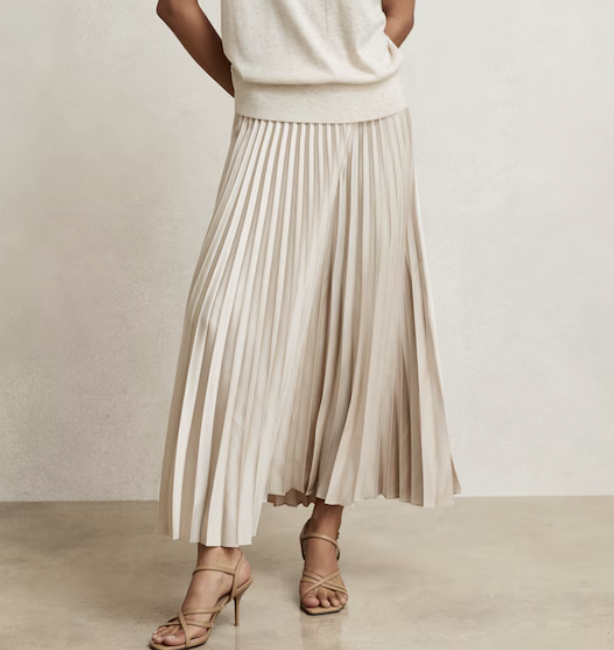
A simple cheat sheet for when your start from nothing is to build the intern capsule. Everything else will fall into place around it.
Ten weeks goes fast. You’ll figure out the job, the commute, the best lunch spots. Every morning you’ll get dressed, and it will get better and better. Come August, you’ll be the one who the new people are looking at for inspo. You will not fully know what you are doing, ever, but you will look incredible. For New York, that counts for a lot.
Xoxo,
Annie
Swim of the Summer
My childhood summers will never be topped. We were on boats before we learned how to swim, and jumping off cliffs before we were old enough to drive. Every summer was the same: the whole day spent in the ocean, you come home purple, jump straight into the hot tub, shower, grill, sleep, do it again. The greatest feeling in the whole world. This lifestyle has given me the credentials of years of swimsuits that I have tried and tested to find the perfect ones.
There is a very specific magic that happens when you find the swimsuit. The one that makes you want to stay in the water longer, walk around without anything else on, and take a million photos. I have been chasing this feeling my entire life, and I will continue to do so.
From my years of dedicated research, I have discovered that the best swimsuit shopping happens right after you leave the beach with a slight burn, salt-matted hair, and slight heatstroke. It’s like grocery shopping hungry.
That’s exactly how this edit was born. In my post-beach delirium during spring break, I collected eight suits that passed the test. These include a variety of styles and prices, with high quality, lasting sets, and sustainably made.
Indah Clothing Koh Top and Samui Bottom
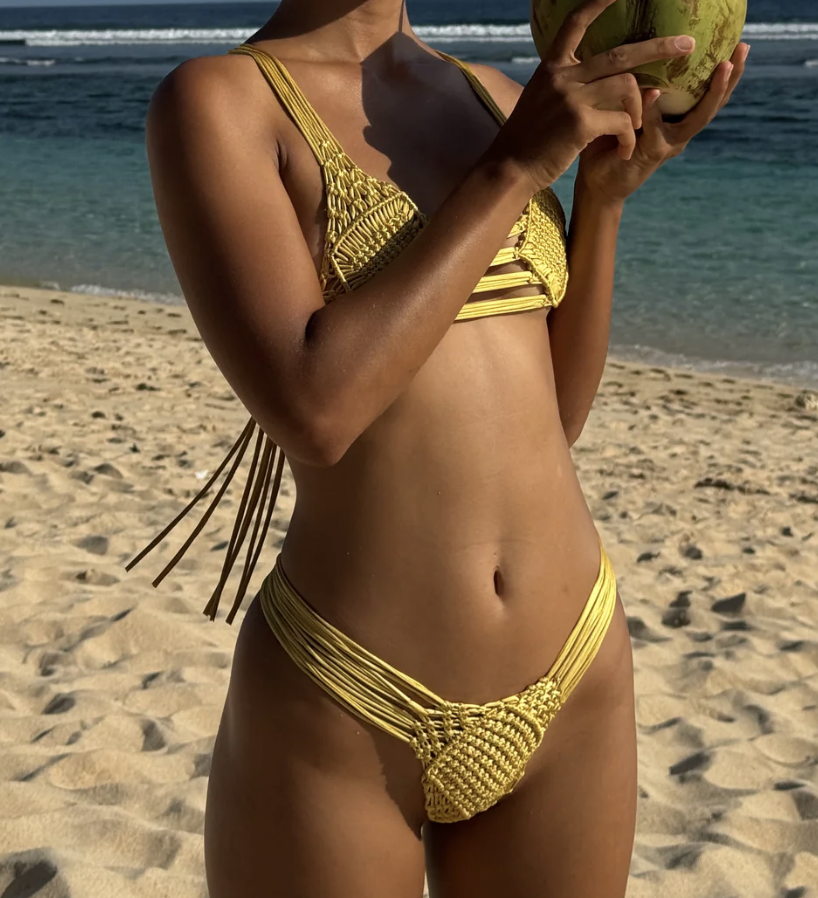
Let me tell you about macramé done right. The top alone takes over a week to make by hand, with each piece being cut into fabric strips and woven into a diamond pattern in Bali. In the Goldi color, it catches the most beautiful light and makes you look like a mermaid. Ties securely at the back, fully adjustable, and fully worthy of obsession.
Indah Clothing Dixie Top and Shelly Bottom
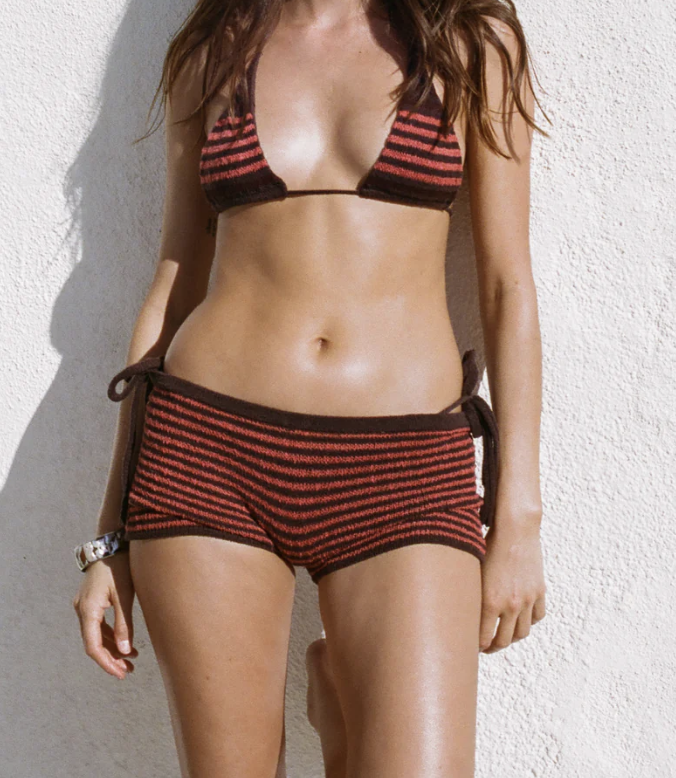
Indah does Bali-made swim the right way, handcrafted, cut and built to last for consecutive summers. The Shelly is cheeky (they warn you, and they mean it) and it’s perfect. The silhouette is vintage-inspired, and spun with a unique yarn that holds its shape when wet.
Anooa / Mise Label Luchi Bikini Set in Brown
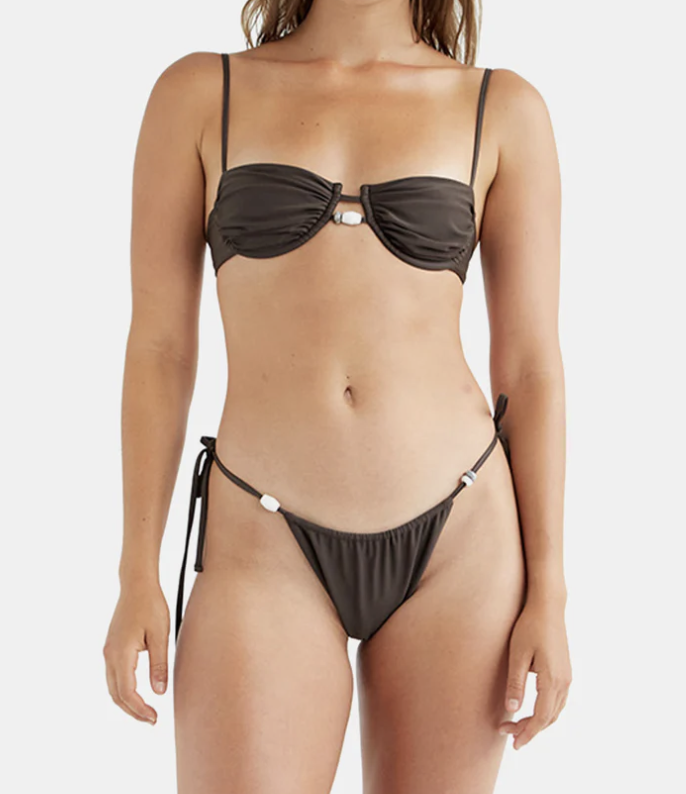
With Italian pearl beads at the center, an underwire bust, ruched balconette cut, and insane brown color, it supports you as much as it flatters you. Brown swimwear has been gaining popularity because of the magic it does to any skin tone, and this one is a perfect example of universally flattering.
Bamba Swim Malibu Top and Amore Bottoms
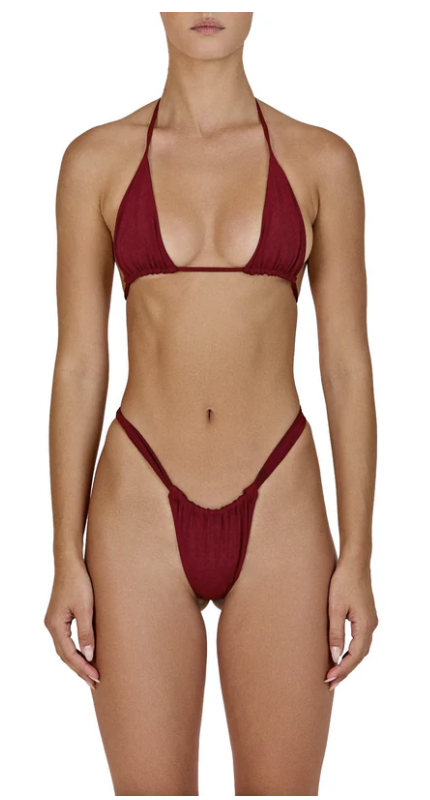
This set has that easy, California slouch that looks so effortless and stays in place so well. I cannot explain my love for Bamba swim, and this set is one that I do endorse from experience. It’s simple and sleek and built for giving you the best tan lines and staying on for swims. This shade of maroon also photographs like a dream against golden skin and white sand.
Bamba Swim Ursula Top and Rio Bottoms in Alligator
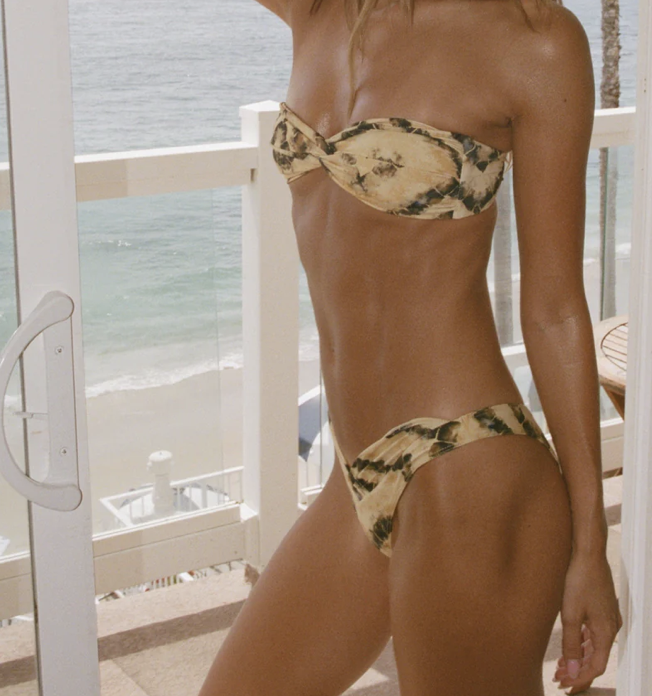
This set hits the waist exactly right, with the most unique print and ideal coverage. Rio is the hottest bikini capitol in the world, and with this set on, you will be turning heads wherever you are.
Horse & Berries Eternal Top and Elba Bottom in Root
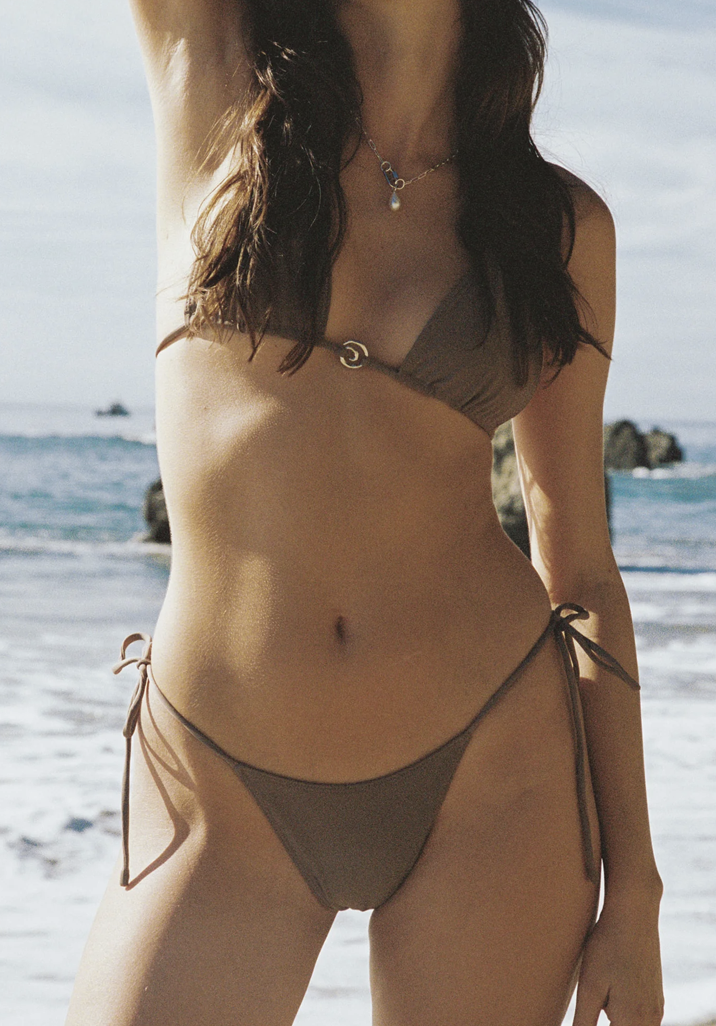
Root is the color of the earth after it rains, a dried fig left in the sun, and a really sick leather bag. This set is the earthy anchor to any good swim collection. So simple, perfect for tanning, and the coolest base to any all-white outfit.
Gooseberry Intimates So Chic One-Piece in Cassis
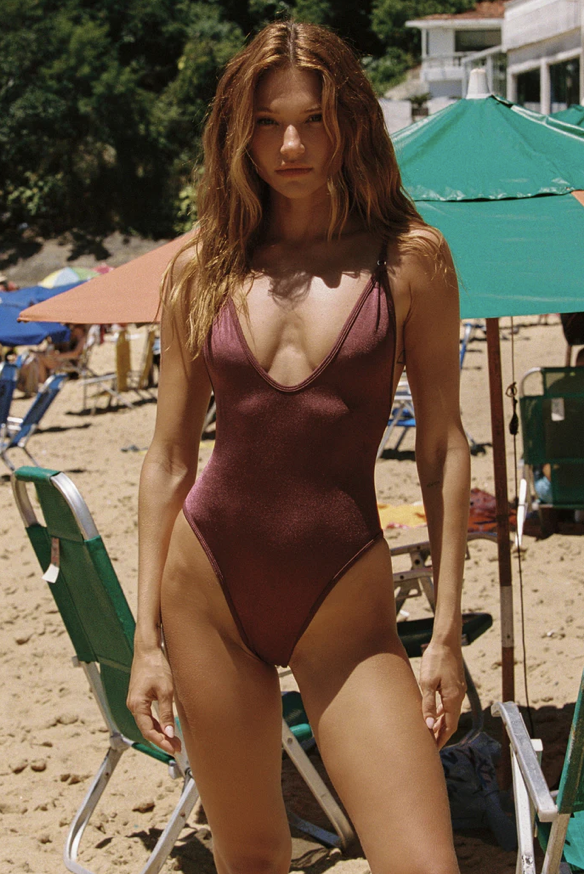
I have done extensive one-piece research, and have yet to find a more flattering choice. The one-piece is everywhere, and for good reason. It’s simple, sexy, sculpting, and genuinely does stay on in the water. I recently discovered this deep, inky-purple black color that reminds me of the south of France. Purchased.
Tropic of C The Sculpting C in Black
Made from recycled materials, built to last, and cut to feel a simple black one-piece feel fresh, the Sculpting C is designed for the girl that swims past the brake until she's fried and pruned. This piece is rare in its ability to function and look insanely cool.
At the end of the day, the right suit does not make the summer, but it most certainly helps. My advice is to try one of these eight options, book the trip, stay in the water until your fingers prune and your skin is fried. There is no better feeling.
Xoxo,
Annie
Oxford and Cambridge Wear Chanel
My two worlds are colliding.
I spent many beautiful years, from high school to college, on the water with 5am alarms and blistered hands. I also grew up with stacks of dog-eared editions of Vogue. These two passions have lived happily in separate corners of my life for years.
Although the sport of rowing is undoubtedly as classy as they come, the Thames is getting even more glamorous this April. Chanel has announced its return as the title sponsor and official timekeeping partner of the Oxford-Cambridge Boat Race.
The Boat Race has been celebrated since 1829, hosting nearly 200 years of Oxford versus Cambridge, dark blue versus light, Putney to Moortlake. This partnership honors that heritage while emphasizing certain key components of both the sport and the maison: precision and excellence.
The J12 was inspired by the world of competitive sailing – so in a way, this partnership was always inevitable. In a sport where eight athletes and a coxswain must move in absolute synchrony with every second counting, the highest level of craft is necessary. The near-perfect instant when all eight rowers move as one — known as 'swing' — was Chanel president Frédéric Grangié's very inspiration for the partnership. These athletes are also high-achieving academics, working towards Masters or PhD degrees while training for five hours a day. This is the exact kind of excellence that Coco Chanel would have recognized. No wonder the maison felt so at home.
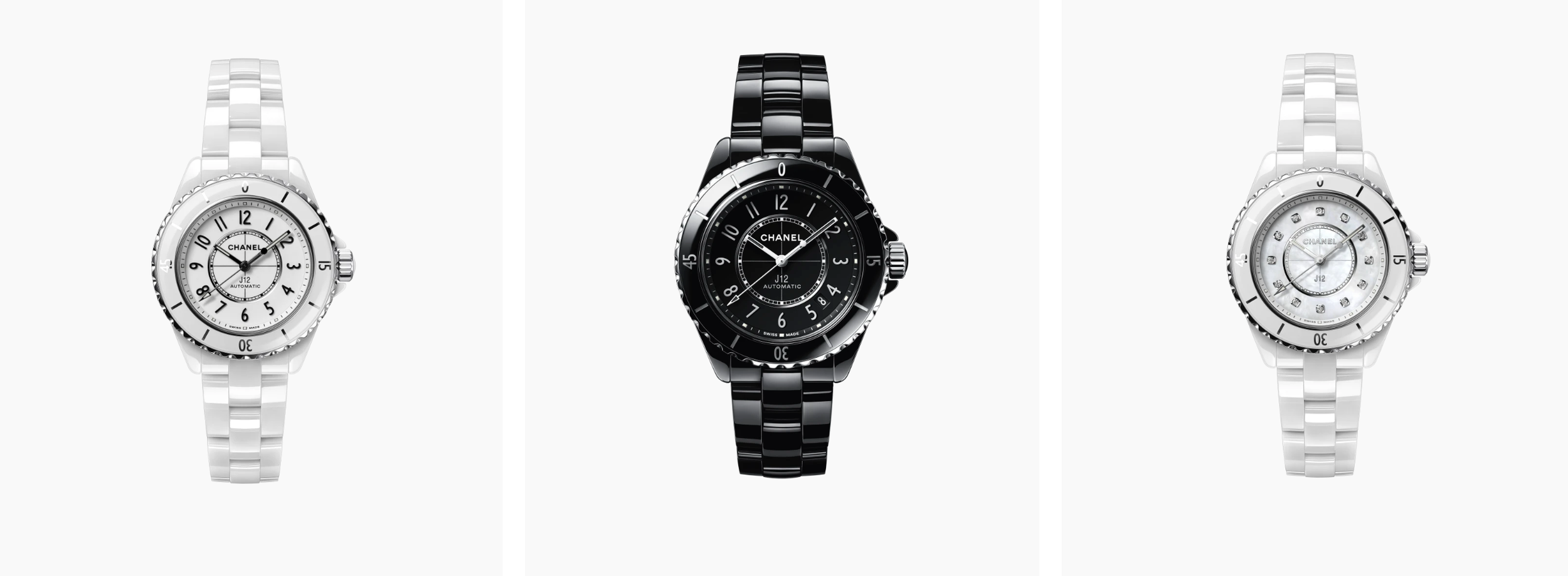
J12 Collection Courtesy of Chanel J12 Universe
What makes this collaboration so chic is that Chanel is not overwhelming the Boat Race with logos and fanfare. It is not a flashy and distinct Chanel campaign, but an acknowledgement that true icons recognize each other. Chanel stands along the banks of the Thames with a respect for the integrity of the sport, while also bringing the maison's hallmark precision and craftsmanship to the world of rowing.

Cambridge Women’s Crew
This year, the CHANEL J12 Boat Race 2026 will begin on Saturday April 4th, lined by over 200,000 spectators on the banks. All that's left is to watch the magic of eight blades catching the water together, and to see what happens when two icons move in perfect sync on Chanel’s time. My two worlds are crossing the finish line together.
Xoxo,
Annie
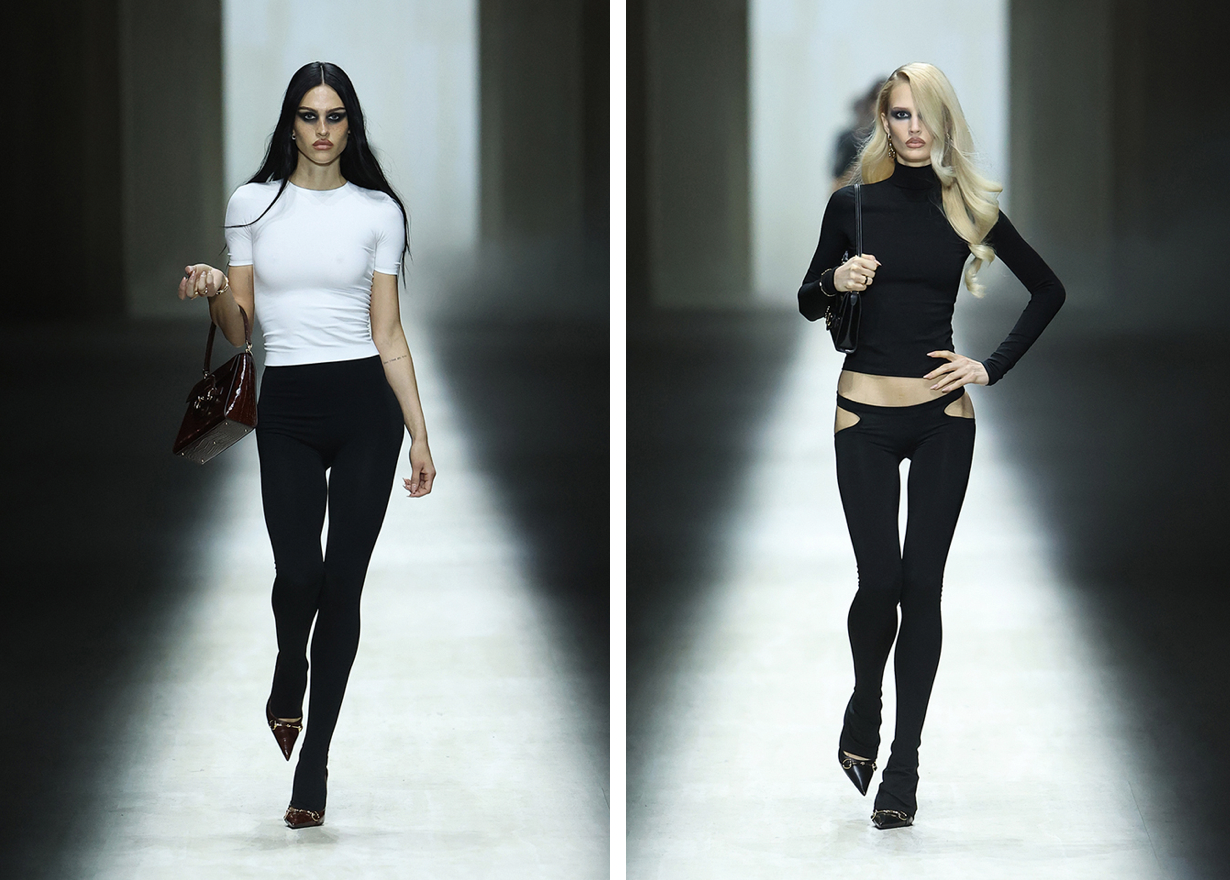
What Happened to Gucci?
I wanted to love it. I genuinely did. Gucci has been in freefall quarter after quarter after quarter, and nobody roots harder for a good comeback story than me. When Demna was tapped by Kering to revamp Gucci, I understood the logic. He resurrected Balenciaga out of its most damaging moments, and he can create cultural relevance out of thin air. I will even go as far as to say that he may be the most talked-about designer of the last decade. I was open to it, genuinely, and I watched the Fall/Winter 2026 show debut with every intention of being convinced.
I was not convinced.
Demna is so talented and formulaic in the way he views his collections. Every detail from the darkened venue with the single dramatic spotlight, the celebrity-stacked front row engineered for maximum press saturation, the provocateur casting of industry legends with new faces and the AI generated campaign teasers are so undoubtedly Demna. It was a spectacle in the very sense of the word, but so were every one of his collections and shows at Balenciaga. In fact, it's almost uncanny how similar the pieces are. The models wore Cagole pumps, but this time with the Gucci horse hardware slapped onto the front. So as undoubtedly Demna as the collection was, I really wanted to see something new.
There were also things in the collection, like the fluid tailored suits and Kate Moss’s backless dress, that were beautifully constructed. But a collection is not a greatest hits compilation, and when I try to imagine the full Gucci Fall 2026 range together in store, I get so lost. Tracksuits were next to pleated floral dresses, which followed mock fur blousons and draped evening gowns. Demna described this collection as different characters all working together to form a cohesive framework for the modern Gucci. There was just far too much explanation needed for this specific collection to form a coherent narrative for the future of Gucci.
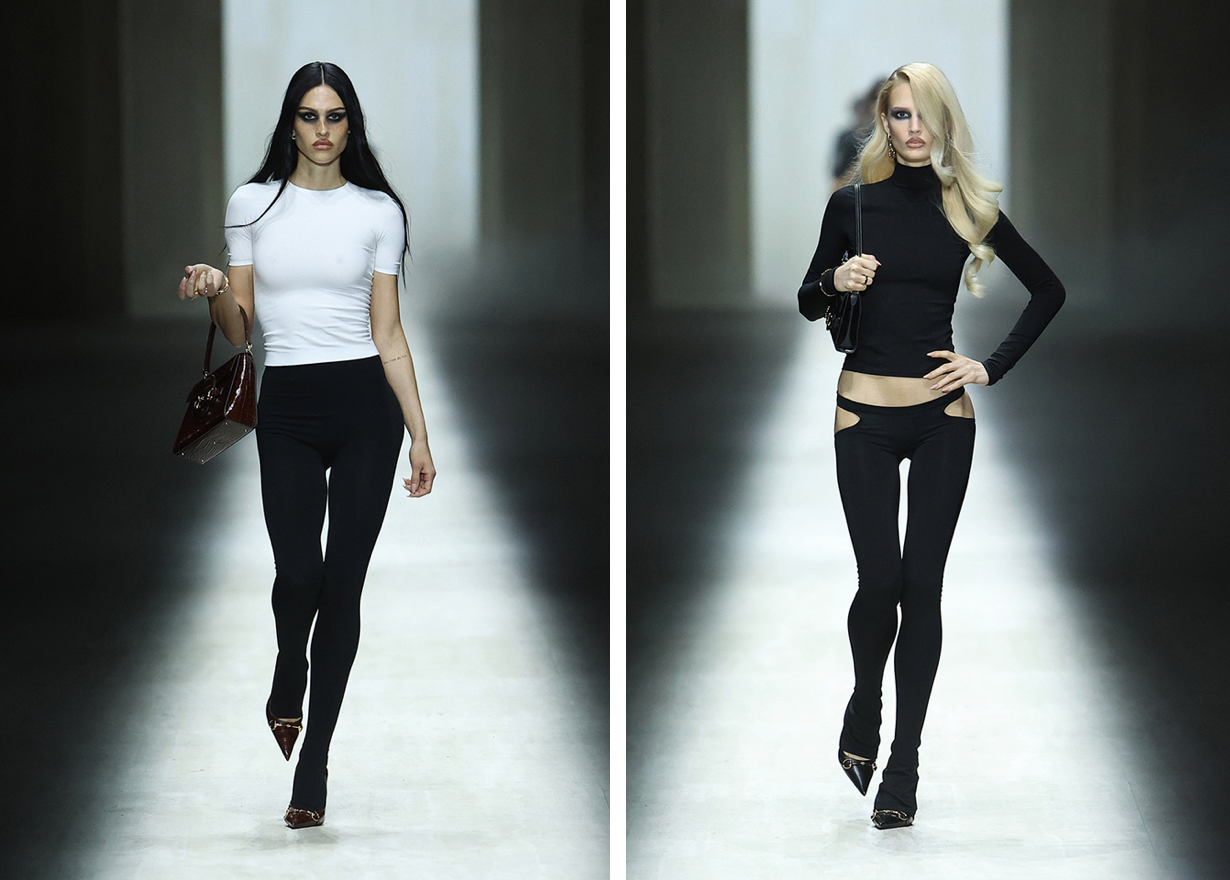
Gucci Lookbook Collection
Gucci was also historically, undeniably sexy under Tom Form. It has not, sadly, been sexy since. The commercial instinct to return to that, with the ultra low trousers, hip-skimming leather suits, and GG logo things, is not without logic. The brand truthfully needs to move product. To do so, they must feel desirable again, and Demna made a calculated decision that the fastest road back to desirability runs through Ford’s greatest hits – which I do think was a mistake.
What the show delivered was not Tom Ford’s Gucci. It was a Black Mirror episode about Tom Ford’s Gucci. I felt like I was watching a parallel reality where all the references I had once known were visually familiar but slightly off. Ford’s era was transgressive because no one saw it coming. It rewrote what luxury sexuality could look like at a specific cultural moment that cannot really be recreated. Demna’s version is not transgressive in 2026. It's almost nostalgic, and nothing is less sexy than nostalgia.
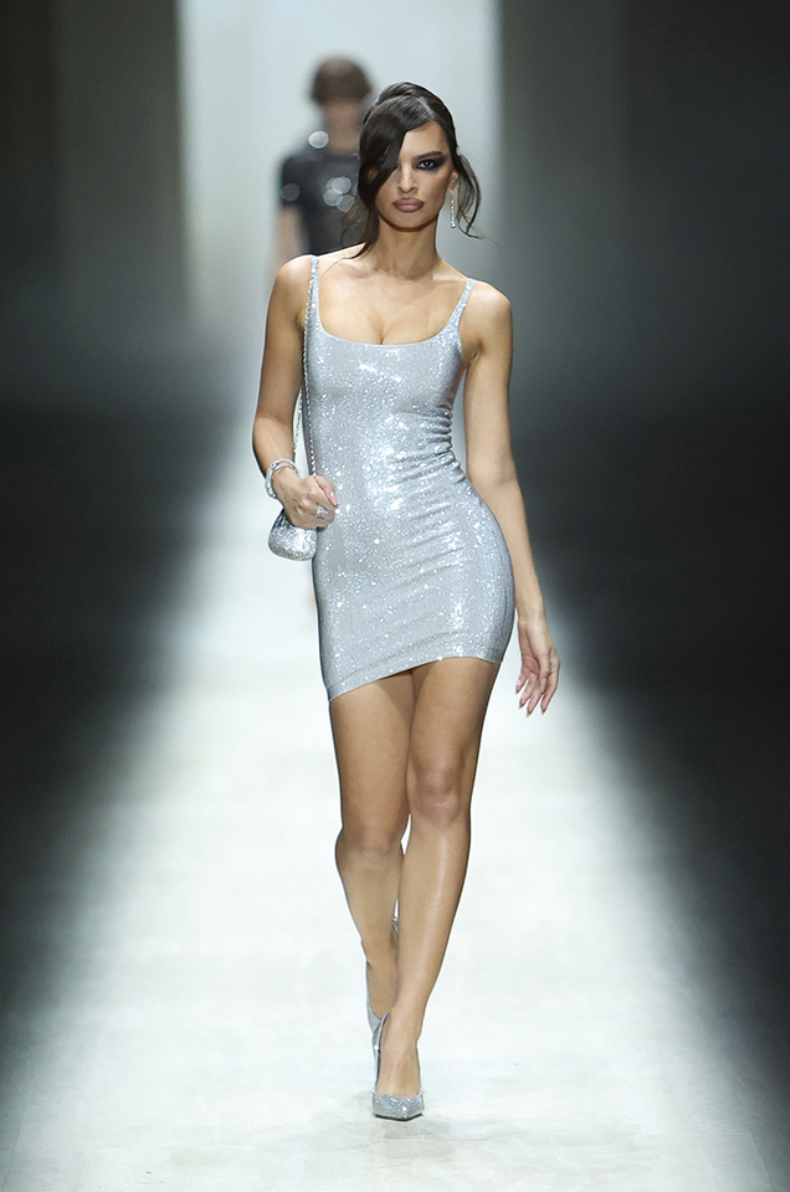
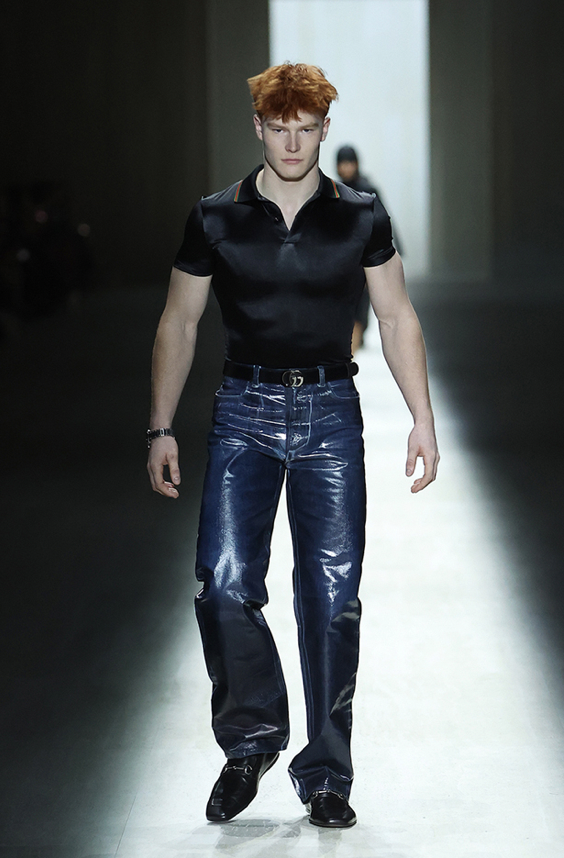
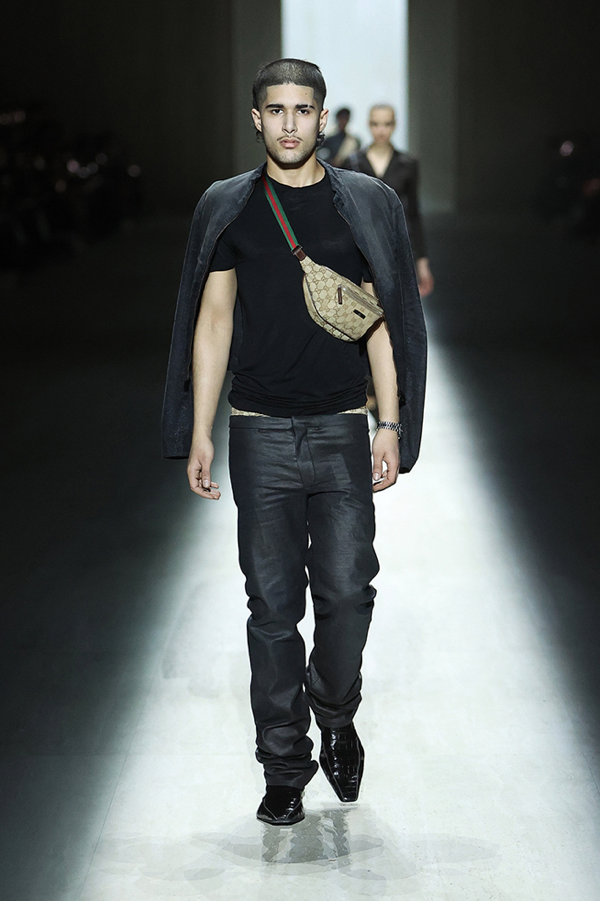
What does this all tell us? Outside the Palazzo de Scintille, fans gathered against barricades to see this show. Honestly, such a fair reaction. Because the spectacle surrounding the collection was doing an enormous amount of work, it placed so much pressure on the clothes themselves to carry their weight. I think Demna was aware of this. The noise was intentional precisely because the collection was not loud enough on its own terms. Luckily, Demna knows how to fake a show. He knew we wanted the sexy Gucci back, so he said, “Ok, I can show you sexy.”
That approach is a defensible strategy for a brand rebuilding from a low point, but Gucci is not rebuilding from nothing. It is a house with a century of real and specific identity accumulation, and there is something genuinely uncomfortable about watching it resort to an engineered virality to prove it still matters. The work is not to manufacture it but to understand its role in the history of fashion and move it forward. The goal for Gucci should not have been to return to its most photographed moment and hope for the audience's anamnesis.
The collection will sell. Demna will definitely get his headlines, Kering will report optimism, and the industry will call the debut a success because the cameras showed up and we responded. But a successful debut and saved house are two separate things. Sexy is not a front row or a legacy callback in a thong. Sexy is so self assured and has nothing to prove. The show needed all of the noise it could get, and that, more than any individual look, is the detail worth sitting with.
Xoxo,
Annie
.

5 Things I Want This Week: Spring Break
This week’s edition of my shopping addiction files feels especially justified because the city decided to start feeling like California this weekend, which can only mean one thing: spring break is dangerously close.
This absolutely scorching forty degree weather has naturally derailed my ability to think about anything practical. Instead, I’ve been sourcing bikinis and convincing myself that it is time to photosynthesize.
So while it may technically still be winter, my brain has already relocated somewhere much sunnier. Here is a list of pieces that are fueling my dreams of long beach days, frying to a crisp, heading back to shower and changing into a perfect outfit, and then biking to dinner… and doing it all over again the next day.
Songmont Small Gather Bag
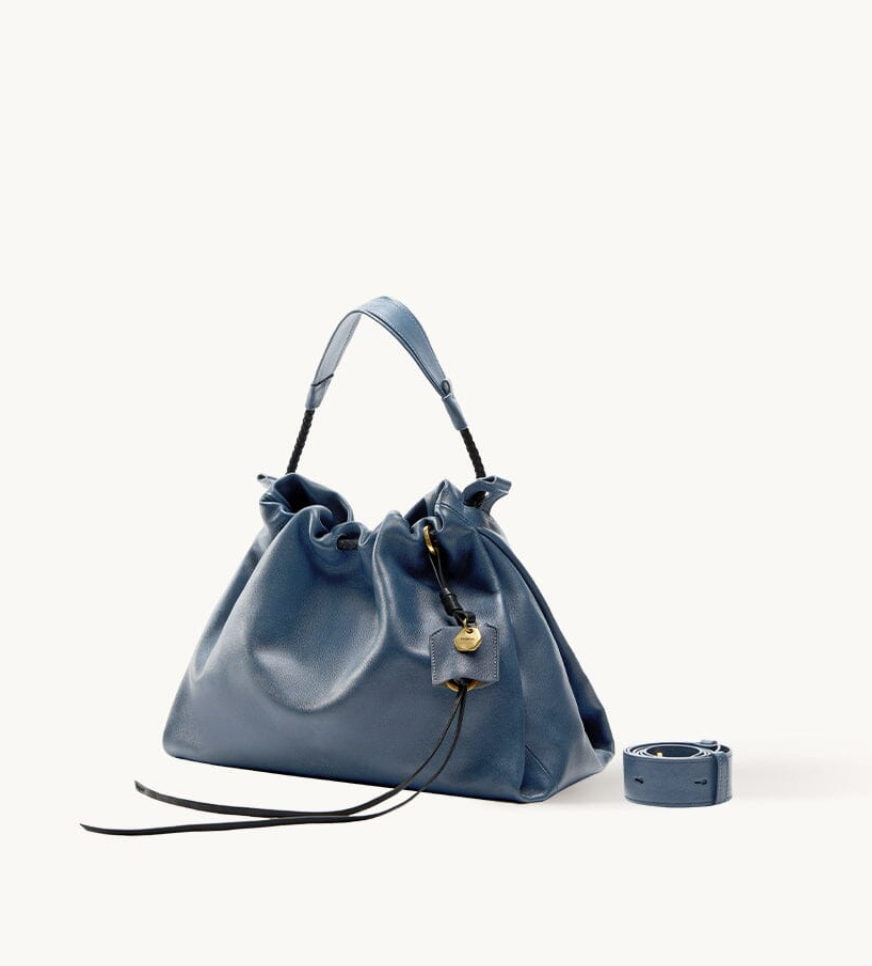
Songmont has been building a very well deserved reputation in the mid-range bag category. The silhouette of this bag is simultaneously effortless and architectural, and the gathered detail gives it this softness and dimension that most bags at this price point simply don't bother with. The navy color is such a transitional neutral, and it feels polished yet versatile enough to carry throughout the day.
Holli Studio Ana Leather Halter in Deep Bordeaux

The Ana halter introduces an unexpected material into warm-weather dressing. The deep Bordeaux leather gives the piece this richness and structure, while the minimal cut ensures it remains wearable within a relaxed seasonal wardrobe. Rather than functioning exclusively as outerwear or statement layering, the material becomes an effective way to add weight to lighter seasonal fabrics.
Havaianas Square-Toe Flip-Flop
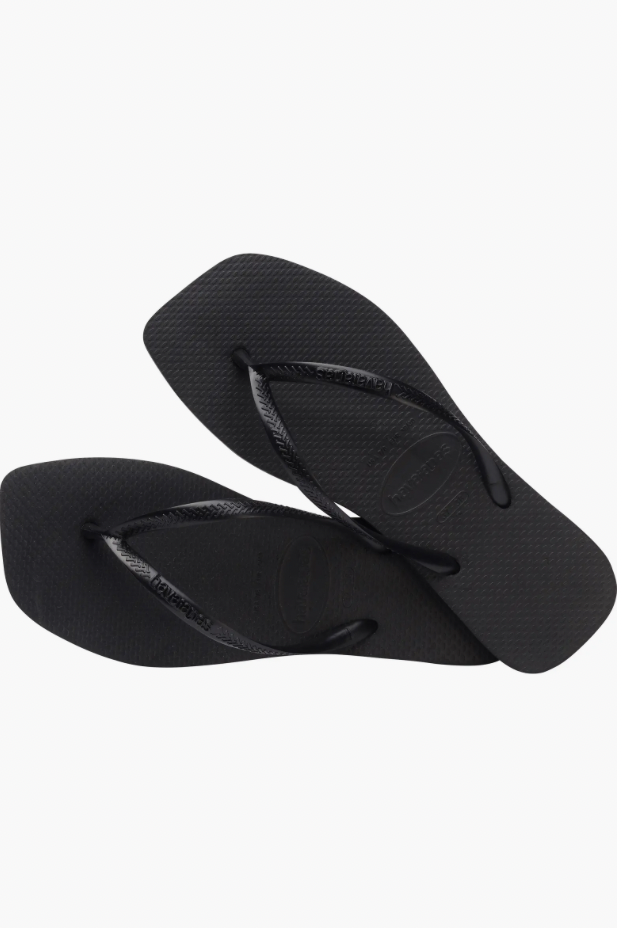
Yes, they’re Havaianas. Yes, I have owned and lost approximately a million pairs. And yes, I will still be buying more, because every summer someone tries to reinvent the sandal, and every summer we end up right back here. The Slim Square version is the sharper, sexier option on the classic, with a square toe, barely-there straps, and that long line profile that elongates your legs.
Triangl Vinca Black Bikini
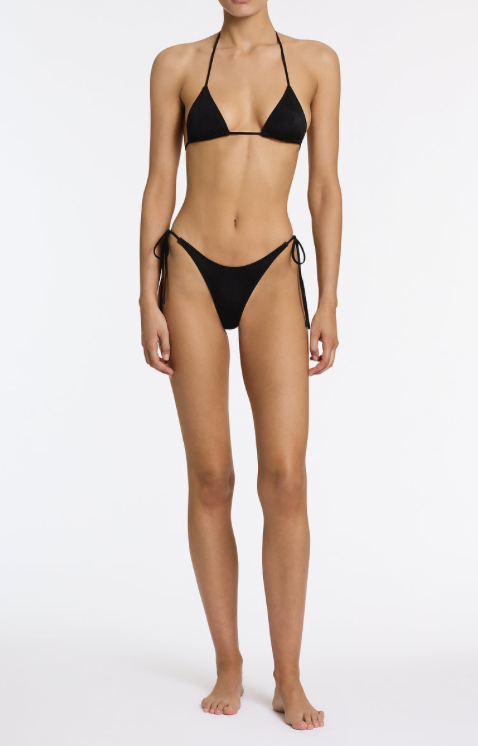
I have done a lot of bikini testing over the years. As a self-proclaimed swimwear expert, I will always gravitate toward a little black bikini. This Triangl one is the hottest Alexis Ren, 2016 summer bikini on the market. It’s universally flattering and effortlessly versatile across skin tones. It’s the bikini you reach for when you just want to feel good.
Asta Resort Ana Top and Carolina Skirt
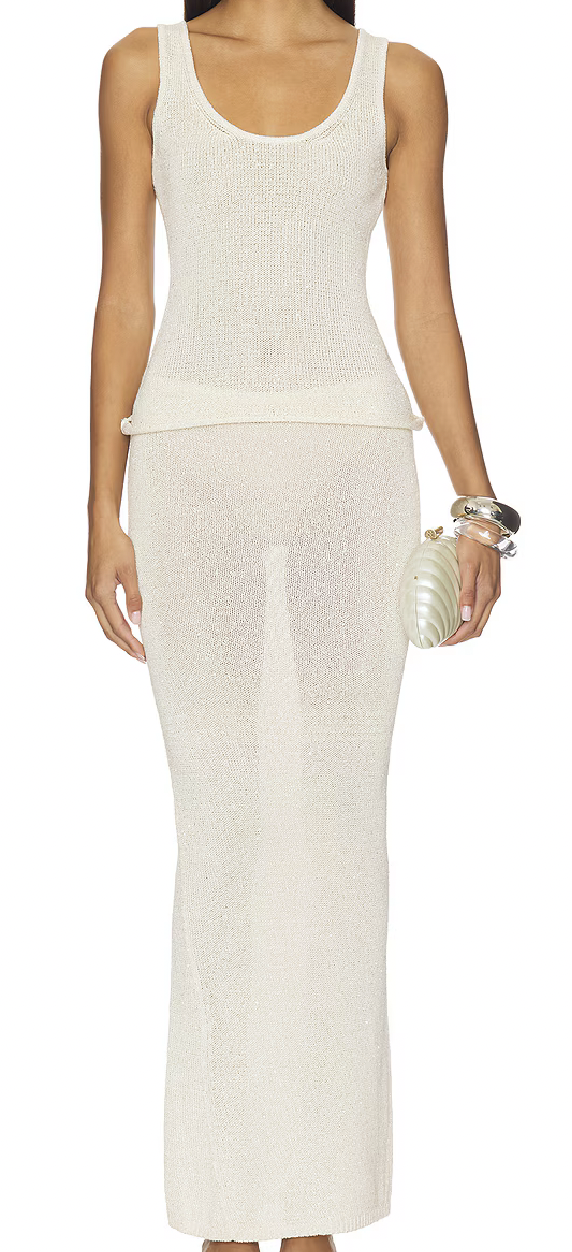
This is the exact kind of effortless set that I envision throwing on for a vacation dinner after tanning. The ivory sequins peeking through introduce texture and catch light without overwhelming the design, while the halter silhouette and long skirt keep the shape clean and modern. It’s a little sheer, a little resort, a little Capri. Paired with sandals or a heel, it easily transitions from dinner to drinks.
The best part of a good vacation wardrobe is not having to think about it once you arrive. You step off the plane and feel the warm air, knowing you are going to look and feel good.
In just a few weeks, I will update you from a beach somewhere in my little black Triangl bikini.
Xoxo,
Annie