Fashion, Art, and Amazon: Met Gala 2026 Review
In my preview piece, I made the claim that “Fashion is Art” the most loaded dress code the Met had ever issued. These three words, I assumed, looked like an invitation but were actually a dare. I said the theme would demand a genuine point of view. That it would create the most legible dividing line in years between people who actually engaged with the intellectual weight of it and the people who just reached for something involving the architectural body. I did not anticipatejust how the dividing line would appear.
Yes, there was noise around the event this year with the Bezos co-chair situation, protests, and notable absences. Of course, I will get to all of it, but I want to start where the theme itself starts: with the body. That was always the real question on the table Monday night, and it almost got lost in the surrounding conversation.
The accompanying exhibition, Costume Art, is structured around the body itself – from the “Naked Body" to “The Mortal Body,” nearly 200 garments placed in conversion with 200 artworks spanning 5,000 years. Curator Andrew Bolton described fashion as the “common thread throughout the whole museum,” or the connective tissue between every curatorial department that the Met has. His goal was to disband the old hierarchy between fashion and fine art, and establish what he called “equivalency of artworks and equivalency of bodies.”
This is a beautifully radical idea, but also a terrifying belief to hand to a celebrity red carpet.
“Fashion Is Art" asks its audience to have a position on the body, and on what the clothing does, says, reveals or conceals about being human. Most dress codes let you interpret your way into a pretty dress. This one asked for an argument.
Best Dressed
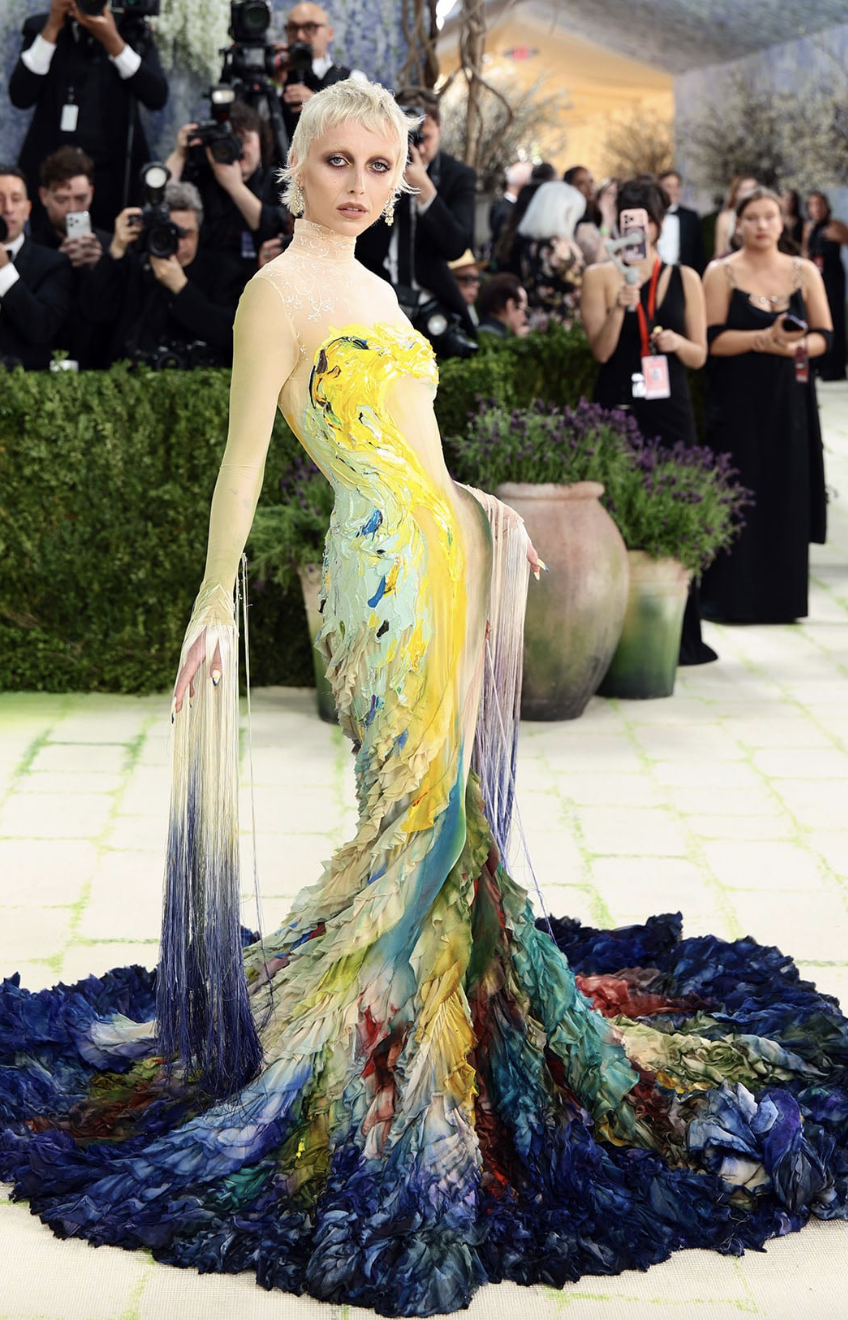
The first look I saw was Emma Chamberlain who opened up the steps with my favorite look of the night. I absolutely adore when a Mugler looks like a Mugler. Castro Freitas and Anna Deller-Yee’s hand-painted design is reminiscent of a dripping watercolor effect as if a wake of paint was to follow her up the steps. The idea of embodying the visible brushstrokes of the Impressionists managed to turn her body into a walking canvas.
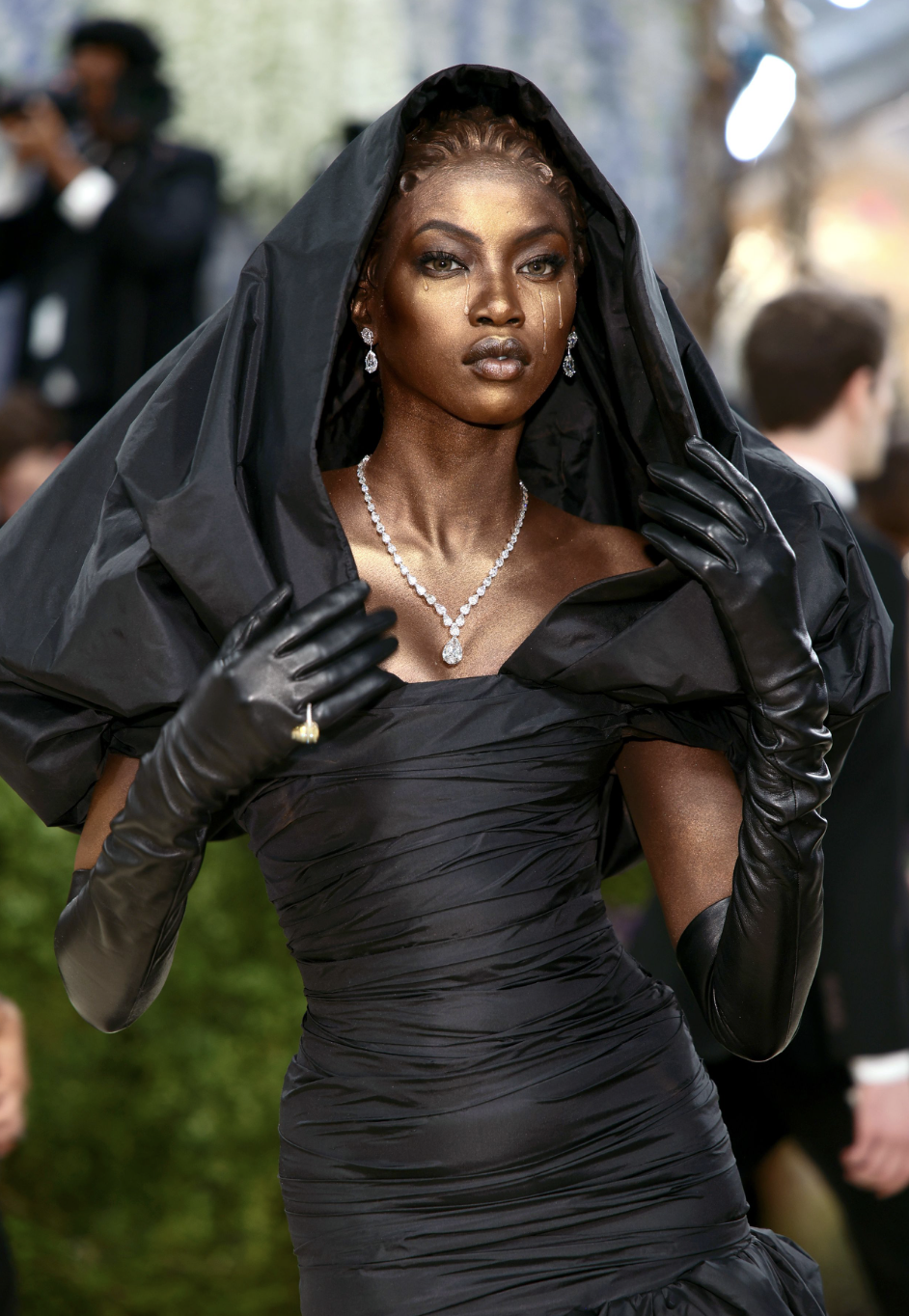
Anok Yai in Balenciaga by Pierpaolo Piccioli was another look of the night that genuinely had me glued to the screen. She arrived as the Black Madonna, having built the concept herself as a hopeful response to the tense climate of the world. The prosthetic hair and gold tears running down her face were sculpted to create the impression of an etched statue of devotion. This looks really means something as a form of protest art, worn on a body with its own story.
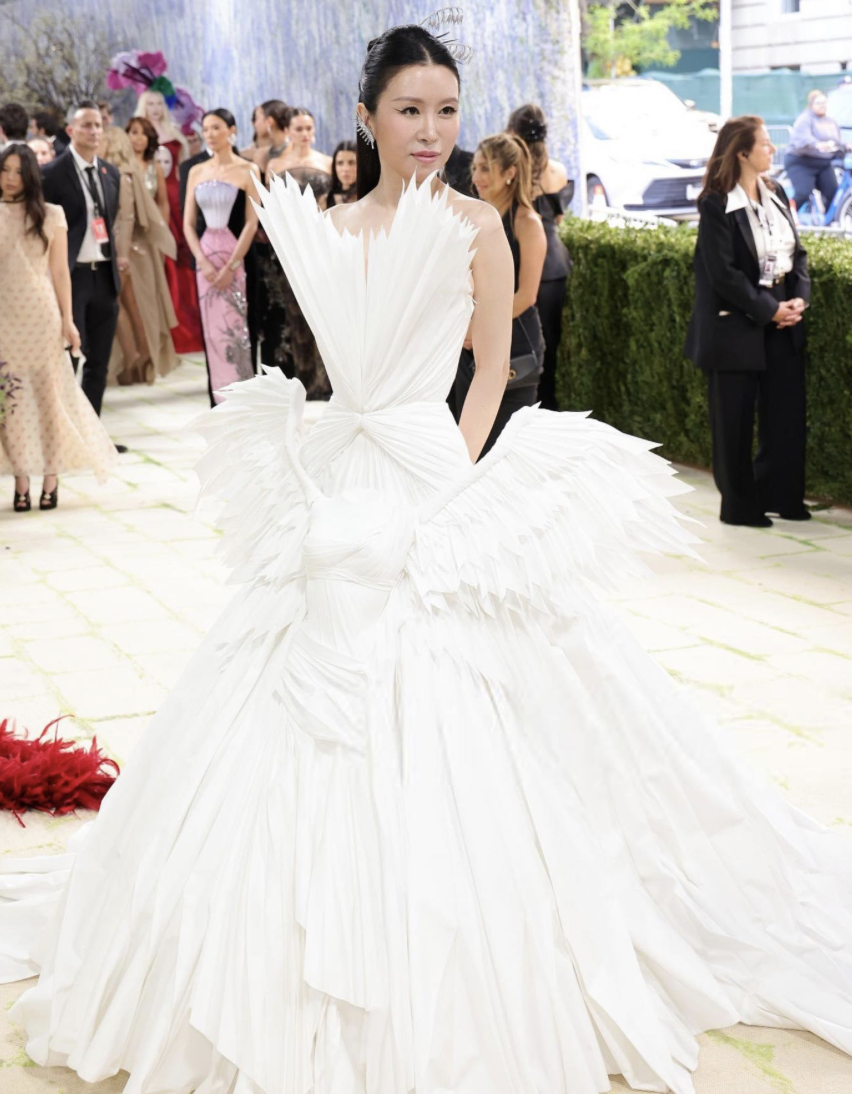
Yu-Chi Lyra Kuo arrived in Jean Paul Gaultier as the Winged Victory of Samonthrace. This headless, wingless Greek goddess of Nike was brought back to life and given a head again, The white sculptural gown with its sharp fan-like neckline and layered pleated skirt gave the statue incredible movement. What the original lacks – a head, arms, and a future – Kuo restored. This is the kind of reference that enters into dialogue with art history. This was the cleanest silhouette and most intellectually satisfying look of the night.
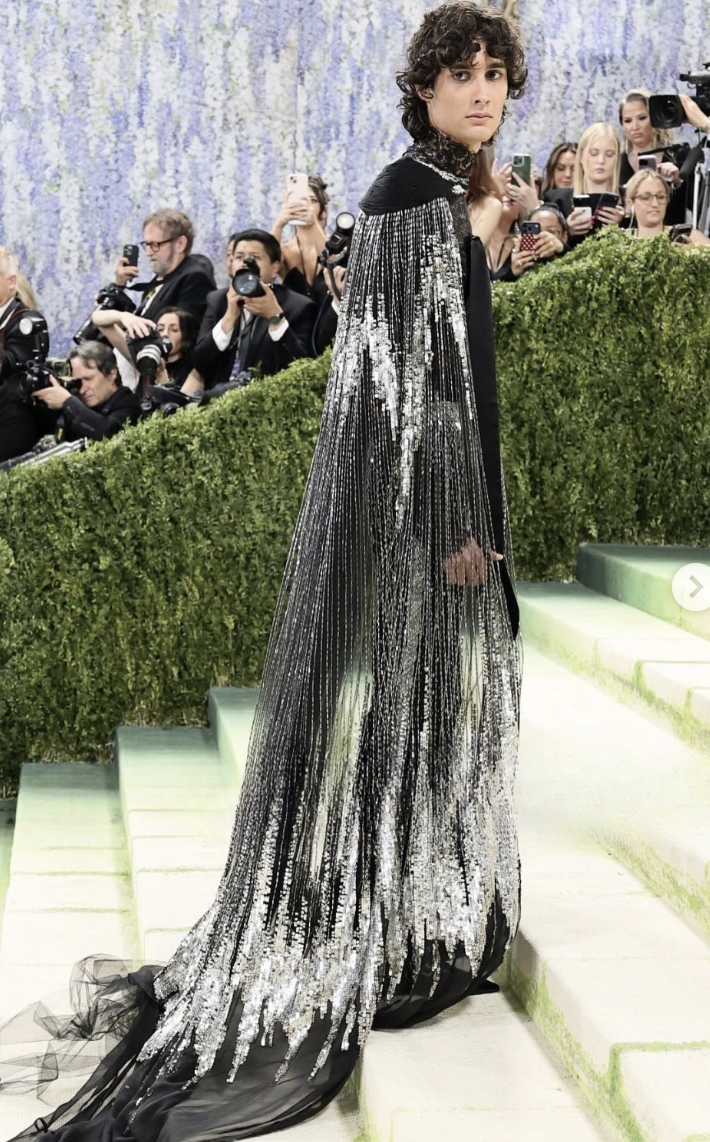
For his Met Gala debut, Sombr arrived in a custom Valentino by Alessandro Michele. A crystal-dotted cape over gothic black lace panels and large shoulder pads looked like a medieval altarpiece adapted for a modern pop star. This look made the sacred feel wearable.
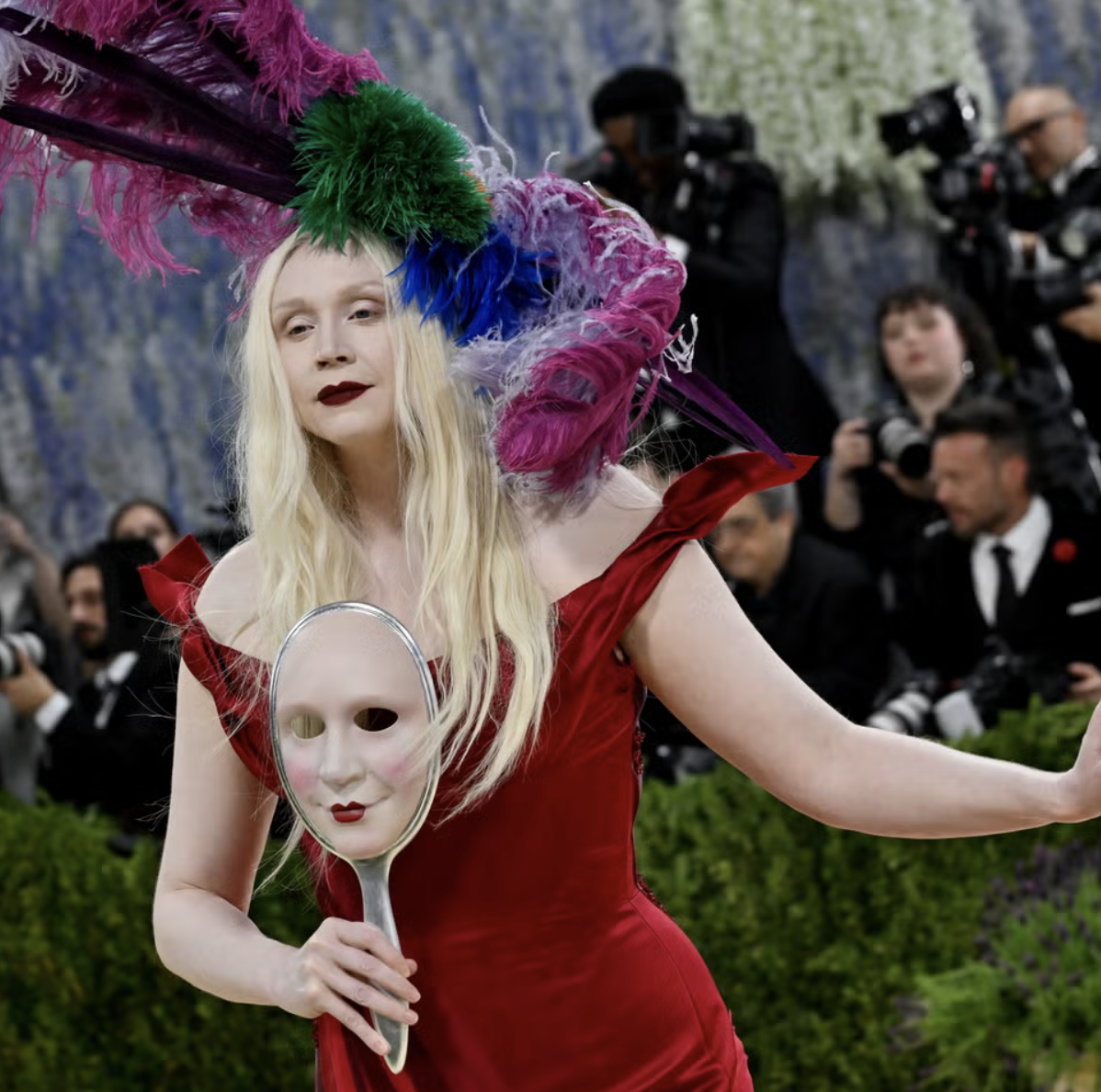
One of my most wild picks of the night was Gwendoline Christie in a custom Giles Deacon gown. This voluminous red look, inspired by John Singer Sargent and Madame Yevonde and topped with a mask of her own face, made performance visible. You cannot look at it without thinking about the nature of image, of celebrity, and of what it means to present yourself at an event of this significance.
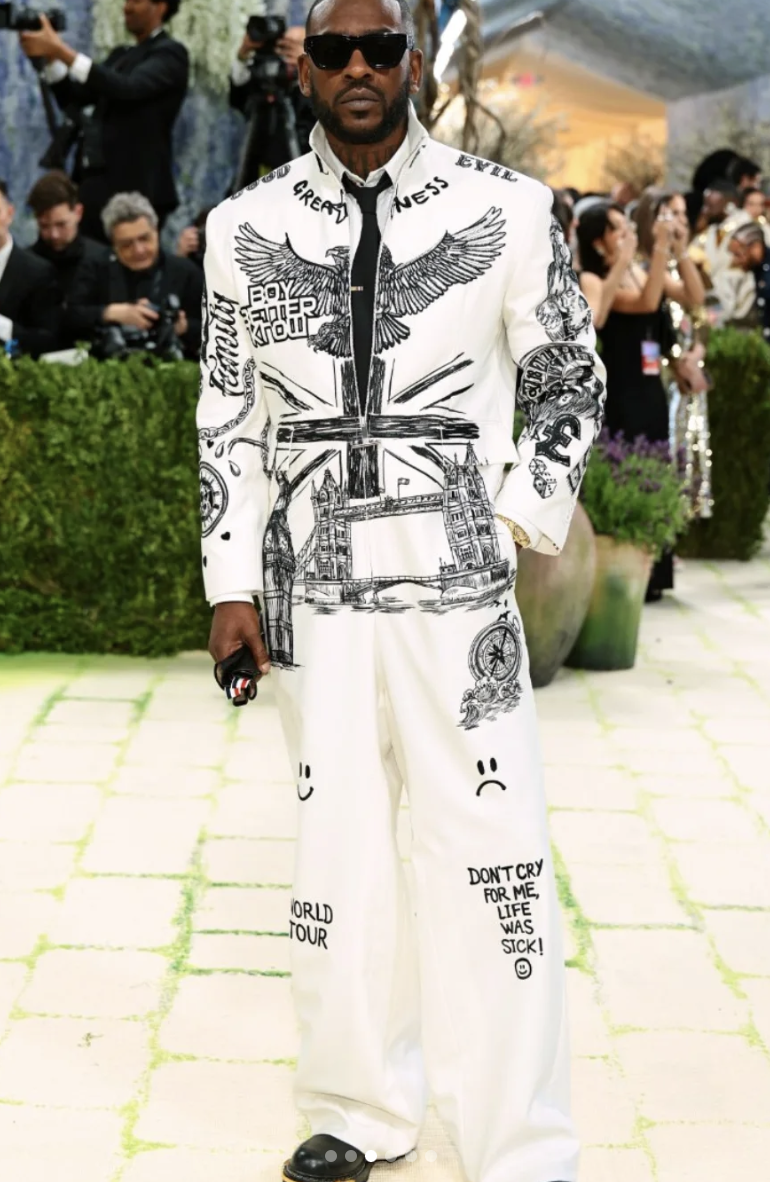
I adore Thom Browne. When I saw Skepta arrive in a Browne custom white wool tailored jumpsuit, embroidered by hand in response to his own tattoos, it inspired so much of this article. The placement of the satin stitching matches his actual body, exposing what is usually under the clothes. The body’s permanent markings, its autobiography in ink, was translated into fabric, Skepta walked on the steps as a man who had already been written on, and then wore that writing for everyone to read.
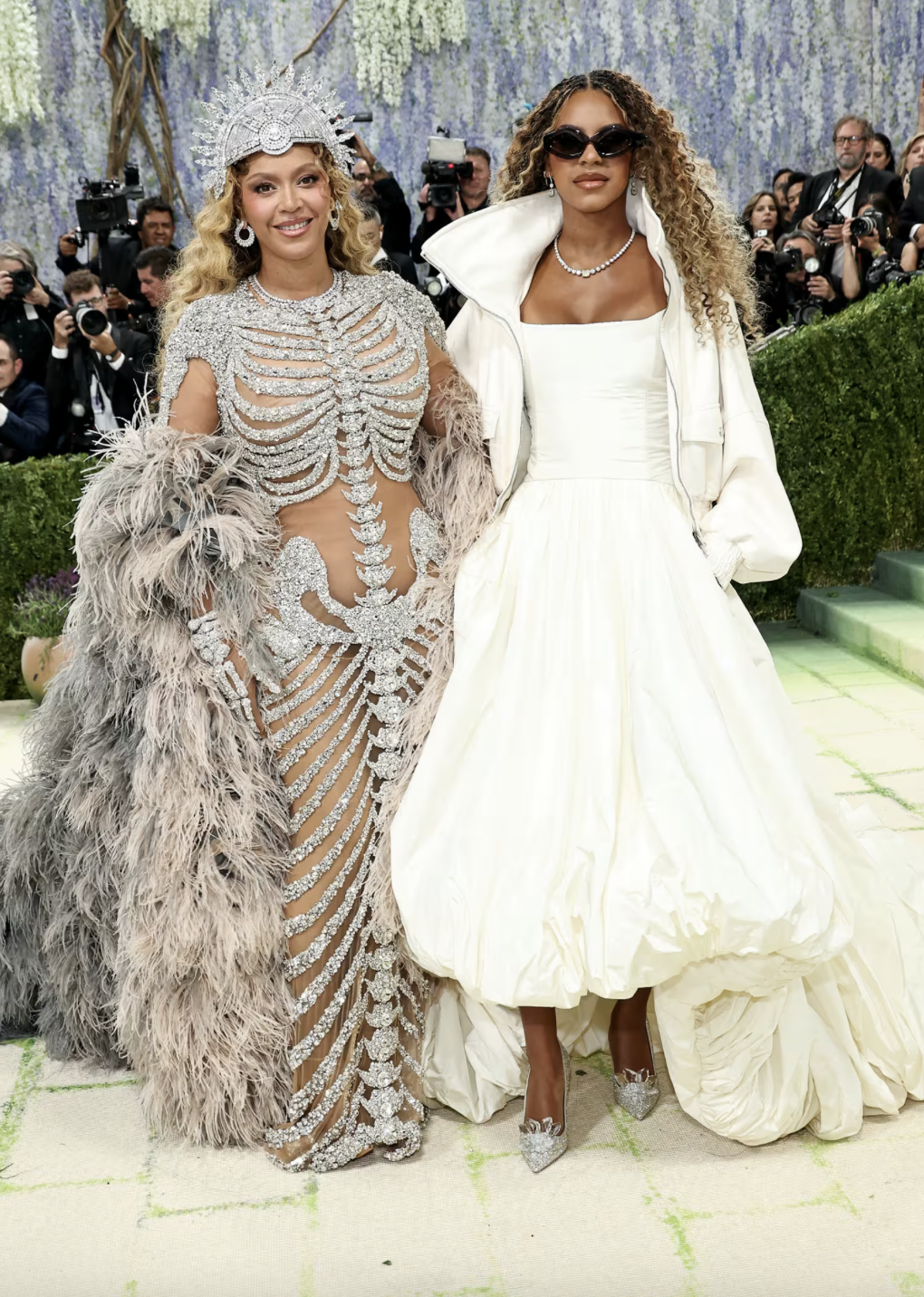
Beyoncé arrived among the co-chairs wearing a sheer Olivier Rousteing gown with diamonds tracing the human skeleton across her body, and an incredibly dramatic feathered coat trailing behind her. She even brought Blue Ivy for her Met Gala debut. In one image of a mother and daughter on those steps, with the skeleton gown catching light, you had the entire exhibition thesis made flesh. The body as canvas, across time, generations, adorned and celebrated.
Other honorable mentions were Jeremy Pope in Vivienne Westwood, Chase Infinite in Thome Browne, Sabine Getty in Ashi Studio, Hunter Schafer in Prada, and Colman Domingo in Valentino.
The Surrealist Wing
Bad Bunny aged himself 53 years into the future via prosthetics and costuming. Heidi Klum came as a breathing statue. Katy Perry arrived fully naked in chrome, identity concealed beneath a Stella McCartney gown.
These are the carnival acts, and I mean that affectionately. Every carpet needs them. The surrealism wing of the Met Gala is a direct line to pieces like Schiaparelli’s Lobster Dress and the legacy of fashion refusing to be merely decorative. While they were not my favorite looks by any means, the body was transformed beyond recognition, and that’s exactly what the theme was asking us to think about.
The Dividing Line I Promised
I said this theme would create the most legible dividing line in years. It did. But I do not think that it was fully between the people who got it and the people who didn’t.
The line was actually between the people who used the body as their argument, and those who used it as a mannequin.
The naked dress contingent mostly fell into the second category. Sheer for sheer’s sake is not the same as sheer with specific intention. There’s a version of “the body as art” that flattens into “skin as spectacle.” The theme asks you to think about the body rather than just revealing it. Those are completely different acts made extremely transparent by this theme.
On the Noise Around the Event
The Bezos co-chair situation, with protests and notable absences of faces such as Meryl Streep and Mayor Zohran Mamdani skipped entirely, is hugely important for the contextualization of this evening.
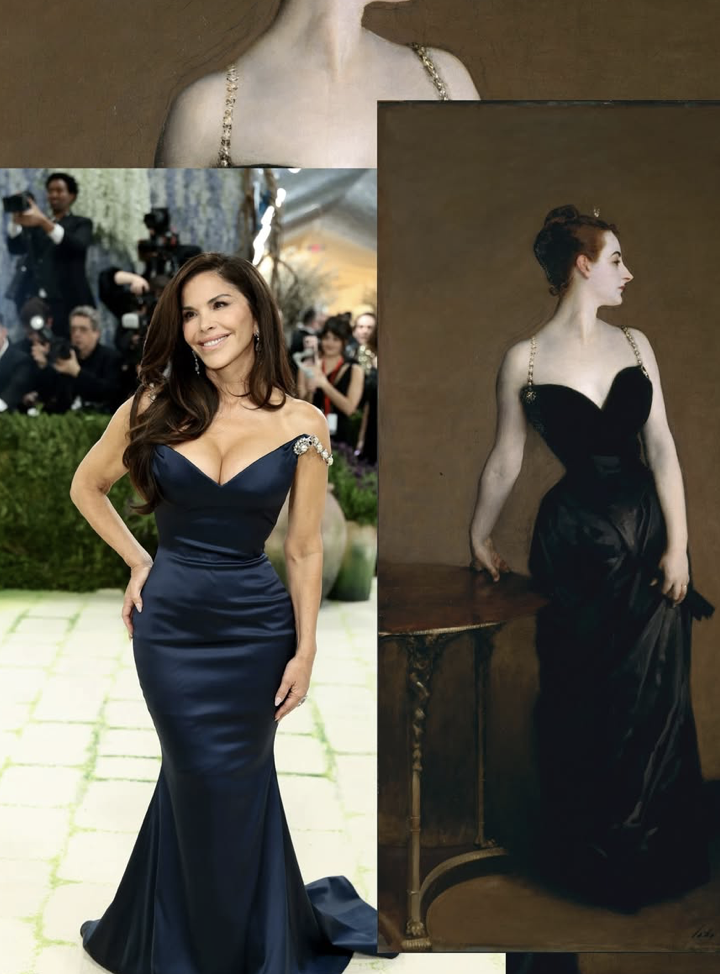
Jeff Bezos did not walk the carpet, but his wife Lauren Sánchez Bezos did in Schiaparelli. This look was ironically inspired by Sargent’s Madame X, which is either an inspired choice or an unfortunate one depending on your art history recall (Madame X was a huge social climbing scandal). Her husband, the man whose $10 million made this whole record-breaking $42 million evening possible, stayed home.
Bezos has actually done this before in 2012, where he sponsored the gala and was honorary chair after being priced at $18.4 billion. Nobody made subway protest posters that year. He went home and spectators moved on. The difference is that the context between 2012 and 2026 is that his excess and repeated political controversies have pushed Americans over their tipping points for good.
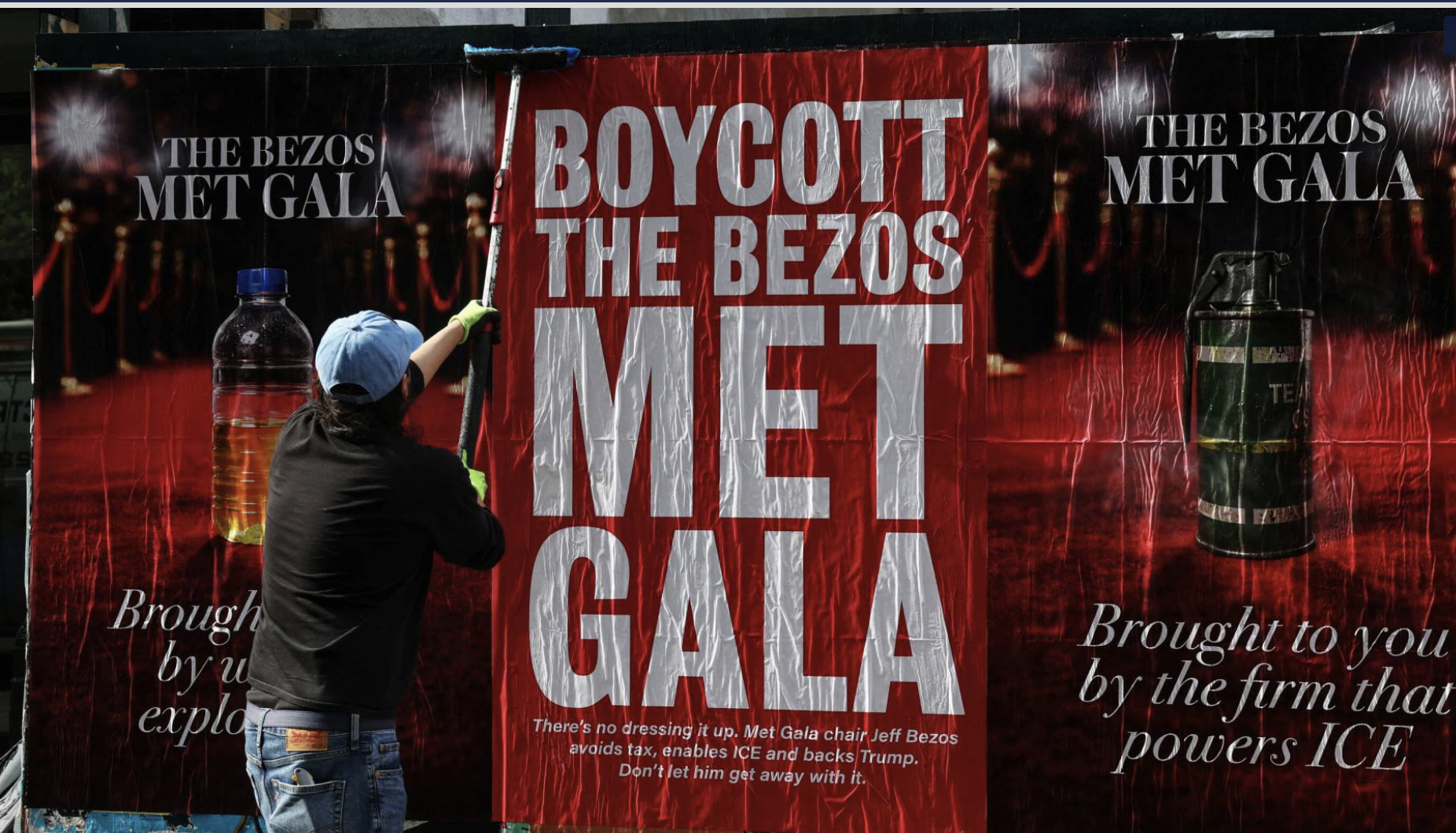
The protest infrastructure that assembled around the gala appeared as guerilla subway ads with “The Bezos Met Gala: Brought to You by the Company that Powers ICE,” plastered all over. By the weekend before the gala, around 300 bottles of fake urine had been placed throughout the Metropolitan Museum of Art, as a reference to the allegations about Amazon’s poor working conditions.
Here’s what I keep coming back to: the protesters outside at the Ball Without Billionaires were actually staging their own fashion show. With emerging designers and a runway, they were making the argument that fashion belongs to everyone, and that it is a meaningful human act. This is really the same theme as that established by Bolton. The inside and outside of the Met on Monday night were, in a strange way, having the exact same conversation from different sides of the steps. Even these protesters admitted that museums let ordinary people see priceless things, face to face.
To be in awe of art is to suspend belief and fix the mind on the intent of the artist’s genius. Despite all of the protests and noise surrounding the event, there was no lack of awe in response to this year’s carpet. This world would no longer allow for a purely innocent event to exist, and neither should it. However, the common denominator between fans and enemies of the Met Gala is the admiration for the fine arts; so much so that fashion and art were used as forms of effective protest.
The Met Gala has always been fashion’s best argument for itself. This year, it really had to prove its case. The theme accomplished what it had set out to do: a profound conversation about fashion’s place in art. Just like a painting, each fashion decision made the spectator analyze, assess, and interpret what the designer, or artist, was thinking and attempting to convey. This year, with a new permanent home, a record-breaking budget, protesters staging their own runway outside, and a carpet that — at its best — genuinely proved the case, fashion earned its place as art.
Xoxo,
Annie